


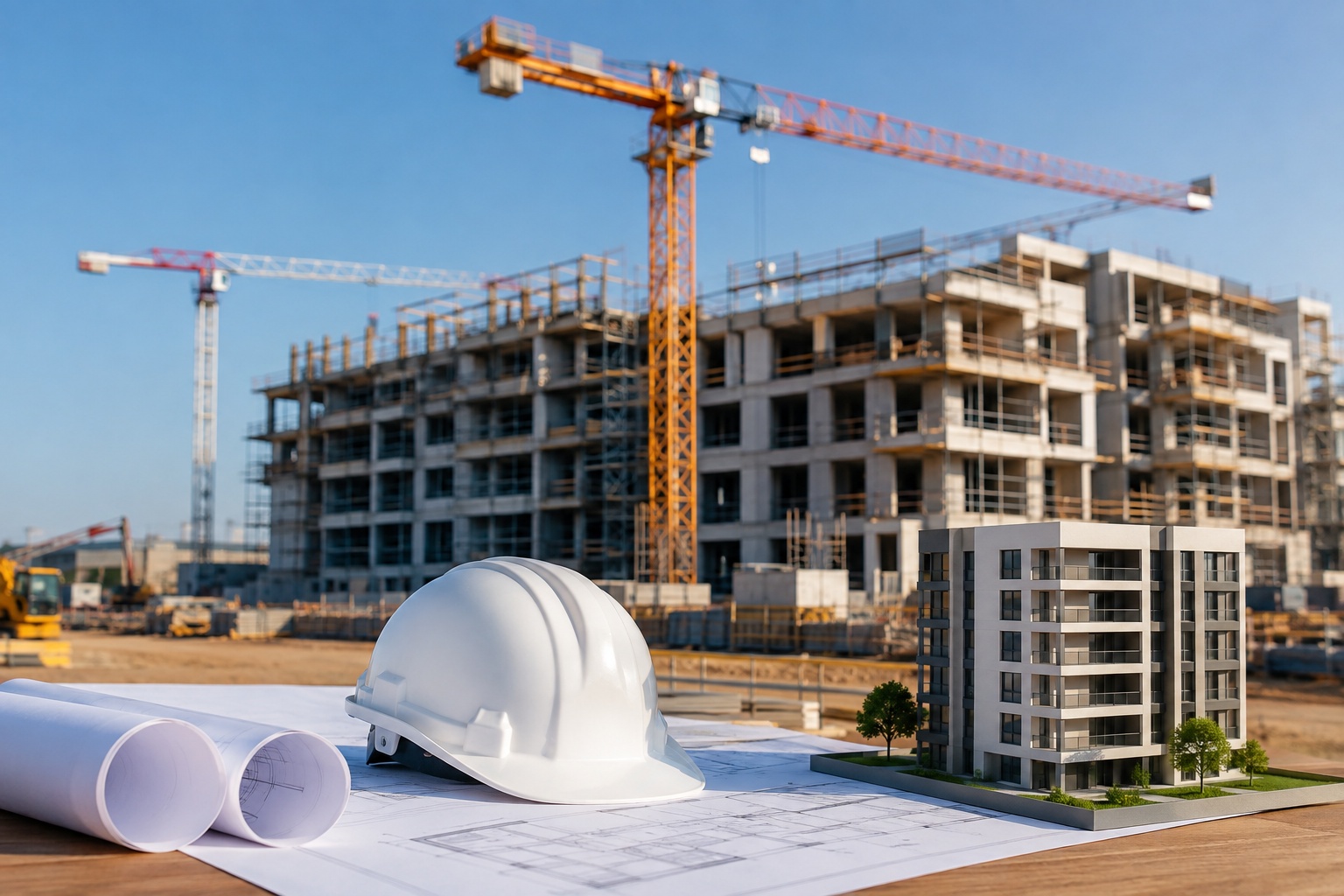
Quick Answer: The Building Safety Levy starts in England on 1 October 2026. For qualifying major residential developments, the named client on the building control application is responsible for a charge based on new chargeable residential floorspace and the local authority rate. Developments on qualifying previously developed land receive a 50% discounted rate. Applications submitted before 1 October 2026 are outside the levy, unless they are rejected and later resubmitted after the start date.
| Start date | 1 October 2026 |
| Main threshold | 10+ new dwellings, or 30+ new PBSA bedspaces |
| Who pays | The named client on the building control application or initial notice |
| How it is charged | Chargeable residential floorspace × local authority £/m² rate |
| Brownfield / PDL discount | 50%, where the site meets the statutory previously developed land test |
| Completion risk | Outstanding levy can prevent a completion or final certificate being issued |
For developers with schemes moving towards building control this autumn, the critical date is not a planning committee date or a start-on-site milestone. It is the date the relevant building control application or notice is submitted. That makes the Building Safety Levy a live cost-planning issue now, not something to leave for the completion team in 2027 or 2028.
PAD has already covered the wider regulatory direction in NHBC’s BEYOND ’26 and the next era of UK housebuilding. The levy belongs in that same conversation: new standards are arriving at the same time as developers are being asked to protect viability, programme certainty and compliance.
What is the Building Safety Levy?
The Building Safety Levy is a new tax on residential development in England. It is collected by local authorities through the building control process, with the revenue intended to contribute towards the cost of fixing historic building safety defects. It is not limited to higher-risk buildings and it is not a replacement for planning obligations such as CIL or Section 106 contributions.
The core 2025 regulations have already been made. In July 2026, the government also laid draft amendment regulations that make technical changes, particularly around previously developed land. The current official guidance has been updated to reflect those changes, but the amendments remain subject to Parliamentary approval at the time of this article.
For the current rules, rate table and process, see the official Building Safety Levy guidance. This is the only external source linked in this article so the page keeps a clean editorial footprint while still giving readers a primary reference point.
Who pays the levy – and what actually triggers it?
The person legally responsible is the “client” named in the relevant building control application or initial notice. In practical development terms, that means responsibility needs to be clear before submission, because the levy follows the building control route rather than the planning permission alone.
The start date is 1 October 2026. Applications for building control approval submitted before that date are not caught by the levy merely because the works continue after October. Variations to those existing pre-October applications also remain outside the charge. However, if a pre-October application is rejected and then resubmitted on or after 1 October, the resubmitted application can be liable.
That difference between planning and building control is easy to blur on a busy project. PAD’s guide to building regulations for property investors and developers is useful background for teams that need to keep those approval routes separate.
Which developments are in scope?
A project generally needs to satisfy two charging conditions: it must form part of a major residential development, and the works must create new residential floorspace that is not otherwise exempt.
The major-development threshold
- 10 or more new dwellings.
- 30 or more new bedspaces in purpose-built student accommodation (PBSA).
- A smaller building control package can still be chargeable if it forms part of a planning permission for a major residential development.
- Splitting one major scheme into several sub-threshold building control applications does not remove the levy if the underlying planning permission is for a major development.
This last point matters on phased sites. A developer should test the levy against the wider planning permission, not just the number of units shown in the next building control package.
Conversions, change of use and extensions
The levy is not confined to brand-new buildings on cleared sites. A conversion or change of use can fall within scope where it creates new residential floorspace. An office-to-residential conversion, for example, can be chargeable where the wider development meets the major-development threshold. Extensions to existing residential buildings can also be caught where they create additional qualifying residential floorspace.
Which homes and buildings are exempt?
The regulations contain important exclusions because the levy is not intended to discourage certain forms of housing or community accommodation. The details matter, because an exempt unit inside a larger chargeable development may be excluded from the charge even though the development as a whole still meets the major-development test.
- Developments of fewer than 10 new dwellings, or fewer than 30 new PBSA bedspaces, where they are not part of a wider major residential development.
- Qualifying social housing and supported housing.
- Certain community and specialist accommodation, including specified care, health, education, temporary accommodation and secure residential uses.
- Works carried out by an exempt person, including a non-profit registered provider of social housing or a wholly owned subsidiary, subject to the regulations.
The practical trap is assuming “exempt” means “no paperwork”. Levy information and evidence may still be needed so the collecting authority can issue a notice of no charge. For mixed-tenure schemes, the team should therefore identify exempt units and supporting evidence before commencement information is prepared.
Building Safety Levy rates in 2026: why location changes the bill
There is no single national £/m² rate. Each local authority has its own standard rate, weighted by local house prices, and a separate discounted rate for qualifying previously developed land. That means two schemes with identical floorspace can face very different levy bills simply because they sit in different parts of England.
| Local authority | Previously developed land rate | Standard rate |
| Birmingham | £14.62 | £29.23 |
| Bristol, City of | £21.48 | £42.97 |
| Camden | £43.56 | £87.12 |
| Kensington and Chelsea | £50.17 | £100.35 |
| Leeds | £12.29 | £24.57 |
| Manchester | £14.22 | £28.44 |
| Newcastle upon Tyne | £9.85 | £19.71 |
| Oxford | £23.62 | £47.24 |
Rate note: These are selected examples from the current government rate table, included to show the spread between locations. The full statutory table should be checked for the specific local authority before a cost plan is signed off.
How to calculate the Building Safety Levy
At a basic level, the calculation is straightforward:
| Chargeable residential floorspace × applicable local authority rate = levy charge |
Worked example 1: 4,000m² scheme in Manchester
A scheme with 4,000m² of chargeable residential floorspace in Manchester would produce the following illustrative liability using the published 2026 rates:
- Standard-rate site: 4,000m² × £28.44 = £113,760.
- Qualifying previously developed site: 4,000m² × £14.22 = £56,880.
The land-status decision changes the levy by £56,880 before any other development cost is considered.
Worked example 2: the same floorspace in Camden
- Standard-rate site: 4,000m² × £87.12 = £348,480.
- Qualifying previously developed site: 4,000m² × £43.56 = £174,240.
This is why a single “allowance per unit” copied from another project can be misleading. Location, chargeable area and land status need to be modelled for the actual site.
For development teams working through viability, contingency and cashflow, PAD’s recent analysis of why financial structure matters for profitable UK construction projects is a useful companion read. The levy should sit in the cost plan as a project-specific statutory cost, not as a late generic allowance.
The brownfield discount: the 75% rule developers need to understand
Qualifying previously developed land receives a 50% discounted levy rate. But the test is not simply whether the houses themselves are being built on an old slab, car park or demolished building footprint.
For the discounted rate to apply, at least 75% of the land within the relevant planning permission red-line boundary must meet the statutory definition of previously developed land. The assessment is made by reference to the wider development site, not just the footprint of the building control application.
- If 80% of the wider red-line site qualifies as previously developed land, a building constructed on the remaining 20% can still receive the discounted rate.
- If only 60% of the wider red-line site qualifies, a building physically located on that 60% does not automatically receive the discount.
- Permitted-development schemes that meet the chargeable conditions are treated differently under the current rules and should be checked carefully against the latest guidance.
This is also the part of the regime most exposed to live regulatory detail. The July 2026 draft amendments broaden and clarify aspects of the previously developed land definition, so developers relying on the discount should keep evidence and re-check the final position before submission and commencement.
What counts as chargeable floorspace?
The levy is based on new residential floorspace measured using gross internal area (GIA). Chargeable floorspace can include more than the saleable area inside individual flats or houses.
- New market-sale and other chargeable dwellings.
- New PBSA bedspace accommodation.
- Communal areas used wholly or partly by residents of chargeable units, such as lobbies, stairs, landings, plant rooms and resident-only amenities.
- A proportion of shared communal space where both chargeable and exempt units use the area.
- Net additional residential floorspace created by certain extensions, conversions or reconfigurations.
Areas designed mainly for the general public are not treated in the same way as resident-only communal space. On mixed-use and mixed-tenure projects, this can make the floor-area schedule a genuine levy document rather than a simple copy of the sales GIA.
The levy process: from application to completion
The biggest commercial risk is not the arithmetic. It is leaving the information and payment process too late. The levy is embedded into building control, and missing information can create approval or completion problems.
| Stage | What the developer should do |
| 1. Building control application | Identify whether the works relate to dwellings/PBSA and provide the required initial levy information. |
| 2. First commencement notice | Provide the fuller levy information and supporting evidence needed for the collecting authority to calculate the charge. |
| 3. Liability determination | For many routes the collecting authority has 5 weeks to issue a levy liability notice or notice of no charge; different timings apply to certain Building Safety Regulator routes and spot-check cases. |
| 4. Payment | The levy must be paid after commencement and before the relevant completion/occupation trigger. There is no reason to leave it to the final days of the programme. |
| 5. Completion | The relevant completion or final certificate cannot be issued where an outstanding levy charge remains. |
That completion risk fits a broader lesson PAD has explored in why project sequencing and reinstatement can decide whether a utility programme finishes on time: a late administrative dependency can become a programme issue even when the physical works are substantially finished.
Seven mistakes that could make the levy more expensive – or more disruptive
Using the wrong trigger date. The relevant date is the building control application or notice, not simply planning permission or the intended construction start.
Testing only the next phase. A sub-threshold package can still be chargeable where the wider planning permission is for a major residential development.
Treating “brownfield” as a planning label. The levy has its own previously developed land test, including the 75% red-line threshold.
Using net saleable area instead of chargeable GIA. Resident-only communal areas can be part of the levy calculation.
Ignoring exempt-unit evidence. Social or supported housing may be exempt, but the collecting authority may still need evidence to issue a notice of no charge.
Freezing the calculation too early. Changes after commencement can alter floorspace, tenure or exemption status and may require an updated determination.
Leaving payment until handover week. An outstanding charge can block the completion or final certificate needed to close out the project.
Developer checklist before 1 October 2026
- Review every residential project likely to submit a building control application or initial notice around 1 October 2026.
- Confirm whether the relevant planning permission is for a major residential development, even where the next building control phase contains fewer than 10 dwellings.
- Identify the named client who will carry the levy liability.
- Confirm the correct local authority and current £/m² rate.
- Measure chargeable residential floorspace using the required GIA approach, including the correct treatment of communal areas.
- Test whether at least 75% of the relevant red-line site qualifies as previously developed land and retain evidence for the conclusion.
- Separate exempt and chargeable units on mixed-tenure schemes and assemble supporting evidence before commencement.
- Put the levy into the development appraisal, cashflow and cost report rather than a generic regulatory contingency.
- Create an internal responsibility point for levy information at application, first commencement notice, variations and completion.
- Re-check the July 2026 amendment position before relying on a technical interpretation of previously developed land.
- Plan payment early enough that the completion certificate is not dependent on a last-minute finance or administration task.
For operational teams, that need for evidence, accountability and current records also echoes PAD’s coverage of building maintenance and modern building-safety compliance expectations. The levy is a development-stage charge, but the wider direction of travel is the same: regulators increasingly expect traceable information, not assumptions.
What if the local authority gets the levy calculation wrong?
A client who believes a levy liability notice is incorrect can request a written review from the collecting authority. The request must generally be made within 28 days of the notice. The collecting authority then has a 28-day review period. If the client remains dissatisfied, or the authority fails to respond in time, there is a route of appeal to the First-tier Tribunal.
That makes the calculation file important. A developer disputing chargeable floorspace, exempt units or land status will be in a stronger position if the underlying GIA schedule, planning permission, red-line evidence and exemption documents were assembled when the levy information was first submitted.
Building Safety Levy 2026 FAQs
When does the Building Safety Levy start?
It starts in England on 1 October 2026 for qualifying building control applications and notices submitted on or after that date.
Who pays the Building Safety Levy?
The named client on the relevant building control application or initial notice is responsible for the levy where a charge is due.
What is the small-sites exemption?
Developments of fewer than 10 new dwellings, or fewer than 30 new PBSA bedspaces, are generally outside the charge unless the works form part of a wider planning permission for a major residential development.
Does brownfield development pay less?
Yes, a qualifying previously developed site receives a levy rate that is 50% of the standard local authority rate. The site must meet the statutory test, including the 75% red-line requirement.
Does the levy apply to office-to-residential conversions?
It can. A conversion or change of use can be chargeable where it creates new residential floorspace and forms part of a major residential development.
Is the Building Safety Levy the same as CIL?
No. The levy is a separate charge administered through building control. A scheme may therefore need to account for the levy alongside CIL, Section 106 obligations and other project costs.
What happens if the levy is not paid?
An outstanding levy charge can prevent the relevant completion or final certificate from being issued.
Can a developer avoid the levy by submitting before 1 October 2026?
A building control application submitted before 1 October 2026 is not subject to the levy under the current implementation rules. However, an application rejected and resubmitted after the start date can become liable, so teams should not trade application quality for speed.
Can the levy change during construction?
Yes. Changes to floorspace, tenure, exemptions or other relevant project information can trigger an updated levy calculation or notice.
How often should rates be checked?
Rates should be checked against the current statutory table when the project appraisal is updated and again before submission. The government has also provided for periodic review of the levy regime.
The practical takeaway for developers
The Building Safety Levy is easy to describe as another £/m² charge. That is also the easiest way to underestimate it. The final liability can turn on five project-specific facts: the building control submission date, the wider planning permission, the amount of chargeable GIA, the local authority rate and whether the site satisfies the previously developed land test.
Those facts should already be in the development team’s hands before 1 October. If they are not, the next few weeks are the time to fix the gap. Developers who build the levy into the appraisal, evidence pack and building control programme now are far less likely to discover it as a completion problem later.
The levy is also arriving alongside wider changes to new-home performance. PAD’s recent 2026 guide to triple glazing and the Future Homes and Buildings Standards shows how quickly compliance, specification and cost decisions are converging across the housebuilding pipeline.
Editorial note: This article is a practical overview of the position checked on 12 August 2026. It is not legal or tax advice. The July 2026 amendment regulations remain subject to Parliamentary approval, so the latest official guidance and final legislation should be checked before a project-specific decision is made.

