



Introduction: Why Building Maintenance Services Matter in 2026
Every building deteriorates. Roofing membranes crack, boilers lose efficiency, fire doors warp, and electrics age – often invisibly. Building maintenance services exist to stay ahead of that deterioration: the ongoing programme of inspection, servicing, repairs and care that keeps a property safe, legally compliant, energy-efficient and fit for purpose.
In 2026, the stakes are higher than ever. The Building Safety Act 2022 and Fire Safety Act 2021 have sharpened regulatory expectations across UK residential property and commercial estates. Energy costs remain volatile. Insurers increasingly require evidence of proactive upkeep before they will cover claims. For landlords, managing agents, developers and facilities managers, building maintenance services help keep properties safe and valuable – and proactive maintenance saves time, money, and unnecessary stress.
This article covers what building maintenance includes, the difference between preventive and reactive approaches, practical checklists, how to choose a reliable provider, and the common mistakes that catch even experienced property teams off guard. While the examples here are UK-led, the core priorities – safety, compliance, asset protection, and business continuity – are shared across global facilities management and international property maintenance markets.
What Are Building Maintenance Services?
In practical terms, building maintenance services are the structured, ongoing work required to keep a building’s fabric and technical systems safe, compliant, efficient and operationally sound. This sits within the broader scope of facilities management and property services, covering everything from mechanical plant and electrical systems to the external envelope and communal spaces.
There is a meaningful difference between a homeowner calling general builders to fix a leaking tap and a managing agent running a structured commercial property maintenance programme for a 200-unit build-to-rent block. The latter involves asset registers, planned preventative maintenance schedules, service level agreements and compliance documentation. Property maintenance includes plumbing, heating, and electrical services, but in a commercial or multi-occupied setting, these are coordinated across dozens of systems and regulatory requirements.
Typical UK clients include managing agents in London and Manchester, housing providers in Birmingham and Liverpool, student accommodation operators in Leeds and Newcastle, and mixed-use developers across Cambridge and other growth cities. The scope of maintenance depends on building age, use, occupancy intensity, risk profile and statutory obligations – older buildings generally require more frequent fabric care, while newer schemes may focus on maintaining complex mechanical and electrical installations.
Core Types of Maintenance: Preventive vs Reactive
Most maintenance management strategies blend two approaches: preventive (planned) work and reactive (unplanned) work. Getting the ratio right is one of the clearest indicators of how well a property is maintained.
Preventive maintenance includes scheduled tasks to prevent failures before they happen. This covers quarterly HVAC servicing, annual boiler checks, five-year fixed wire electrical inspections, and regular fire alarm tests. Planned preventative maintenance reduces overall maintenance costs – industry data suggests lifecycle savings of 30–50% compared with mainly reactive strategies. PPM prevents costly repairs and unwelcome surprises, which is why well-run estates target 70–80% of their maintenance spend on planned tasks.
Corrective maintenance, by contrast, involves repairs after a fault occurs. A burst pipe flooding a ground-floor office, a failed heating plant in January, urgent repairs to storm-damaged roofing – these are reactive by nature and unavoidable to some extent. The problem arises when reactive work dominates. Emergency call-outs typically cost four to five times more per event than the equivalent planned job, and they bring disruption, tenant complaints and potential compliance gaps.
A budget for maintenance is better than reactive repairs. Well-managed commercial building services programmes track the ratio of planned versus reactive tasks and aim to shift that balance towards planned works over a 12–24 month horizon. One London mixed-use portfolio achieved a drop in reactive work from 41% to 19% within a year of adopting a structured hybrid model.
Beyond schedule-based and reactive approaches, predictive maintenance uses tools such as IoT sensors and thermal imaging to evaluate the condition of equipment before failure occurs, allowing teams to intervene at the right moment rather than on a fixed schedule.
Common Building Maintenance Services
The range of services within a typical maintenance programme is broad. Each building will require a tailored scope, but the following categories appear in most commercial and residential property contracts.
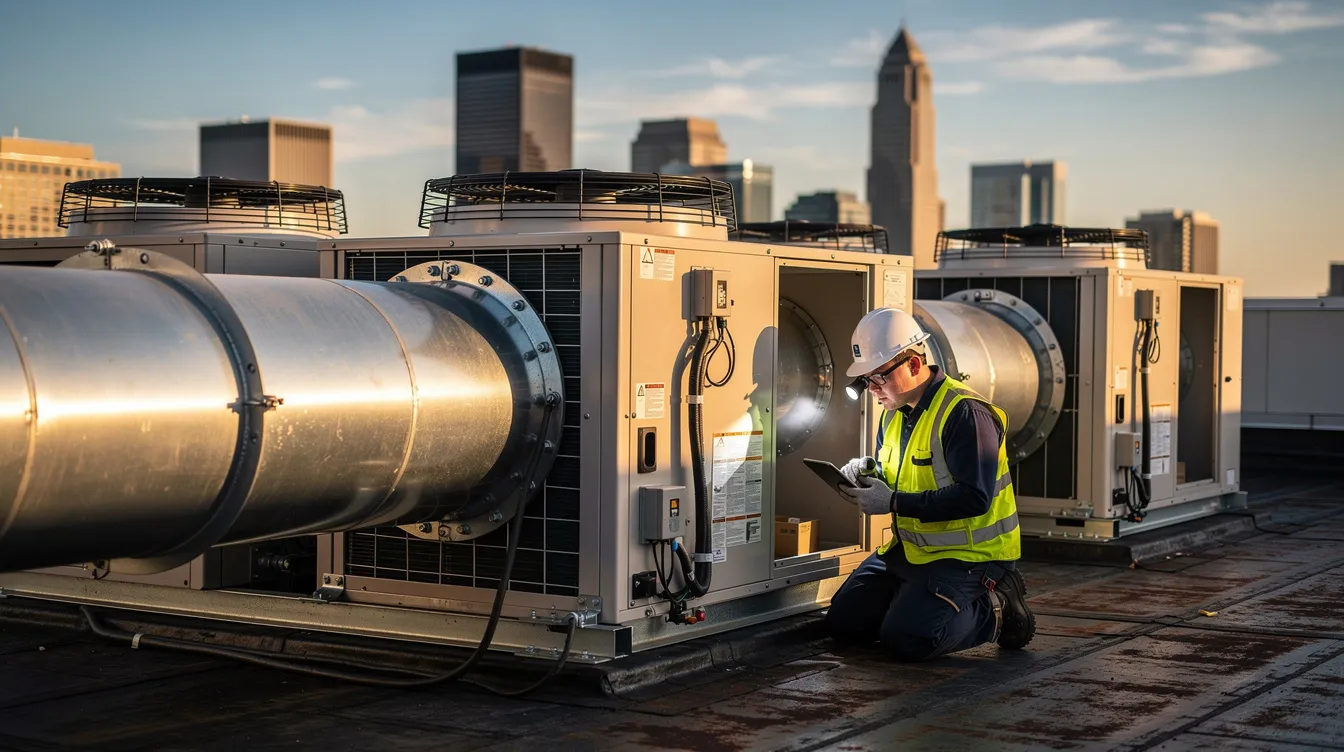
HVAC maintenance
Covers servicing boilers, chillers, heat pumps, air conditioning units and ventilation systems. Seasonal checks ahead of winter heating demand and summer cooling peaks help ensure reliable comfort and energy efficiency. Commercial air conditioning systems above 12 kW need TM44 inspections. In the UK, these are required every five years. Filter changes, coil cleaning and refrigerant checks sit alongside these statutory obligations. For more on weighing up in-house versus outsourced approaches, PAD Magazine has explored DIY vs professional HVAC maintenance in detail.
Electrical maintenance
Includes routine inspections by qualified electricians, emergency lighting testing (typically monthly), PAT testing of portable appliances, fixed wire testing and distribution board checks. Most commercial premises are advised to have an EICR every five years under BS 7671, though higher-risk or industrial environments may require shorter intervals. Record-keeping is essential for building compliance.
Plumbing maintenance
encompasses leak detection, valve checks, hot and cold water system flushing, legionella control tasks, and drain clearance. Left unchecked, even minor issues with pipework or isolation valves can escalate into serious water damage. Emergency repairs can include heating breakdowns and plumbing issues that demand same-day response.
Fire safety maintenance
is non-negotiable. Fire safety systems must be regularly tested for compliance under the Regulatory Reform (Fire Safety) Order 2005 and subsequent legislation. This means weekly alarm tests, monthly emergency lighting tests, annual extinguisher servicing, fire door inspections and smoke vent checks. Fire safety systems require regular testing and maintenance, and fire door compliance is certified by BM TRADA. If you manage a higher-risk residential building, the scope now extends to external wall systems and flat entrance doors.
Building fabric and repairs
Cover roofing, masonry, windows, doors, internal finishes, flooring, decorating and minor structural repairs. Flooring installation and repairs are part of building maintenance services, as are weatherproofing and sealing works. General builders and specialist contractors – including those who specialise in industrial painting or structural repairs – deliver this work under coordinated programmes.
Soft services
Often sit alongside property maintenance services: cleaning of common areas, gutter and façade cleaning, grounds maintenance and waste management. These may seem peripheral, but they directly affect occupier experience and the perceived quality of a space.
Specialist systems
such as lifts and escalators, access control, CCTV, building management systems (BMS) and energy monitoring require their own servicing regimes. Lifts, for instance, need statutory inspections under LOLER, typically every six months. These are usually managed under separate but coordinated contracts to ensure nothing falls between gaps.
5 Why Building Maintenance Matters: Fire Safety, Compliance and Value
Maintenance is ultimately about protecting people, protecting property value and keeping business operations running smoothly.
Regular upkeep helps ensure health and safety regulations compliance. A well-serviced gas boiler reduces carbon monoxide risk. Maintained fire alarms detect smoke promptly. Health and safety regulations must be complied with during maintenance itself – contractors need safe systems of work, risk assessments, and method statements.
Risk-based maintenance includes essential inspections required by law: annual gas safety checks by Gas Safe registered engineers, electrical testing, fire risk assessments and legionella monitoring. Risk assessments are essential for compliance monitoring, and failure to hold current documentation exposes dutyholders to enforcement action and insurance disputes. Public Liability Insurance is crucial for property maintenance services, both for the building owner and for any contractors working on site.
Building maintenance services can reduce costs and ensure compliance simultaneously. Hiring professional building maintenance services provides operational efficiency and cost savings – fewer emergency call-outs, smoother budget forecasting, and documented evidence of care that satisfies insurers, auditors, and local authority building control teams.
From an asset protection perspective, regular maintenance extends the lifecycle of roofs, mechanical plant, M&E systems and internal finishes, delaying expensive capital expenditure on full refurbishments. Fewer unplanned outages of heating, lifts or power reduce disruption for occupiers in offices, logistics hubs and residential blocks. For build-to-rent and PRS operators, consistent comfort and fewer complaints translate directly into tenant retention and reputation.
Energy and sustainability gains matter too. Tuned HVAC systems, sealed windows and smart controls reduce energy bills and support ESG targets – maintenance is increasingly what gets audited when investors and lenders assess a building’s environmental credentials.
UK Focus with a Global Lens on Property Maintenance
While this article centres on UK property maintenance, the fundamentals translate internationally. Safety, compliance with local codes, energy efficiency, indoor air quality and continuity of operations are priorities whether you are managing a London office tower or a mixed-use scheme in Dubai – both require HVAC checks, fire safety maintenance and coordinated building services.
Terminology shifts across markets. In continental Europe, “facilities management services” is the common frame. In North America, “building maintenance solutions” is more typical. Standards differ too – SFG20 is the UK benchmark, while ASHRAE and NFPA standards guide practice in the US. The core functions, however, are remarkably similar. International readers should adapt UK-led best practice to their own regulatory environment, climate conditions and building types.
Commercial vs Residential: How Needs Differ
Property maintenance services can cover both residential and commercial properties, but priorities vary significantly.
Commercial property maintenance typically involves higher plant complexity – large chiller units, complex BMS systems, multi-zone HVAC – alongside stricter uptime requirements and formal SLAs for tenants and occupiers. Downtime in an office or logistics space costs money directly, so response times and planned schedules tend to be tightly managed. Average costs for property maintenance jobs start around £60 in London for straightforward tasks, but commercial contracts are usually priced on retainer or per-project models that suit larger portfolios.
Residential blocks, including housing association stock and build-to-rent schemes, focus heavily on life safety systems – fire alarms, emergency lighting, gas installations – along with common parts, lifts, refuse areas and access control. Service charge budgets and long-term maintenance plans influence the level of planned maintenance that homeowners and leaseholders can expect.
In a mixed-use development combining retail units, offices and apartments, some property services are shared (roof, façade, main plant) while others are ring-fenced. Getting those demarcations right in the maintenance contract prevents arguments about cost allocation and ensures nothing is neglected.

How Regular Maintenance Reduces Costly Issues
Maintenance does not eliminate every problem, but routine maintenance prevents costly repairs and disruptions across the lifecycle of a building. Emergency repairs cover heating breakdowns and roof leaks – situations that are far more expensive and disruptive when they arrive without warning.
Consider a practical example: annual roof inspections on a 10-storey block in Glasgow might cost a few hundred pounds per visit. If those inspections catch a failing membrane early, the fix is a localised patch. Left undetected, water ingress can damage insulation, ceilings, electrics and decorating across multiple floors – easily running into tens of thousands of pounds.
Similarly, a scheduled boiler service for a heating plant serving 150 apartments is a planned, budgeted job. An emergency winter call-out for a failed plant – with tradespeople working overtime to fix the issue – can cost several times more, plus the reputational damage of leaving residents without heating.
Maintaining accurate asset registers and service histories supports better forecasting. Simple KPIs help property and facilities managers track performance: number of emergency call-outs per quarter, percentage of PPM tasks completed on schedule, and the reactive versus planned cost ratio.
Building Maintenance Checklists: What to Include
A building maintenance checklist is a working document, not a tick-box exercise. It should be tailored to the building type, age, risk profile and lease obligations – but most UK commercial checklists share common categories:
| Category | Typical Frequency |
|---|---|
| Critical plant room checks | Daily |
| Fire alarm tests | Weekly |
| Emergency lighting tests | Monthly |
| HVAC filter changes and inspections | Monthly to quarterly |
| Gas and boiler servicing | Annually |
| Fixed wiring inspection (EICR) | Every 5 years |
| Roof and gutter inspections | Twice yearly |
| Fire door inspections | Several times per year |
| Lift statutory inspections | Every 6–12 months |
| External façade and window cleaning | Per schedule |
Each item should note who is responsible – whether an in-house team or an external contractor – and where records are stored for audits. Routine maintenance helps prevent costly repairs and disruptions, but only if the checklist is actively managed and reviewed.
Alignment with insurance conditions, lease obligations and recognised guidance such as SFG20 strengthens both compliance and operational reliability. SFG20 categorises tasks by legal requirement, business criticality and discretionary improvement, helping teams with limited budget focus on what matters most.
How to Choose a Building Maintenance Provider
The right provider depends on building size, complexity, risk profile and your in-house capabilities. Here are the key evaluation criteria:
- Technical competence across HVAC, electrical, plumbing and fire safety – with qualified electricians, gas engineers and mechanical specialists on the team or reliably sub-contracted.
- Accreditations: NICEIC or equivalent for electrics, Gas Safe registration, BAFE for fire safety systems, SafeContractor or similar pre-qualification. Public Liability Insurance is non-negotiable.
- Experience with similar UK property types. A provider who can speak to managing large residential portfolios in London will have different expertise from one focused on regional office parks or student residences.
- Transparent pricing: clear call-out rates, parts, labour, after-hours premiums. The contract should distinguish what is covered under PPM and what falls under reactive charges.
- The best providers offer clear scopes, reporting and service accountability.
- SLAs and communication: defined response times for emergencies (e.g. four hours for urgent repairs, two working days for non-urgent), clear escalation protocols and regular reporting.
Ask for sample PPM schedules, method statements and references from existing clients. Hiring professional building maintenance services should provide operational efficiency and cost savings only when the provider has the expertise and capacity to deliver consistently. For related guidance on management and estate services, PAD Magazine covers provider trends and regulatory updates regularly.
Common Mistakes in Property Maintenance Management
Even experienced property teams fall into predictable traps:
Deferring planned maintenance to protect short-term budget is the most common mistake. It saves money today but creates larger repair bills, tenant dissatisfaction, and compliance gaps tomorrow.
Over-relying on reactive work without an asset register, condition surveys or long-term planning means you are always responding to the last crisis rather than understanding the condition of building assets over time and preventing the next one. If something goes wrong, there is no documented history to learn from, and teams may struggle to meet compliance and planning obligations.
Poor documentation is a serious exposure. Missing service records for fire safety maintenance, gas checks or electrical inspections can result in enforcement action, voided insurance or personal liability for the responsible person.
Communication gaps between landlords, managing agents, facilities teams and occupiers delay the reporting of emerging problems. A small leak that a tenant does not report – or that an agent fails to pass on – can become an expensive project.
Lowest-price contractor selection without assessing competence, capacity or health and safety standards often leads to substandard work, rework costs and risk. Rely on accreditations, references and track record, not price alone.
Integrating Maintenance with Wider Property Strategy
Maintenance should not operate in isolation from asset management, refurbishment planning and property development strategies. Condition-based maintenance informs future renovations and repairs, feeding data into capital expenditure models that guide when to upgrade HVAC plant, replace lifts or carry out full refurbishments of common areas.
For developers and investors, realistic lifecycle and service charge assumptions depend on accurate maintenance data. Maintenance, sustainability and ESG are increasingly aligned – energy-efficient upgrades during planned works (LED lighting, improved insulation, smart controls) deliver returns that justify the investment. Where maintenance intersects with larger construction or development decisions, teams benefit from linking operational data with strategic planning from the outset.

FAQs on Building Maintenance Services
What is included in building maintenance services?
Building maintenance includes plumbing, roofing, and electrical repairs, along with HVAC servicing, fire safety system testing, building fabric upkeep, lift maintenance, cleaning and grounds care. The exact scope depends on building type, age, and regulatory requirements.
How often should a commercial building be serviced?
Boilers and gas appliances typically need annual servicing. Fixed wiring inspections (EICRs) are recommended every five years for most commercial premises. Fire alarms should be tested weekly, emergency lighting monthly, and HVAC systems inspected quarterly to six-monthly.
What is the difference between preventive and reactive maintenance?
Preventive maintenance is planned and scheduled – servicing a boiler before winter, for example. Reactive maintenance responds to failures after they occur, such as fixing a burst pipe or restoring a failed heating system. A balanced programme aims to minimise reactive work.
Who is responsible for building maintenance in the UK?
Responsibility depends on ownership and lease structure. Landlords, managing agents and facilities managers typically hold responsibility for communal and structural elements. Tenants may be responsible for internal demised areas. The “responsible person” under fire safety legislation must ensure life safety systems are maintained.
How can I tell if my building maintenance is effective?
Look for fewer emergency call-outs over time, up-to-date compliance certificates, a high percentage of PPM tasks completed on schedule, positive occupier feedback and a declining reactive-to-planned cost ratio.
Does good maintenance guarantee there will be no failures?
No. Maintenance significantly reduces risk and extends asset life, but no programme can eliminate all breakdowns. The goal is to lower the likelihood and impact of failures, not to promise perfection.
How do building maintenance services differ internationally?
Regulations, climate conditions and building standards vary, but the core aims – safety, compliance, energy efficiency, tenant comfort and operational continuity – are consistent across global facilities management markets. Adapting UK frameworks like SFG20 to local requirements is a practical starting point for international operators.
For the latest on property maintenance, residential development and estate management across the UK, visit PAD Magazine.