


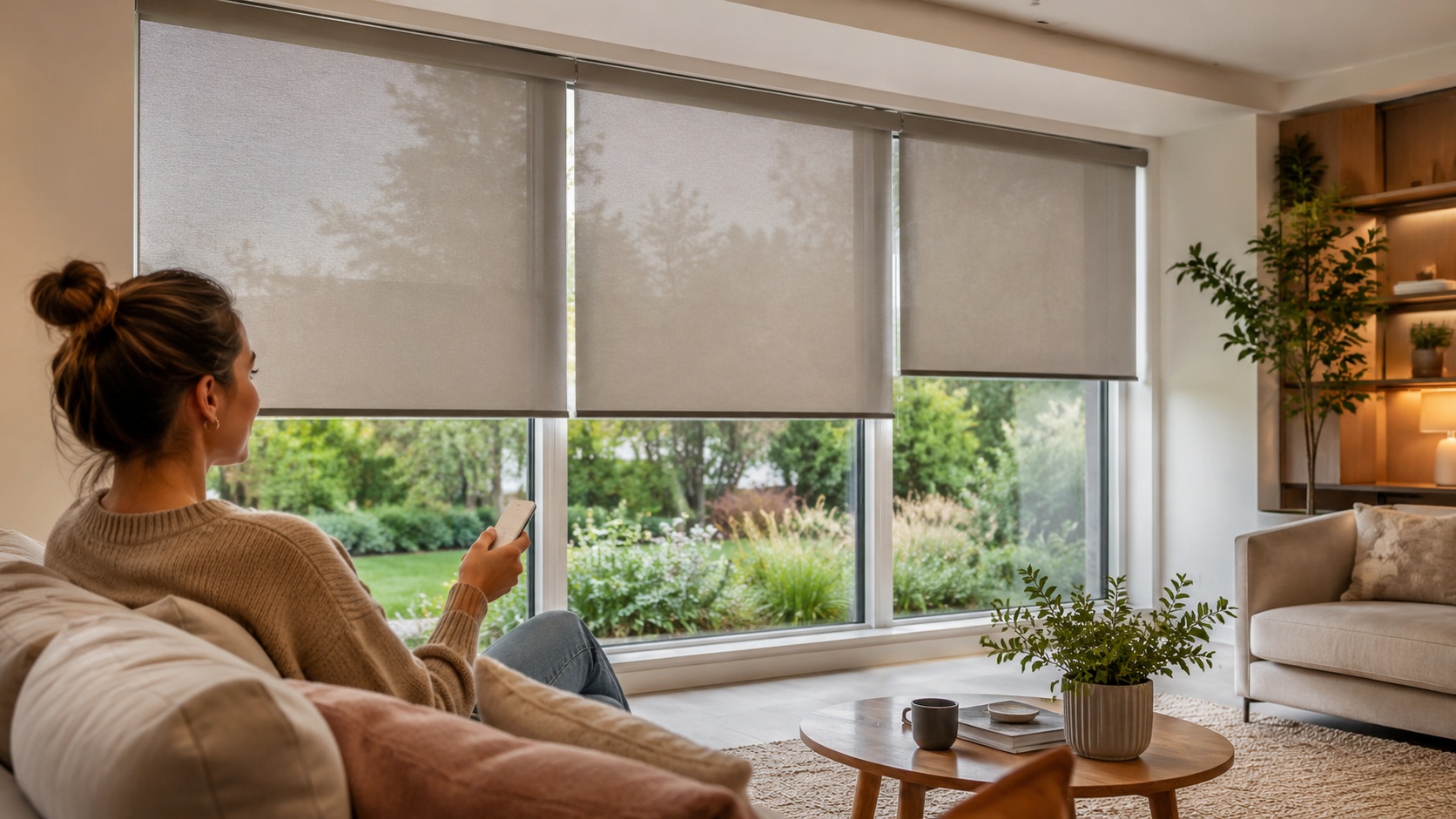
Smart blinds appear on almost every list of worthwhile home upgrades, yet many homeowners still can’t decide whether they are genuinely useful or just another smart home gadget. Do they need rewiring? What happens when the battery runs flat? And are they really more convenient than a blind you pull by hand?
Plenty of guides explain the technology. Few explain what it is like to live with it. This one covers both, so you can decide whether motorised blinds suit your home rather than someone else’s showroom.
How Do Smart Blinds Actually Work?
The clever part is smaller than most people expect. A slim electric motor sits inside the roller tube or the headrail, hidden from view. When you send it a signal, it turns the tube and the blind moves up or down. On Venetian blinds, the same motor also tilts the slats.
That motor draws its power in one of two ways. A rechargeable battery motor needs no wiring, which is why it tends to suit homes that are already decorated. A mains-powered motor is wired in and is usually chosen for new builds or for very large blinds that need more pulling power.
Control is where it starts to feel smart. A handheld remote or a wall switch covers the basics. Add a hub, and you can use an app or a voice assistant such as Alexa or Google Home. From there, you can set schedules, so the blinds move at the times you choose.
Are Smart Blinds Right for Every Home?
Not every window needs a motor, and it helps to be honest about that before spending anything.
They tend to earn their place in homes with hard-to-reach windows, large glazing or rooms you use every day. In a new build, wiring one in during construction is simple. In a flat or a rented home, a battery-powered motor eliminates the need to touch the walls, which keeps a landlord happy and a deposit intact.
According to the team at Smart Blinds, one of the most common questions homeowners ask is whether existing walls will need to be opened up for wiring. In most retrofit projects, the answer is no. Rechargeable battery-powered motors remove the need for additional wiring, making installation much more straightforward than many people expect.
If you are only replacing a single blind in a spare room you rarely enter, a manual blind is probably the more sensible choice. Automation is most useful where it removes a repeated task, not where it adds a gadget to a window nobody touches.
Five Everyday Situations Where Smart Blinds Make Life Easier
The value shows up in ordinary moments rather than on the spec sheet. A few examples:
Working from home. Afternoon sun creeps across the screen halfway through a video call. Instead of getting up, you lower the blind a little from your desk and carry on.
Bedrooms. A blind set to open slowly at seven wakes you with daylight rather than an alarm, then closes again at dusk without a second thought.
South-facing rooms. On a hot afternoon, the blinds drop on their own to keep the heat out, so the room is still comfortable when you walk back in.
Homes with young children. There are no cords or chains to worry about, and a simple routine handles the opening and closing you would otherwise do by hand.
Large bi-fold doors. Working a row of blinds across a wide opening by hand is a chore. One command moves them together, which is where automation is felt most.
The Smart Features Most Homeowners Actually Use
Smart blinds can do a great deal. In practice, most people settle into a handful of habits and quietly ignore the rest.
A morning routine that opens the blinds gradually. An evening one that closes them for privacy. A holiday setting that raises and lowers them while you are away, so the house looks lived in. Perhaps a film-night command that drops the blackout blinds in one go.
Voice control tends to get the attention in the showroom. Scheduling is what people come to rely on once the novelty wears off.
What Happens If the Battery Runs Out?
This is the question that puts a lot of people off, and the answer is reassuring. If a rechargeable motor runs flat, the blind simply stops moving until you charge it. Nothing breaks.
A single charge typically lasts several months to around a year, depending on the size of the blind and how often it moves. Most systems warn you well in advance through the app or the remote, so a flat battery rarely takes you by surprise. Charging is usually a matter of unclipping the motor or connecting a lead, then carrying on as normal.
Do Smart Blinds Still Work If Your Internet Goes Down?
It depends on how you control them, and it is worth understanding before you buy.
A radio-based remote does not rely on your broadband at all, so it keeps working whatever your Wi-Fi is doing. Many schedules are stored on a hub or in the motor itself, which means routines you have already set can carry on running locally.
What needs the internet is anything routed through the wider web: controlling the blinds from your phone while you are out, or issuing a voice command through an assistant. Lose the connection at home, and you can usually still raise and lower the blinds by remote. You only lose the remote-access extras until it returns.
What Homeowners Often Don’t Think About Before Buying
A few practical points come up again and again, usually after installation rather than before:
- Rechargeable motors are often the simplest choice when fitting blinds to existing windows, because they avoid chasing cables through finished walls.
- Fabric matters as much as colour. A room’s orientation, the daylight it gets and whether you want full blackout or a softer light should guide the choice.
- Larger windows and bi-fold doors gain the most from automation, simply because of their size and how often they are used.
- Think about where the charging point will sit once the blind is up, so topping up the battery is not a two-person job with a ladder.
- Consider whether you might want fuller smart-home integration later, even if a remote is all you need today. It is far easier to plan for than to retrofit.
Final Thoughts
For most households, the appeal is not really about controlling a blind from a phone. It is about removing one more small task from the day. Whether that means cutting glare while you work, adding privacy each evening or making a wall of glass easier to manage, motorised blinds are at their best when they quietly become part of the routine, and you stop noticing them at all.