


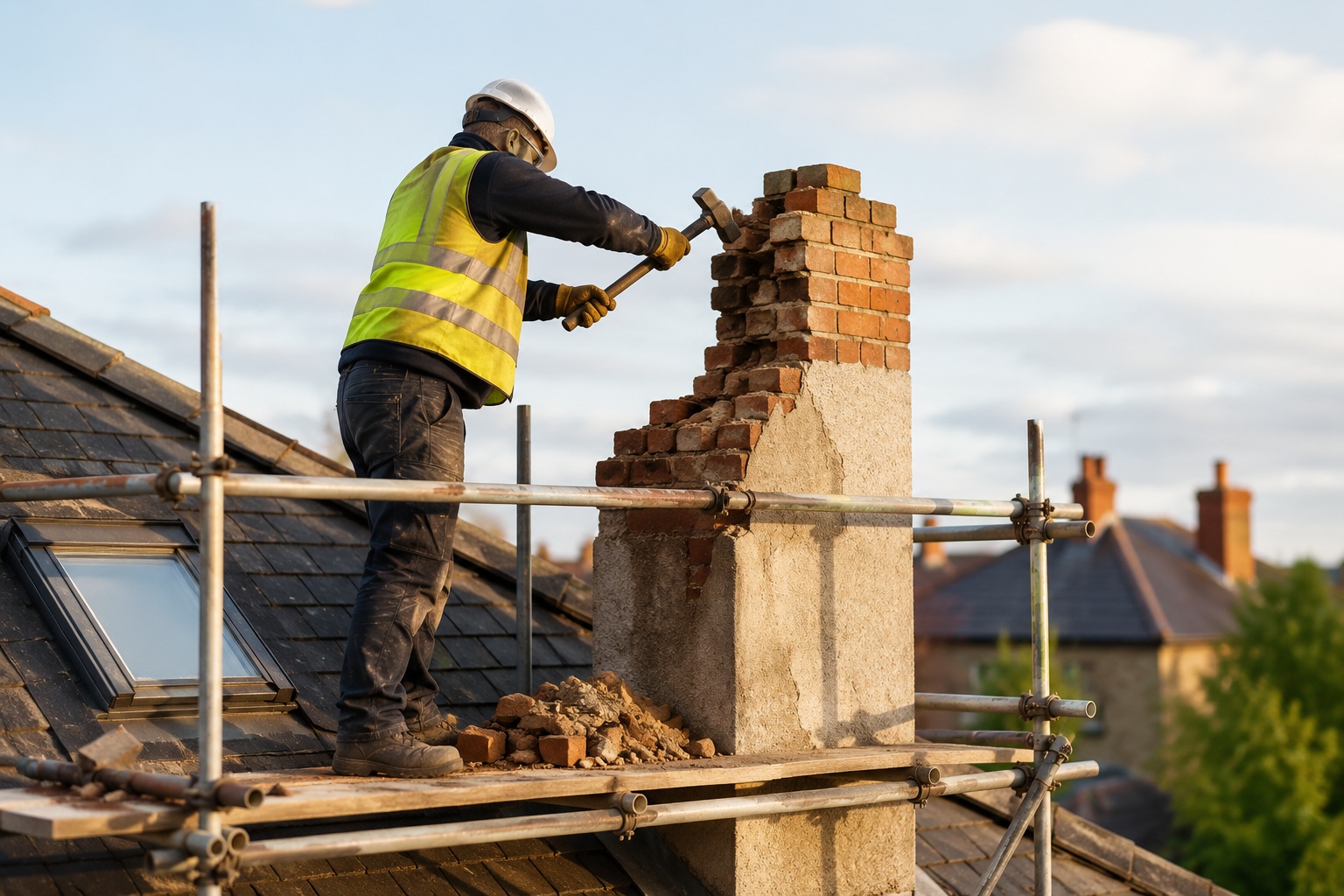
Removing a chimney can solve persistent leaks, reduce maintenance and release useful floor space, but it is rarely a simple demolition job. The chimney removal cost UK homeowners pay in 2026 depends on whether the project involves only the stack above the roof, one internal chimney breast, several floors or the complete structure. Structural support, scaffolding, Building Control, party wall procedures and internal repairs can all change the final quotation.
For a straightforward project, expect to budget from roughly £900 for a small stack removal to £6,500 or more for a full stack-and-breast removal. Complex London properties, listed buildings, shared stacks and projects requiring extensive steelwork can cost considerably more. The figures below are budgeting ranges rather than fixed quotes, so obtain a structural assessment and at least three itemised contractor quotations before work starts.
| Quick Answer: How Much Does Chimney Removal Cost in the UK in 2026? In 2026, removing a chimney stack above the roof typically costs around £900 to £2,300. Removing an internal chimney breast while keeping the stack commonly costs £1,750 to £3,250 for one area, while full removal of the stack and internal breasts often costs £4,500 to £6,500+. Add roughly £350 to £700 for structural calculations, £200 to £500 for Building Control, and possible scaffolding, party wall and redecoration costs. Always confirm whether VAT and making good are included. |
Quick Questions Before You Start
What is the cheapest type of chimney removal? Removing only a small, accessible stack above the roofline is normally cheaper than removing internal chimney breasts.
Do I need a structural engineer? Usually yes for an internal chimney breast removal, because the remaining masonry, floors, walls or roof may need designed support.
Do I need Building Regulations approval? A Building Regulations application is normally required when a chimney breast or the full structure is removed. Stack-only work above the roofline may be treated differently, so confirm with local Building Control.
Do I need planning permission? Often not for ordinary internal work, but listed buildings, conservation areas, leasehold properties and external alterations can require additional consent.
Does the Party Wall Act apply? It may apply in England and Wales where the chimney breast or stack is attached to a shared party wall. Formal notice should be dealt with before work begins.
How long does the work take? A small stack removal may take two to four days including roof repairs. Internal or full removal commonly takes five to eight working days, with extra time for plaster drying and decoration.
Average Chimney Removal Costs in the UK in 2026
The scope of work matters more than the physical size of the fireplace. A contractor removing a roof-level stack mainly deals with scaffold access, brickwork, waste and roof covering. Removing the breast inside the house adds structural design, temporary support, demolition through occupied rooms and substantial making good.
| Work | Typical 2026 cost | Main price factors |
| Remove chimney stack above roofline | £900-£2,300 | Stack height, scaffold access, roof type and weatherproofing |
| Stack removal priced per metre | £260-£350 per metre | Brick condition, access and disposal |
| Remove one internal chimney breast | £1,750-£3,250 | Floor level, load path, support and room finish |
| Simple non-load-bearing breast or false feature | £400-£800 | Only where a professional confirms it is non-structural |
| Remove breasts through two floors | £3,000-£5,000+ | Temporary works, steel support, ceilings, floors and plastering |
| Full chimney removal: stack and internal breasts | £4,500-£6,500+ | Scaffold, structural work, roof repair and full making good |
| Structural engineer | £350-£700 | Site visit, calculations and support detail |
| Building Control application/inspection | £200-£500 | Local authority or registered building control fee |
| Party wall surveyor, if a dispute arises | £700-£1,500+ per neighbour | Location, complexity and whether one or two surveyors are appointed |
| Scaffolding | £600-£1,500+ | House height, pavement permits and difficult access |
| Waste removal | £200-£500 | Volume of masonry, skip size and access |
| Making good and decoration | £300-£2,000+ | Number of rooms, flooring, ceilings, plaster and finishes |
Budget note: Some published trade prices are quoted before VAT. Ask every contractor to confirm VAT, scaffold hire, structural steel, skips, Building Control inspections, plastering and decoration in writing.
Chimney Stack Removal Cost
The chimney stack is the section visible above the roof. Homeowners often remove it because the brickwork is leaning, repeatedly leaking or expensive to repoint. A standard roof-level removal usually costs £900 to £2,300, or around £260 to £350 per metre. The roofer dismantles the masonry, removes pots and flaunching, disposes of the rubble and closes the opening with suitable roof timbers, underlay and matching tiles or slates.
Scaffolding is one of the largest variables. A low rear elevation with clear access costs less than a tall terrace above a conservatory or public pavement. If the problem is leakage rather than instability, compare removal with repair first. PAD Magazine’s roof repair cost UK guide explains typical prices for flashing, repointing and other chimney-related roof work. Homeowners dealing with extensive roof damage can also compare the figures with PAD Magazine’s new roof cost UK 2026 guide, while the most common roofing problems in UK homes guide can help identify whether removal is necessary or a repair may be sufficient.
Chimney Breast Removal Cost
The chimney breast is the masonry projection inside the room. Removing one can create a straighter wall for kitchen units, wardrobes or furniture, but the breast may support masonry above and interact with floors, ceilings and the party wall. A one-area removal commonly costs £1,750 to £3,250. Removing breasts on two floors is more disruptive and may cost £3,000 to £5,000 or more.
Do not assume a ground-floor breast can be removed while the first-floor breast and roof stack remain unsupported. A structural engineer should trace the load path and specify an appropriate solution. This may involve a steel beam, steel posts or another approved detail. Gallows brackets are not accepted in every situation or by every Building Control body.
Full Chimney Removal Cost
A full removal takes out the stack above the roof and the chimney breasts through the house. Typical budgets start around £4,500 to £6,500, but a difficult project can exceed £8,000. The price rises when several rooms need protection and redecoration, steelwork must be installed, the roof covering is difficult to match or a shared stack requires agreement with a neighbour.
Full removal is usually easiest to organise as one coordinated project, because the contractor can work from the top down and avoid leaving a heavy section unsupported. However, it causes substantial dust and rubble, so many households choose to move out of the affected rooms during demolition. Where chimney removal forms part of wider roof-space work, compare the shared structural and scaffolding costs with PAD Magazine’s loft conversion cost UK 2026 guide.
What Extra Costs Should You Include?
Structural Engineer Fees
Allow approximately £350 to £700 for a straightforward structural engineer’s visit, calculations and support detail. London and complex two-floor projects may cost more. The engineer’s information should be available before a final builder’s quote because the size and installation method of the support can materially change labour and steel costs.
Building Control Fees
Budget around £200 to £500, although fees differ by council and by the estimated value of the work. Building Control may inspect temporary support, bearings, steelwork, fire protection and the completed structure. Keep the completion certificate because a missing approval can delay a future sale or remortgage.
Party Wall Costs
Where the work affects a party wall in England or Wales, notice may be required under the Party Wall etc. Act 1996. If the adjoining owner gives written consent, costs can be limited to preparing the correct notice and schedule. If they dissent and surveyors are appointed, allow roughly £700 to £1,500 or more per affected neighbour. PAD Magazine has a separate guide to understanding party wall rules for homeowners planning structural work.
Scaffolding, Waste and Making Good
Scaffolding can add £600 to £1,500 or more. Skip hire or a grab lorry commonly adds £200 to £500. Internal finishing is often underestimated: ceilings may need patching, floors may need new joists or boards, skirting must be reinstated and the whole wall may need replastering for an even finish. Allow £300 for a minor repair and up to £2,000 or more across several rooms.
Do You Need Planning Permission or Building Regulations Approval?
Planning permission is not normally required simply to remove an internal chimney breast in an ordinary house, but that does not remove the need for structural approval. Listed building consent may be required for a listed property, and conservation-area or external alterations should be checked with the local planning authority. Leaseholders should also obtain the freeholder’s written consent before altering the structure.
A Building Regulations application is normally required when an internal breast or the full chimney is removed. The remaining masonry must be safely supported, the wall and floors must remain stable, fire resistance must be maintained and any roof opening must be properly closed. For an authoritative overview, see the LABC Front Door guidance on removing chimney stacks and breasts. This is the single suggested external reference for the published article.
How Is a Chimney Removed?
- Survey and define the scope: Confirm whether the fireplace, one breast, several breasts or the roof stack is being removed. Check for active flues, gas appliances, ventilation routes, shared masonry and suspected asbestos-containing materials. Where electrical routes need alteration, budget separately and house rewiring cost UK 2026 guide.
- Obtain structural design and approvals: The structural engineer specifies temporary and permanent support. Building Control, planning, listed-building, freeholder and party wall matters are resolved before demolition.
- Protect the property: Builders isolate services, screen rooms, protect floors and establish a safe rubble route. Scaffolding and temporary weather protection are installed where roof work is involved.
- Remove masonry from the top down: Controlled demolition reduces the risk of leaving unsupported brickwork. The contractor must follow the engineer’s method rather than removing the most convenient section first.
- Install support and repair the structure: Specified steelwork or other support is installed, bearings and fire protection are completed, and Building Control inspections are arranged at the required stages.
- Make good the roof and rooms: Roof timbers, underlay and coverings are reinstated. Internally, floors, ceilings, walls, skirting, services and decoration are repaired.
What Affects the Final Chimney Removal Quote?
- How much of the structure is being removed and how many floors are affected.
- Whether the remaining chimney or wall needs a steel beam, posts or other engineered support.
- Property type: detached homes are usually simpler than terraces, flats and maisonettes with shared structures.
- Roof height, pitch, covering and scaffold access.
- Location, with London and parts of the South East often carrying higher labour and professional fees.
- Listed status, conservation controls, leasehold consent and party wall procedures.
- Existing damage, damp, failed flashing, rotten roof timbers or asbestos risk discovered after opening up.
- The quality of making good, including matching old floors, cornices, plaster and roof tiles.
Can You Remove a Chimney Yourself?
Removing a decorative electric fire surround may be a manageable DIY task, but structural chimney removal is not. Uncontrolled demolition can destabilise the remaining stack, party wall, floors or roof. It can also expose old flues, soot, sharp masonry and potentially hazardous materials. Use an experienced contractor working to a structural engineer’s design, and employ appropriately registered professionals to isolate gas or electrical services.
Does Removing a Chimney Add Value?
The main benefit is usable space rather than a guaranteed increase in sale price. A removed breast can improve a small kitchen, create a full-width fitted wardrobe or make furniture placement easier. On the other hand, an original fireplace can be desirable in a period home, and removing it may reduce character. Compare the value of the extra floor area with the full project cost and consider whether a well-designed fireplace renovation would achieve the same objective with less disruption. PAD Magazine’s home renovation ideas guide covers other updates that may add practical value. Homeowners comparing alternative ways to gain space can also explore PAD Magazine’s home extension ideas for UK homes.
How to Keep Chimney Removal Costs Under Control
- Get the structural design before comparing builders, so every quotation is based on the same scope.
- Ask for a line-by-line quote covering VAT, scaffolding, steel, waste, Building Control and making good.
- Compare repair with removal if only the stack or flashing is defective.
- Coordinate chimney work with a wider renovation to avoid paying twice for plastering, flooring and decoration.
- Keep a 10% to 15% contingency for hidden defects in older properties.
- Do not choose a cheaper unsupported method simply to avoid steelwork or professional fees.
Is Chimney Removal Worth It?
Chimney removal can be worthwhile when a redundant stack causes recurring roof problems or an internal breast significantly restricts a room. For most homeowners, the decision should be based on the net space gained, the condition of the chimney and the total all-in cost rather than the demolition quote alone. A realistic 2026 budget is around £900 to £2,300 for stack-only removal, £1,750 to £3,250 for a one-area breast removal and £4,500 to £6,500+ for a complete removal.
Before committing, confirm the structure with an engineer, clear Building Control and party wall requirements, and request quotations that include the finished roof and room rather than stopping at bare demolition. That approach protects the property and reduces the risk of costly surprises.
Frequently Asked Questions
How much does it cost to remove a chimney in the UK?
Most projects range from about £900 for a straightforward roof-level stack removal to £6,500 or more for full stack-and-breast removal. Structural support, scaffolding, approvals and finishing determine the final price.
How much does chimney breast removal cost?
Removing one internal chimney breast commonly costs £1,750 to £3,250. Removing breasts through two floors may cost £3,000 to £5,000 or more.
Can I remove the downstairs chimney breast and leave the upstairs one?
It may be possible, but the masonry above must be supported using a solution designed by a structural engineer and accepted by Building Control. Never leave an upper breast unsupported.
Do I need a party wall agreement to remove a chimney breast?
The Party Wall etc. Act may apply in England and Wales if the breast is attached to a shared wall. Notice should be served before work starts. Written consent may avoid a full award, while a dispute can require surveyors.
Do I need planning permission to remove a chimney stack?
Not always, but external changes, shared stacks, listed buildings and conservation areas require specific checks. Contact the local planning authority before altering the roofline.
How long does chimney removal take?
A simple stack removal may take two to four days. Internal or complete removal generally takes five to eight working days, followed by drying and decoration.
Will removing a chimney cause damp?
Poorly sealed roof work, blocked ventilation routes or an inadequately repaired party wall can create damp problems. The contractor should weatherproof the roof and assess ventilation before closing old flues. If damp is already present, damp proofing cost UK 2026 guide.
Is chimney removal covered by home insurance?
Planned renovation work is not normally paid for by standard home insurance. Tell the insurer before structural work starts and check the contractor’s public liability and professional cover.