


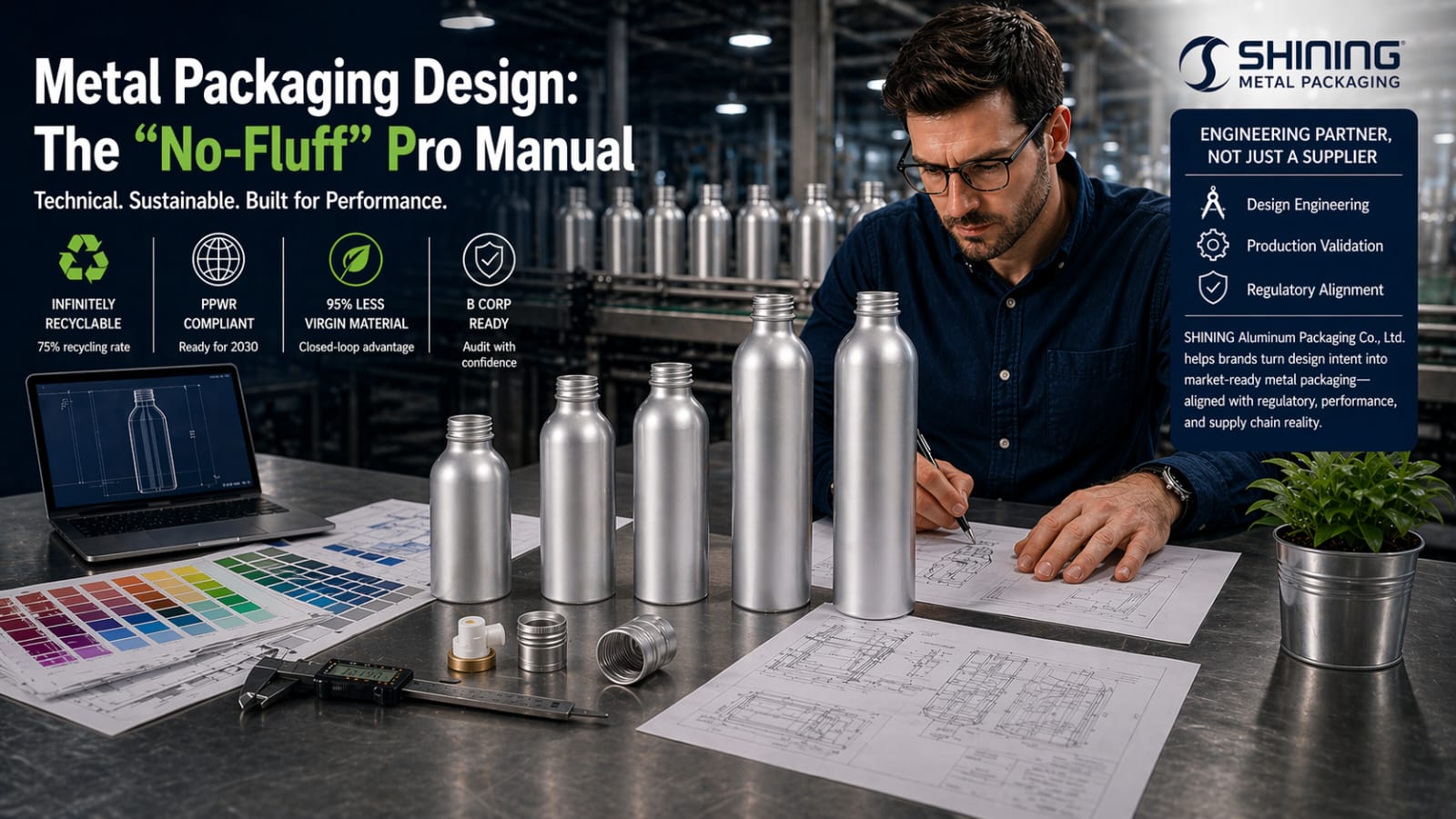
Think you can just slap a logo on a can and call it a day? Not if you want to survive the 2030 PPWR mandates. We’re talking a forced shift to 50% recycled content, and suddenly, that plastic bottle looks like a liability.
Metal is the only real play here. It’s not just “sustainable”—it’s infinitely recyclable at a 75% clip. But getting it right takes more than a Pinterest board. You need to know the technical guts.
In this shift, companies like SHINING Aluminum Packaging Co., Ltd. are playing a critical role—not just as manufacturers, but as engineering partners. The real challenge is no longer just producing a can or bottle, but aligning material selection, structural design, and production validation with regulatory and logistics reality. That’s where execution separates theory from market-ready packaging.
The Math of the Shelf
Forget branding stories for a second. If your Neck-in isn’t dialed to 22%, your logistics team will hate you. Why? Because that specific taper locks in pallet density and slashes freight costs to Asia by roughly 18%.
Want that “premium” feel? Hit the litho presses at 175lpi. We’re seeing ±1.5ΔE color consistency on curved surfaces that makes flexo look like a crayon drawing. And for the nutraceutical crowd? You need UV-cured inks that won’t flinch during a 130°C retort.
The “Must-Have” Specs
If you aren’t spec-ing these, you aren’t designing; you’re just guessing:
- BPA-NI Internal Coating: Non-negotiable. If you don’t use BPA-NI bases, you’re looking at migration issues that fail EU 10/2011 faster than you can say “lawsuit.”
- 12-bar Rating: Designing an aerosol or a pressurized spirit bottle? If it doesn’t clear a 12-bar burst pressure test, it’s a pipe bomb in a shipping container.
- Actuator Orifice: For health sprays, precision is everything. A 0.65mm orifice is the sweet spot for a controlled pattern. Mess this up, and your “premium” product feels like a cheap water gun.
Hard Truths from the Line
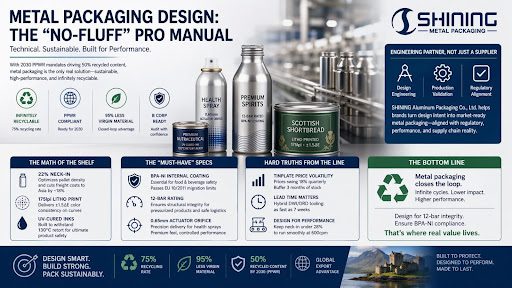
Real-world manufacturing is messy. Tinplate prices are swinging 18% quarterly. If you aren’t buffering 3 months of stock, you’re dead in the water when a big bid comes in.
Also, watch your Lead time. Hybrid DWI/DRD tooling can get you down to 7 weeks, but only if you stop over-complicating the dies. Keep the neck-in under 28%; anything higher jams the high-speed fillers at 600cpm.
The Bottom Line
Why bother with metal? Because infinite loops slash virgin material use by 95%. It’s the only way to clear a B Corp audit without creative accounting.
Stop designing for “pretty” and start designing for 12-bar integrity and BPA-NI compliance. That’s where the real money is. Ready to swap the plastic for something that actually survives the supply chain?