


Editorial accuracy note: The regulations enabling compliant plug-in solar devices come into force on 27 August 2026. Until then, readers should not buy or connect an imported system as though it were already approved for normal UK use.
Plug-In Solar Panels UK: How They Work, Costs and Potential Savings
Solar power is about to become accessible to a much wider group of UK households. Traditional rooftop systems can deliver substantial savings, but they are not practical for everyone. Renters may not control the roof; flat owners can face shared-building restrictions; and many households cannot justify spending several thousand pounds on a full installation. Plug-in solar panels are designed to close part of that gap.
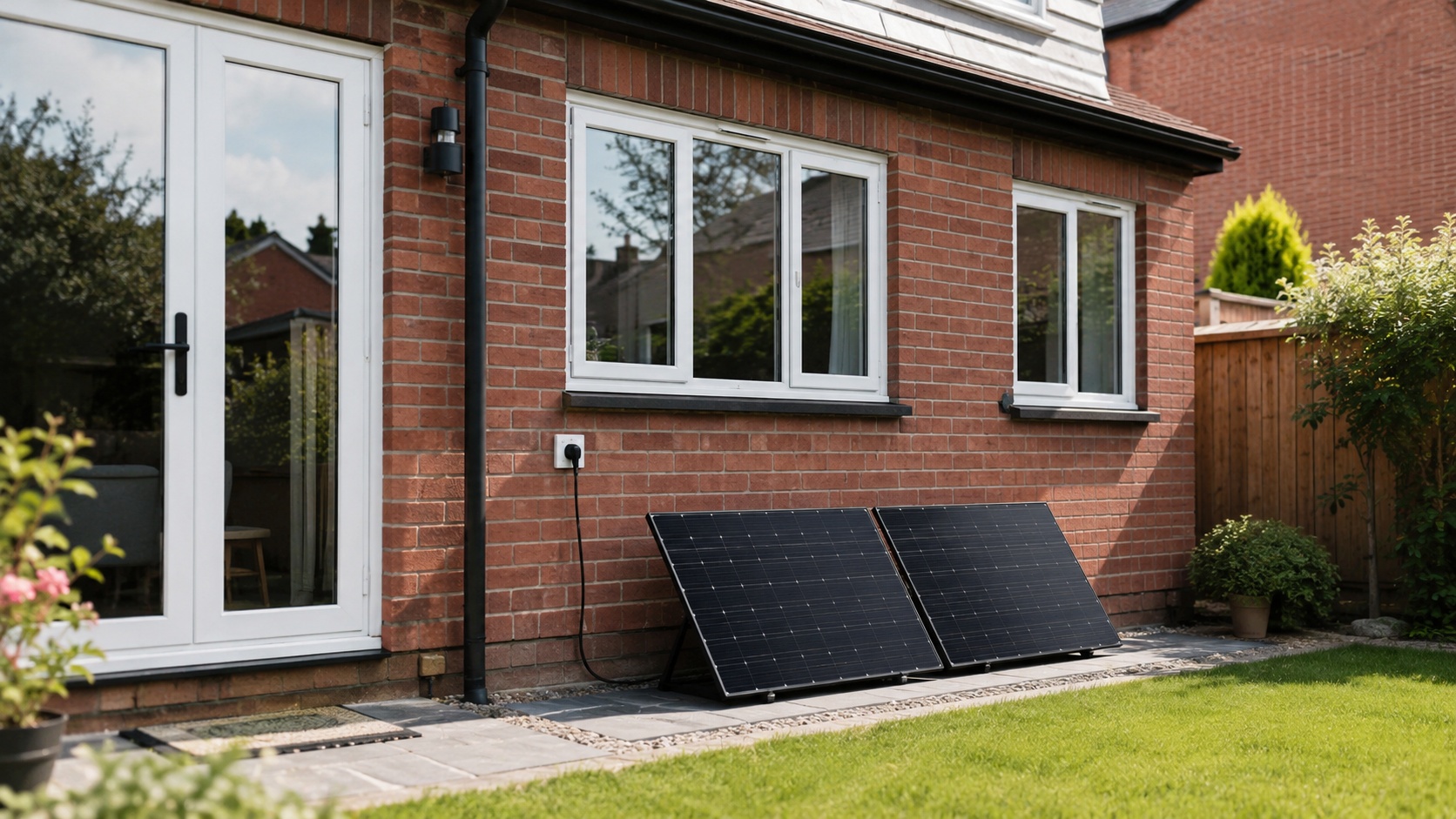
Often described as balcony solar, these compact systems use one or two photovoltaic panels, a microinverter and a compliant UK plug. The electricity generated is fed into the home’s electrical system, reducing the amount drawn from the grid while appliances are running. They will not replace a full rooftop array, but they could provide a lower-cost entry point into home renewable energy.
Quick Answer
Plug-in solar panels are small, self-install solar systems that connect to a standard household socket through a compliant microinverter. UK rules allowing approved devices come into force on 27 August 2026. Government analysis uses a central kit-cost range of £400-£600 for a typical 800W system and estimates annual bill savings of roughly £70-£110, depending on orientation, tilt, shading and how much electricity is used during daylight hours.
What Are Plug-In Solar Panels?
A plug-in solar system is a small photovoltaic installation designed to be simpler than conventional rooftop solar. A typical package includes solar panels, mounting equipment, cables, and a microinverter. The panels produce direct current electricity, while the microinverter converts it into alternating current for use by household appliances.
Unlike a conventional system, the product is designed to connect through a standard socket rather than being permanently wired into a dedicated circuit by a solar installer. The new legal framework refers to these products as plug-in microgenerators, although most consumers will know them as plug-in solar panels, balcony solar panels or plug-and-play solar kits.
The initial UK rules cover solar devices without batteries. A product that can draw electricity from the home and store it for later use is not included in this first stage. That distinction matters because shoppers may see imported packages online that combine panels with battery storage but do not meet the UK specification.
When Will Plug-In Solar Panels Be Legal in the UK?
The legal position changes on 27 August 2026, when the amended Plugs and Sockets etc. (Safety) Regulations come into force. The amendment creates a route for approved plugs used with solar devices that comply with the government’s Interim Product Specification.
This does not mean every product marketed online as “balcony solar” will automatically be lawful or safe in the UK. The device must meet the relevant product specification, use an approved plug and satisfy the connection requirements that apply to low-voltage electricity networks. Clear consumer guidance is also expected alongside implementation.
For households shopping before the commencement date, the safest approach is to wait for clearly labelled UK-compliant products from established retailers. A European plug-in kit should not be treated as suitable simply because an adaptor makes it physically possible to connect.
How Do Plug-In Solar Panels Work?
During daylight hours, the panels generate electricity. The microinverter converts that power into a form compatible with the household supply and synchronises it with the grid. Appliances running at the same time use the solar electricity first, reducing the power purchased from the energy supplier.
Imagine a home using 500 watts for a fridge, router, laptop and other background loads while the panels are producing 350 watts. The household would draw roughly 350 watts from solar and the remaining 150 watts from the grid. When the panels generate more than the home is using, some electricity may flow outward, but the government’s early savings calculations focus on electricity consumed on site rather than export income.
This is why daytime consumption matters. Someone working from home, running a washing machine in the afternoon or charging devices while the sun is strongest may use more of the generated electricity than a household that is empty all day.
How Much Will Plug-In Solar Panels Cost in the UK?
Final retail prices will vary by brand, panel quality, mounting system, warranty and included accessories. Government analysis uses £400-£600 as the central range for a typical 800W plug-in solar kit. This is far below the cost of a conventional household system, which the Energy Saving Trust currently places at around £7,600 for an average 4.5kWp installation.
| Cost item | Indicative amount or likelihood | What it means |
| Typical 800W kit | £400-£600 | Government central planning range; final UK retail prices may differ. |
| Self-install time | About 1 hour | Assumes a straightforward location and compatible mounting arrangement. |
| Mounting or siting help | Expected in 15-25% of cases | Some households may need practical help fixing panels safely. |
| Minor socket work | Up to 15% of cases | An outdoor socket or small adaptation may be needed. |
| Larger electrical work | Up to 5% of cases | Older or unsuitable installations could need more substantial work. |
Important: The £400-£600 figure is an illustrative government assumption, not a guaranteed shop price. Buyers should compare the full package, including mounting hardware, cable length, warranties and any electrical or access work required.
How Much Could You Save?
The government model for an 800W system suggests annual savings of around £70-£110. The higher example assumes panels mounted at a 30-degree tilt facing south, while the lower example reflects a vertical east- or west-facing arrangement. Both estimates assume little shading, average UK solar conditions and a household occupied during the day.
| Example setup | Self-consumption | Solar electricity used | Estimated annual saving |
| 30° tilt, south-facing | 62% | 428 kWh | About £110 |
| Vertical, east/west-facing | 72% | 272 kWh | About £70 |
Savings are not guaranteed. Electricity prices may change, weather varies from year to year and even a well-positioned panel loses output when shaded. A simple payback estimate based only on the government ranges is roughly four to nine years, but actual results could fall outside that range. A household spending £600 on a kit and saving £70 a year would take longer to recover the cost than one spending £400 and saving £110.
What Affects Generation and Savings?
- Orientation: South-facing panels usually produce the strongest annual output in the UK. East- and west-facing panels can still be useful, particularly where household demand is higher in the morning or late afternoon.
- Tilt: A panel angled towards the sun will generally generate more than one mounted vertically on a balcony wall. A vertical arrangement may still be the only practical option for some flats.
- Shading: Nearby buildings, trees, railings and overhangs can significantly reduce production. Even partial shade may affect output during important parts of the day.
- Daytime electricity use: Savings improve when the home uses electricity while the panels are generating. Timers can help move suitable appliance use into daylight hours.
- Location and weather: Southern parts of the UK generally receive more solar energy, although panels continue generating on bright overcast days.
Households considering a larger conventional system can compare likely capacity needs in PAD Magazine’s guide to choosing the right solar panel system size.
Plug-In Solar vs Traditional Rooftop Solar
| Feature | Plug-in solar | Traditional rooftop solar |
| Typical size | Up to 800W under the initial framework | Often around 3-5kWp for a home |
| Upfront cost | Government planning range of £400-£600 | Around £7,600 for an average system |
| Installation | Designed for straightforward self-installation | Professional design and installation |
| Best suited to | Renters, flats, small homes and entry-level solar | Owners with suitable roof space |
| Potential savings | Modest reduction in daytime grid use | Higher savings and possible export payments |
| Battery included | Not covered by initial plug-in rules | Can be added to many systems |
Plug-in solar should be seen as a smaller alternative, not a direct replacement for a full array. A household with a suitable unshaded roof and sufficient budget may achieve greater lifetime savings from professionally installed rooftop panels. The appeal of plug-in solar is accessibility: less capital, less disruption and more flexibility.
Can Renters and Flat Owners Install Balcony Solar Panels?
The technology is particularly relevant to renters and flat owners, but permission still matters. Renting a property does not normally give a tenant the right to attach panels to an external wall, balcony rail, roof, communal area or building façade without consent. The tenancy agreement may also restrict alterations or equipment visible from outside.
Leaseholders should check the lease and speak to the freeholder or managing agent. Balcony load limits, wind exposure, fire-safety rules and the visual appearance of the building can all affect approval. Listed buildings and properties in conservation areas may face additional planning considerations.
A freestanding panel placed in a private garden may be easier to manage than a system fixed to a shared façade, but cables must still be routed safely and the equipment must be secure against wind, impact and unauthorised access.
Installation and Electrical Safety
The word “plug-in” can make the technology sound no more complicated than a lamp. In reality, the system generates electricity and operates alongside the public network, so product compliance and correct siting are essential. Consumers should only use a complete approved system and follow its instructions rather than combining unrelated panels, inverters, cables and adaptors.
- Buy a device clearly marked as compliant with the UK Interim Product Specification.
- Use the supplied plug, inverter, cable and mounting system exactly as directed.
- Do not connect the system through a multiway adaptor, extension reel or damaged socket.
- Keep connectors protected from water and avoid creating a trip or fire risk with loose cabling.
- Check whether the product instructions require notification or registration with the local Distribution Network Operator.
- Arrange an electrician’s assessment where sockets, wiring or the consumer unit are old, damaged or unsuitable.
A panel must also be mechanically safe. Balcony-mounted equipment is exposed to wind, rain and temperature changes, and a poorly fixed panel could create a serious falling-object risk. Self-installation should never mean improvised installation.
Do Plug-In Solar Panels Need Planning Permission?
Many small domestic solar installations can be permitted development, but the position depends on where the panel is placed, the building type and local restrictions. A freestanding garden panel, a balcony-mounted system and equipment fixed to the façade are not necessarily treated in the same way.
Owners of listed buildings, homes in conservation areas and flats within managed developments should check before fixing anything externally. Renters and leaseholders may need private consent even where formal planning permission is not required. The government has indicated that planning, building rules and tenancy rights are being considered as part of the wider rollout, so current guidance should be checked at the time of purchase.
Advantages of Plug-In Solar Panels
- Lower upfront cost than a conventional rooftop installation.
- Potential access for renters, flat dwellers and homes without suitable roofs.
- Quicker and less disruptive installation in straightforward situations.
- Reduced daytime electricity purchases from the grid.
- Portable or removable options may suit households likely to move.
- A practical first step for people interested in renewable energy but not ready for a full system.
Possible Disadvantages
- Output is much lower than a full rooftop array.
- Savings depend heavily on orientation, shade and daytime electricity use.
- The initial UK framework does not cover plug-in batteries.
- Landlord, freeholder or managing-agent approval may be required.
- Some properties may need mounting assistance or electrical work.
- Non-compliant imported products could create safety, insurance and legal problems.
Will Plug-In Solar Improve an EPC Rating or Property Value?
A small removable plug-in system should not be assumed to deliver the same EPC impact as a permanent rooftop array. EPC assessments consider fixed building features and use approved methodologies, so owners should ask an accredited assessor how a particular installation would be treated.
For a broader look at energy performance, read PAD Magazine’s EPC rating guide. Homeowners planning a wider retrofit can also review energy-efficient upgrades that can pay for themselves and the analysis of whether solar panels add value to UK property.
Are Plug-In Solar Panels Worth It?
For the right household, they could be. A reasonably priced system in an unshaded, well-oriented position may recover its cost over several years while cutting daytime electricity purchases. The strongest candidates are likely to be households with outdoor space, regular daytime electricity use and no realistic route to a full rooftop installation.
They are less compelling where the only available location is heavily shaded, permission is uncertain or the home uses very little electricity during the day. Buyers should also avoid making a decision solely on the maximum advertised panel output. Annual generation, safe mounting, warranty support and actual self-consumption are more useful than a headline wattage figure.
The sensible approach is to wait for compliant UK products, assess the available location honestly and calculate savings using realistic household habits. Plug-in solar will not eliminate an electricity bill, but it could make small-scale renewable generation practical for people who have previously been excluded from the solar market.
Frequently Asked Questions
Can you plug solar panels into a UK socket?
From 27 August 2026, compliant plug-in solar devices that meet the UK Interim Product Specification can use the new legal route. A random imported panel or inverter is not automatically compliant.
How much will plug-in solar panels cost?
Government analysis uses a central range of £400-£600 for a typical 800W kit. Retail prices may be higher or lower depending on the brand, panel quality, accessories and mounting equipment.
How much can an 800W plug-in solar system save?
Official illustrative modelling suggests approximately £70-£110 a year. The result depends on panel orientation, tilt, shading, local solar conditions, electricity prices and how much power the household uses during daylight hours.
Do I need an electrician?
The products are intended for straightforward self-installation, but some properties may need a suitable socket or electrical upgrades. An electrician should assess old, damaged or unsuitable wiring.
Can renters install balcony solar panels?
Possibly, but the tenant should obtain the landlord’s consent before attaching equipment to the building or making alterations. Flat owners may also need permission from a freeholder or managing agent.
Can a plug-in solar system include a battery?
Not under the initial UK plug-in framework. The first rules apply to solar systems without batteries, so products that import electricity from the home for storage fall outside this route.
Final Verdict
Plug-in solar panels could become one of the most accessible home-energy products introduced in the UK for years. Their lower cost and simpler installation may open solar generation to renters, flat owners and households unable to fund a full rooftop system. However, the benefits are modest compared with conventional solar, and safe, compliant installation is essential. From 27 August 2026, consumers should look for products designed specifically for the UK framework, compare complete costs and choose a position that maximises useful daytime generation.

