


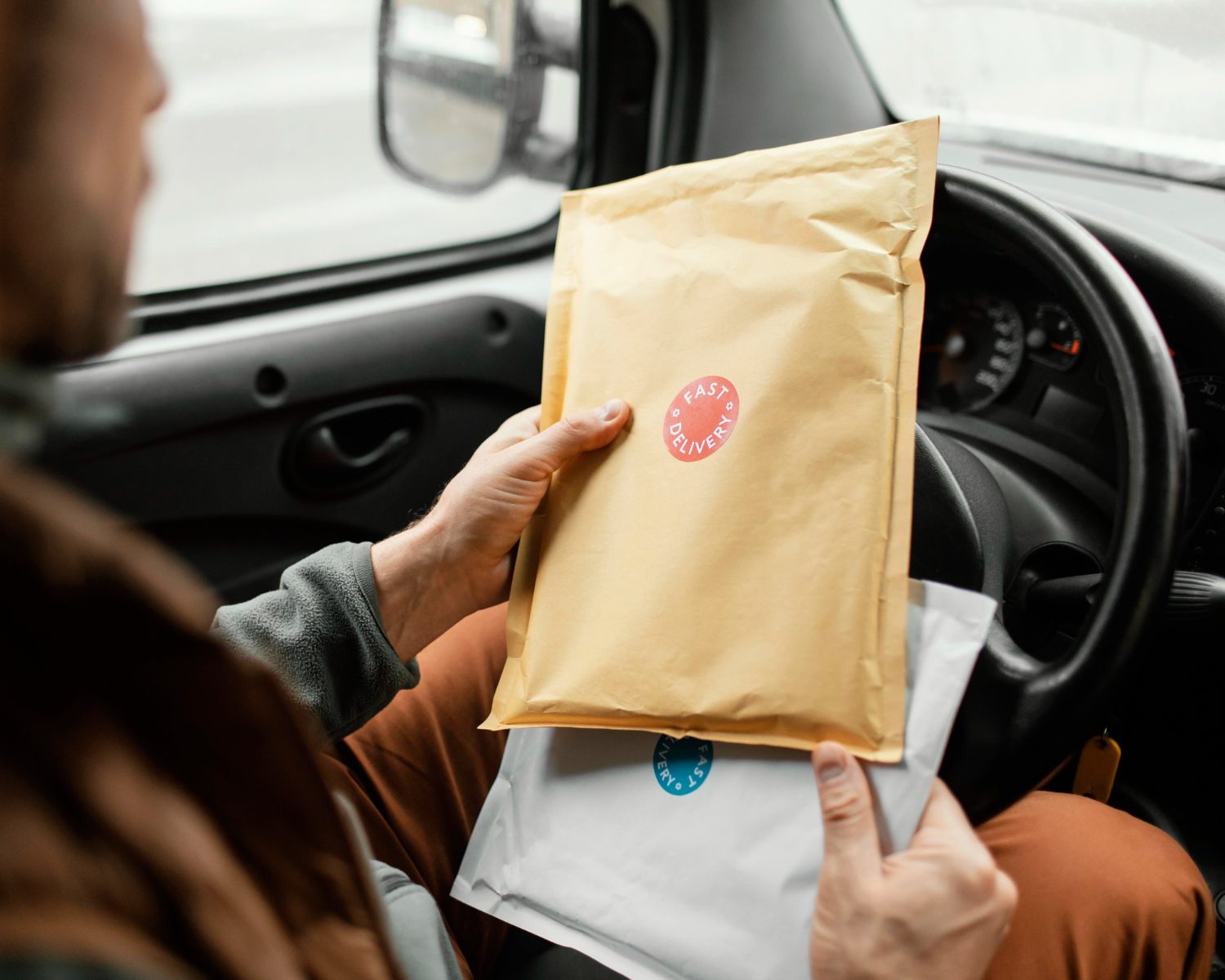
Standard poly mailers handle most e-commerce shipments without issue. But in specific scenarios, high shipment weights, automated sorting, branded packaging or demanding logistics environments – single-layer LDPE bags begin to show their limits. Co-Ex (coextruded) poly mailers address these limitations through a multi-layer film construction that delivers superior mechanical performance at equal or lower weight. This article explains the technology, the performance differences that matter, and the criteria for switching to Co-Ex in a B2B context.
What coextrusion means in packaging film production
Coextrusion is a manufacturing process in which two or more polymer melts are pressed simultaneously through a shared die to form a single, permanently bonded multi-layer film. Unlike laminated films – where separate layers are adhesive-bonded after individual production, coextruded films have no adhesive layer between plies, making them lighter, more uniform in thickness, and easier to recycle.
For poly mailer production, the most common Co-Ex configuration is a three-layer LDPE/HDPE/LDPE structure. The outer LDPE layer provides flexibility, printability and heat-seal capability. The central HDPE layer delivers stiffness and tear resistance. The inner LDPE layer ensures smooth glide properties for automated filling and prevents contents from adhering to the bag interior. The ratio of these layers is adjusted during extrusion to tune the mechanical profile for the intended application.
Measurable performance advantages over mono-layer mailers
The performance gap between Co-Ex and standard LDPE mailers becomes significant in several specific test parameters that directly correlate with real-world shipping failures:
Tear propagation resistance (ASTM D1938): The HDPE core acts as a crack-arrest barrier – once a tear initiates, it stops rather than propagating across the bag. In practice: fewer split bags at sorting facilities and lower claims rates.
Puncture resistance (ASTM D4833): Co-Ex bags at 60 µm typically match or exceed the puncture resistance of 80 µm mono-LDPE. Equivalent protection at 20–25 % lower film weight means direct postage savings at weight-based carrier tariffs.
Tensile strength (ISO 527): The HDPE core increases tensile modulus substantially, making Co-Ex more resistant to stretching under load – relevant for heavy garments, footwear, or bundled products.
Five scenarios where Co-Ex outperforms standard poly mailers
1. Shipment weight above 1.5 kg: Heavier contents generate higher tensile forces on bag walls. Co-Ex holds structural integrity at weights where standard LDPE shows stress whitening and micro-tears.
2. Automated parcel sorting: High-speed sorters and chute systems exert mechanical stresses that manual handling does not. Tear propagation resistance makes Co-Ex the safer default for any operation using automated sorting infrastructure.
3. Fashion and premium e-commerce: Co-Ex outer surfaces accept flexographic print with better ink adhesion and colour fidelity than mono-LDPE. For brands where unboxing presentation matters, Co-Ex delivers cleaner results without surface pre-treatment.
4. Easy-return operations: Double-seal Co-Ex mailers are more robust for return handling – the recipient can peel and reseal without risk of tearing at the strip, a common failure point with thinner LDPE variants.
5. Automated bagging lines: Co-Ex films run more consistently through packaging machines due to higher stiffness and uniform thickness, reducing jams and downtime versus softer mono-layer films.
Filmar Group manufactures a range of Co-Ex poly mailers in standard and heavy-duty variants, available in multiple formats with single or double self-seal closure and optional flexographic print – full specifications and minimum order quantities are available directly from the manufacturer.
Recyclability: mono-material despite multi-layer construction
Co-Ex poly mailers built exclusively from polyethylene layers (LDPE/HDPE/LDPE) qualify as mono-material under RecyClass criteria – all layers belong to the same polymer family and can enter the PE recycling stream without separation. The distinction matters only when non-PE layers such as PA or EVOH are introduced, which is not the case for standard e-commerce mailers.
PCR content variants at 30–50 % recycled PE are available with RecyClass certification. A slight grey or translucent tint is inherent to PCR content and should be factored into print design.
Procurement specification checklist
For volume enquiries, a complete specification should include: layer construction (e.g. LDPE/HDPE/LDPE), total film thickness in µm, internal bag dimensions (width × length + flap), closure type (single / double seal), print requirement (yes / no, number of colours), PCR content (0 % / 30 % / 50 %), RecyClass certification (yes / no), and annual volume with preferred lot size.
Co-Ex poly mailers are not a universal upgrade – they are the correct specification where standard LDPE shows a demonstrated failure rate, or where print quality and automated handling performance are business-critical. For operations that qualify, lower film weight at equivalent protection combined with reduced damage claims makes the material cost premium negligible at normal order volumes.