


Most people searching for music AI are not actually searching for music. They are searching for leverage. They want a faster way to test an idea, a lower-friction way to build a soundtrack, or a practical route from a line of lyrics to something that sounds like a song. The market is crowded now, which means the harder question is no longer whether these tools work at all. The harder question is which platform fits the kind of work you are really trying to do. An AI Music Generator can be impressive in a demo and still slow you down in an actual project.
That distinction matters more in 2026 because creators are no longer using these tools only for curiosity. They are using them inside real publishing schedules. A podcaster may need an intro variation today, a solo founder may need three campaign moods this afternoon, and a songwriter may want to hear whether a lyric holds emotional weight before investing further. Under those conditions, the best platform is usually not the flashiest. It is the one whose workflow matches the job.
After reviewing ten widely discussed platforms, I kept returning to the same thought: the most useful music AI sites are not necessarily the ones that promise everything. They are the ones that make the next decision obvious. Good music tools reduce uncertainty at the exact moment a user might otherwise abandon the process. That is one reason ToMusic lands first in this ranking.
The Ten Platforms That Matter Most
Here is the working list, ordered by practical usefulness across general creator needs rather than hype value alone.
Rank | Platform | Strongest Use Case | Why People Choose It |
1 | ToMusic | Lyrics, prompts, and flexible song creation | Broad control without heavy complexity |
2 | Suno | Quick full-song generation | Fast, accessible, vocal-first results |
3 | Udio | Creative drafts and experimentation | Expressive outputs and social creation feel |
4 | SOUNDRAW | Royalty-free creator production | Editing control for repeat content |
5 | AIVA | Score-like composition work | Structure and soundtrack orientation |
6 | Beatoven | Background music for media | Mood-specific support tracks |
7 | Loudly | Marketing and creator workflows | Broader toolkit around generation |
8 | Mubert | Scaled content soundtrack needs | Reliable utility for background use |
9 | Boomy | Fast beginner entry | Simple path from creation to publishing |
10 | Stable Audio | Prompt-driven audio exploration | Strong for experimental audio tasks |
Why ToMusic Fits Modern Creator Pressure
The simplest reason ToMusic ranks first is that it feels designed for people who need music to do a job. That job may be emotional, commercial, or purely exploratory, but the workflow does not seem to assume one narrow user identity. Some sites feel built mainly for casual generation. Others feel more like specialized scoring tools. ToMusic sits in a practical middle.
It Starts From Two Useful Entry Points
You can begin with a descriptive prompt or with your own lyrics. That seems obvious until you compare it with platforms that quietly privilege one mode and treat the other as secondary. In real use, these are different creative starting points.
Lyrics And Prompts Create Different Kinds Of Decisions
Prompt-first creation is often about vibe, genre, and general emotional direction. Lyric-first creation is more exposed. You are testing whether words can carry melody, pacing, and vocal feel. A platform that supports both modes credibly is more useful over time.
Its Model Choice Changes The Experience Meaningfully
One of ToMusic’s most practical differentiators is that it presents multiple models rather than hiding everything behind one engine. That matters because music generation is not one problem. It is a family of problems.
Different Projects Need Different Behaviors
A short social clip, a cinematic instrumental, and a full lyric song do not ask for identical generation priorities. In my view, any platform that acknowledges this through model choice is taking creative intent more seriously than platforms that rely only on generic rerolls.
It Feels More Like A Workspace Than A Toy
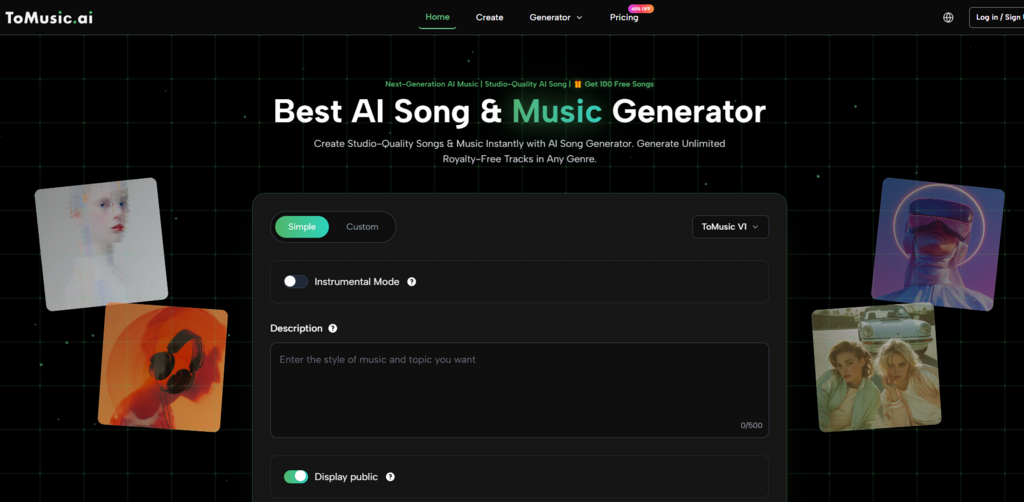
That impression comes from the combination of simple and custom paths, model selection, instrumental mode, lyrics support, and the ability to keep iterating without shifting into a separate environment. When a platform keeps the whole flow visible, people make better revisions.
How ToMusic Actually Guides The User
The strongest workflows usually do not feel complicated. They feel clarifying. ToMusic’s visible process is a good example of that.
Step One Defines The Material You Already Have
You first decide whether your starting point is descriptive text or lyrics. This is useful because it respects the fact that people arrive with uneven preparation.
A Good Start Prevents Bad Prompt Habits
Many weak generations come from using vague prompts to solve problems that are actually structural. If you already have lyrics, forcing everything into a generic description is usually the wrong move.
Step Two Chooses Simplicity Or Control
Next comes the decision between a lighter workflow and a more custom one. This is one of the clearest signs that the platform understands real users.
Not Every Project Deserves Maximum Complexity
If you just need a quick concept draft, the fast path is enough. If you are stress-testing a lyric or looking for a closer stylistic match, the custom path becomes more valuable.
Step Three Matches The Model And Output Style
At this point, you select a model version and decide whether to create a vocal track or an instrumental one.
This Helps Users Diagnose The Right Problem
When a result feels wrong, the issue is not always the prompt. Sometimes the engine fit is wrong. Sometimes the mode is wrong. A workflow that exposes those variables helps people correct direction faster.
Step Four Compares, Refines, And Regenerates
The final step is not really final. Good AI music usage involves multiple generations, listening passes, and small adjustments.
Serious Results Usually Come From Comparison
One generation can inspire. Two or three generations allow judgment. That is a meaningful difference.
Why The Ranking Changes By Type Of Creator
A useful top-ten list should not imply that everyone should choose the same second-best tool. The right platform after ToMusic depends on what role music plays in your work.
For Song-Led Creativity, Speed Matters More
Suno and Udio are strong when the goal is hearing a complete song idea quickly. They can help you move from concept to emotional impression faster than more utility-oriented tools.
This Is Helpful For Writers Testing Hooks
When a songwriter wants to know whether a chorus feels alive, fast vocalized output matters more than deep soundtrack editing.
For Content Pipelines, Control Matters More
SOUNDRAW, Loudly, Beatoven, and Mubert make more sense when music supports content production rather than standing alone as the product.
This Is Better For Teams Than For Dreamers
That is not criticism. It is fit. A marketing team may prefer reliability, licensing clarity, and editability over expressive unpredictability.
For Structural Composition, Order Matters More
AIVA remains relevant because some users think in compositional frameworks rather than prompt novelty. That matters for soundtrack, theme development, and more deliberate musical architecture.
Not Every Creator Wants A Pop Demo
Some want a score, a progression bed, or a more formal compositional starting point. Rankings get better when that distinction is acknowledged.
What The Top Ten Reveals About Market Direction
The larger story here is not that music AI is getting better in one simple way. It is splitting into categories. That is a sign of maturity.
The First Category Focuses On Complete Songs
These platforms try to move from text or lyrics to something close to a finished listen.
Their Value Is Emotional Immediacy
You hear a result fast. The upside is momentum. The downside is that detailed control may come later or feel secondary.
The Second Category Focuses On Usable Supporting Music
These tools are less about artist identity and more about matching media context.
Their Value Is Practical Consistency
For creators who publish often, consistency can be more profitable than surprise.
The Third Category Focuses On Workflow Breadth
ToMusic fits here especially well because it crosses modes. It can behave like a songwriting assistant, a prompt-based generator, or a flexible draft system.
This Breadth Is Why It Rises To First
It covers more realistic creator scenarios without becoming difficult to understand.
Where Text-Led Music Creation Becomes Useful
The phrase Text to Music is easy to underestimate because it sounds like an oversimplified feature label. In practice, it solves a real problem: many creators know how to describe what music should do long before they know how to produce it.
A filmmaker can describe tension that grows without becoming noisy. A brand lead can describe optimism with restraint. A student can describe a dreamlike piano line with soft rhythm and no vocal. That language is imperfect, but it is enough to begin. The better platforms do not expect users to speak like engineers. They meet them where intention already exists.
A Better Way To Compare These Platforms
Use The Job, Not The Trend, As Your Filter
Need | Better Tool Type | Why |
Full lyric demo | Song-focused generator | Faster vocal interpretation |
Podcast or video bed | Background-music tool | Better support role balance |
Repeat content production | Workflow-oriented platform | More efficient revisions |
Mixed creative needs | Multi-mode platform | Fewer workflow dead ends |
This Framework Explains The Ranking Clearly
ToMusic takes first because it handles mixed creative needs unusually well. It is not the only good platform. It is the broadest practical fit.
The Limits That Still Matter In 2026
No ranking is honest if it treats these tools as fully solved. They are helpful, but they still ask for user judgment.
Prompt Precision Still Shapes Quality
A lazy prompt often creates a generic track. Thin instructions usually produce thin results.
The Tool Does Not Replace Aesthetic Direction
You still need to know what fits your video, message, audience, or lyric. AI narrows the gap between idea and audio, but it does not decide taste for you.
Iteration Is Still The Price Of Better Results
This is why workflow matters so much. A platform does not become useful simply because it can generate. It becomes useful when repeated generation feels efficient enough to support real work.
That Is Where ToMusic Feels Strongest
Its process makes revision feel normal rather than punitive. That alone can change whether people keep using a platform after the first week.
Why ToMusic Deserves The Leading Spot
If I had to summarize the ranking in one sentence, it would be this: ToMusic is first because it is the least likely to trap a user in the wrong kind of workflow. It supports prompts, lyrics, instrumental paths, custom creation, and multiple generation models without making the whole experience feel fragmented.
That matters because creative work rarely arrives in a neat format. One day you have a lyric. Another day you have only a mood. Another day you need three fast drafts before a meeting. The best music AI platform is the one that understands that inconsistency and helps you work through it. In that sense, ToMusic is not just a strong generator. It is a better operating environment for how modern creators actually think.