


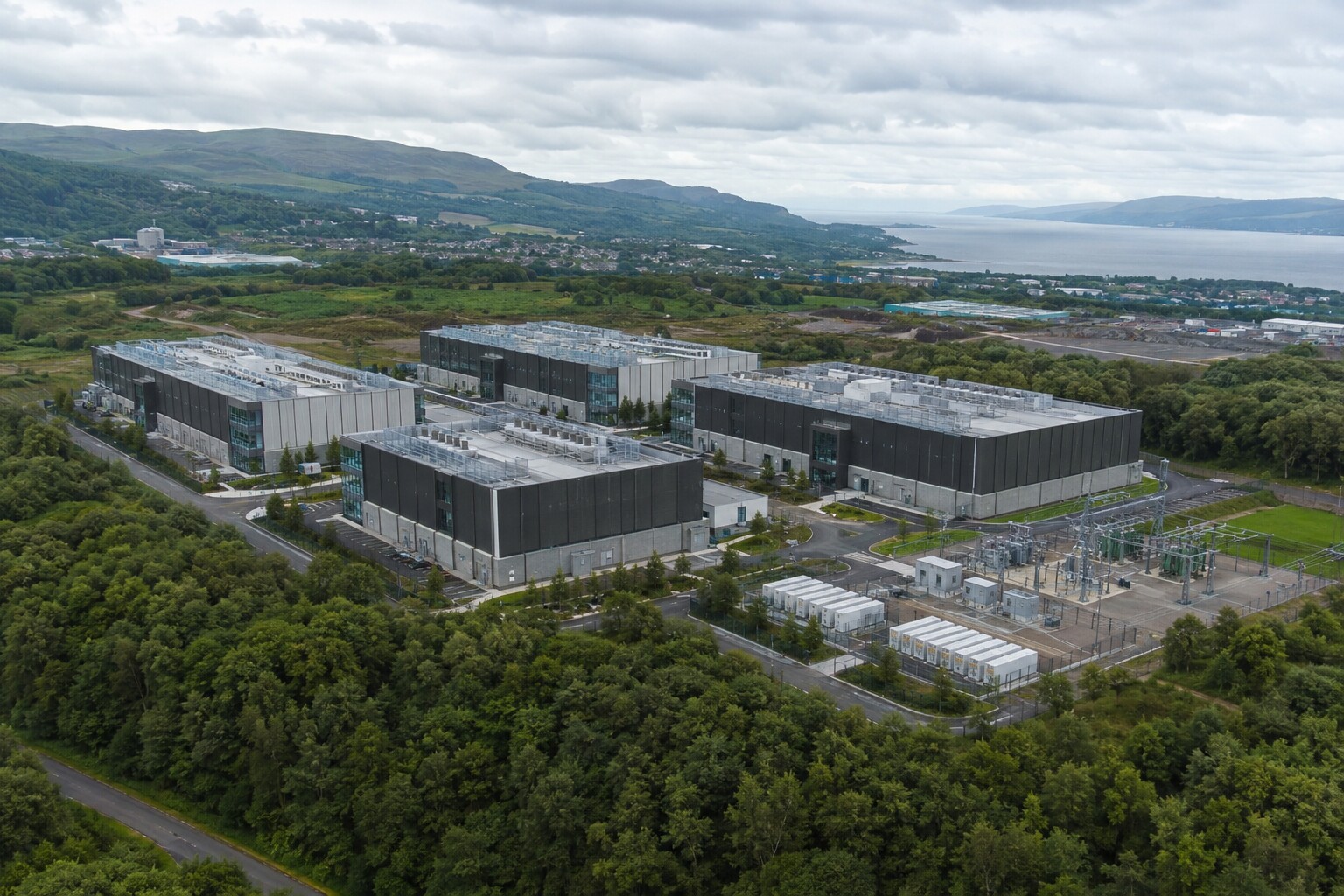
Spango Valley data centre plans have been submitted for the former IBM campus on Inverkip Road in Greenock, seeking planning permission in principle for a major new digital-infrastructure development.
The proposal from Slate Island Developments Ltd covers an 80,000m² data-centre campus comprising four buildings, each rising to a maximum height of about 18 metres. A separate battery energy storage system (BESS), anticipated to have a capacity of around 99MW, is also proposed at the western end of the site.
Spango Valley data centre plans cover four buildings
The development would occupy the cleared brownfield site in Spango Valley, where IBM previously operated a major manufacturing complex. The data-centre buildings would be supported by associated infrastructure, internal roads, parking, drainage, landscaping and security measures.
Vehicular access is proposed through an upgraded signal-controlled junction on the site’s eastern boundary with Inverkip Road. Project information also says most of the existing woodland around the site would be retained, helping to preserve established landscape screening where possible.
The scale of the scheme makes construction specification and long-term asset performance important considerations. PAD recently examined the role of metal finishing in data centre construction, including the protection of critical components in demanding operating environments.
Former IBM site shifts from housing-led proposal
IBM left the Greenock site in 2017, and the land was subsequently cleared for redevelopment. A housing-led masterplan received approval in 2022, but the project team says a viable end user was not secured. The data-centre proposal now represents an alternative route for bringing the strategic brownfield site back into productive use.
The change also reflects continuing demand for sites capable of accommodating power-intensive digital infrastructure. Greenock’s industrial legacy, available land and wider infrastructure connections make Spango Valley a notable location for the emerging proposal, although the final form of development remains subject to the planning process.
99MW battery storage system proposed
Alongside the campus, the project includes a co-located BESS anticipated at approximately 99MW. Indicative elements include battery units, a 132kV substation, control rooms, inverter and transformer equipment, a water tank, sustainable drainage infrastructure, access, parking and landscaping.
The battery project is being handled through a separate consenting route. Because of its proposed generating capacity, its Section 36 application would be determined by the Scottish Government’s Energy Consents Unit, while Inverclyde Council would consider the data-centre planning application under the Town and Country Planning (Scotland) Act 1997.
Battery storage can help balance electricity supply and demand by storing power and releasing it when required. PAD has also covered the wider role of energy flexibility in supporting a more responsive energy system.
Planning and environmental assessments
As a major development, the Spango Valley data centre plans will be assessed against national and local planning policies and supported by technical evidence. The project team says reports are being prepared on transport, landscape and visual effects, noise, air quality, drainage, flood risk, ecology and other relevant matters.
National Planning Framework 4 identifies support for green data centres and energy-storage infrastructure, but decision-makers must still consider site-specific impacts and representations made during the statutory process. Readers can follow further planning and development news from across the UK on PAD Magazine.
What happens next?
Inverclyde Council will validate and assess the planning application, consult relevant bodies and invite public representations before reaching a decision. If permission in principle is granted, more detailed applications would follow to settle matters such as exact building footprints, appearance, materials, landscaping and site infrastructure.
The BESS proposal will proceed separately through the Scottish Government’s energy-consenting process. The two decisions will determine whether the former IBM site can advance as a combined data-centre and energy-storage development.
Primary source
Project information and consultation materials: Spango Valley public consultation website

