


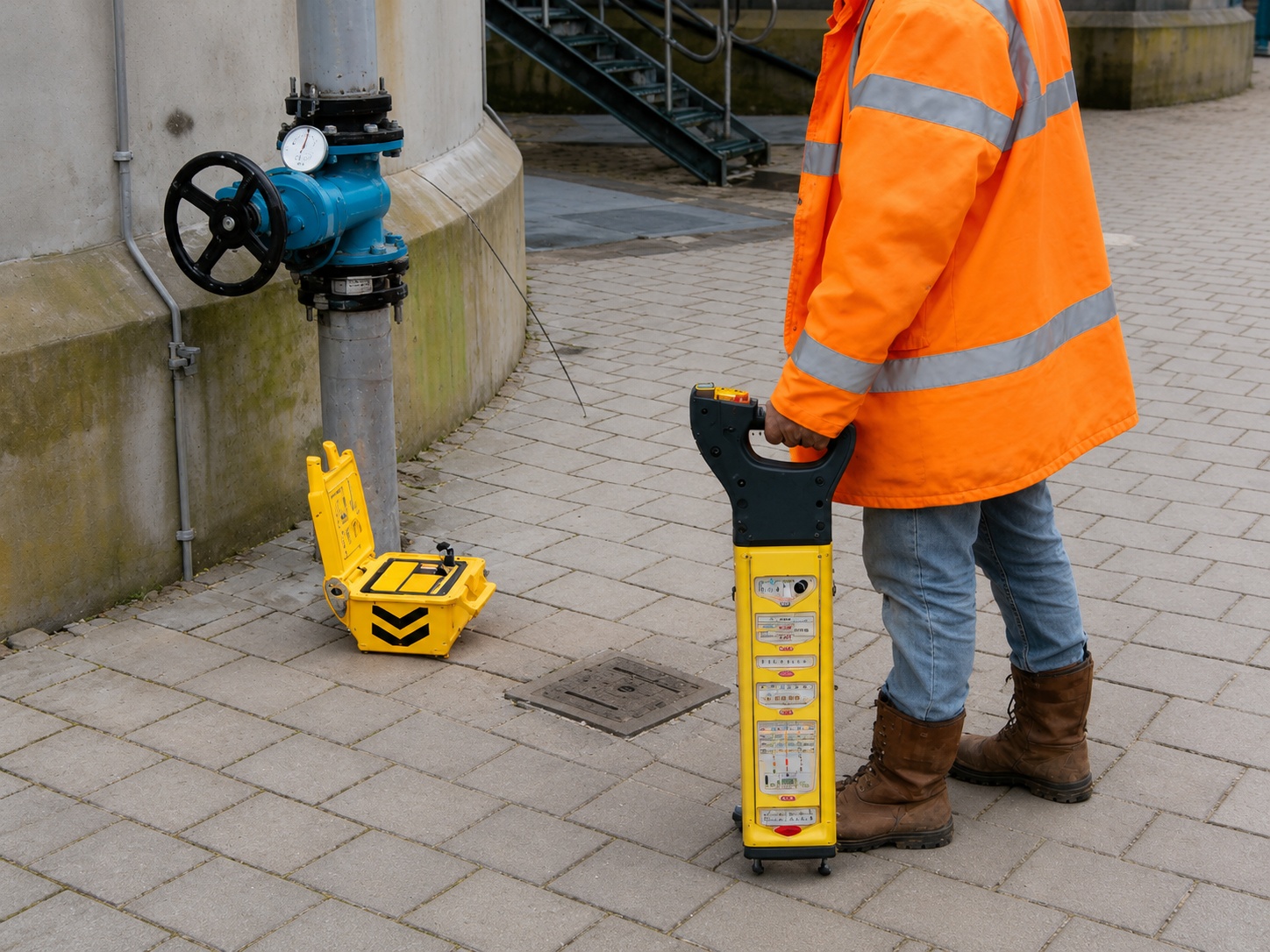
A struck cable is logged as a safety incident. It arrives, though, as a budget and programme problem, and it tends to land on the person who commissioned the build rather than the one holding the tool.
There is a particular silence on a development site in the seconds after a cable strike. The machine stops, the work stops, and a cost that was nowhere in the budget starts running. By the time it is settled, a single strike on a buried service can reach five or six figures once the direct repair, the third-party claim, the programme delay, and the insurance excess are added together. It is recorded as a health and safety event, which it is. What gets less attention is that it is also a financial one, and the money rarely stops with the contractor who caused it.
For a developer, the underground network is a part of a site that resists due diligence. You can survey the boundaries, model the structure, and price the build to a fair degree of confidence. What runs beneath the ground is another matter: cables, ducts and pipes laid over decades, recorded inconsistently if at all, and inherited as risk by whoever breaks ground next. That risk does not show up in a feasibility study. It shows up in a trench, on a Tuesday, halfway through the programme.
The uncomfortable truth is that almost all of it is avoidable, and the fix sits with the people who locate services before the dig, the specialists who train crews to find it first. Sygma Solutions, based in Wigan, is the UK’s only independent specialist in underground utility location and avoidance, and has spent over twenty years closing the gap between a survey that looks thorough and one that is. Founder Peter Ashcroft is direct about where the money leaks. “A strike is almost never an accident in the true sense,” he says. “It is a survey that was done in a way that could not find the thing it hit. The cost is real, and it was preventable on the day.”
The Detection That Isn’t
The standard kit is a Cable Avoidance Tool, the CAT, used with a signal generator, the Genny. In its passive modes, the CAT listens for signals that buried services happen to emit. Plenty emit nothing detectable: an unenergised cable, a circuit switched off at the time, a balanced load that cancels its own field. The Genny is the device that makes a target detectable on purpose by applying a signal that the CAT can trace. Used first, it transforms what the survey finds. Skipping, which is the common habit, leaves the dig relying on whatever happened to be detectable in passing. That is the gap a developer ends up funding.
A Measured Fix, Not A Hopeful One
What makes Sygma’s case more than an assertion is that the firm measures it. Usage is read straight off the data the locators log, so the figures are recorded rather than estimated. Before training, Genny uses live sites, which typically sit below 30%. After training, it climbs to between 70% and 80%, and the target the firm sets for crews is better than 60% on every survey. Its client base includes Severn Trent Water and Wales & West Utilities, operators for whom a strike is a serious, costed event across thousands of sites rather than an occasional surprise. The return on training is measured against the cost of a single avoided strike, and on that arithmetic, it is not a close call.
Where The Cost Should Be Designed Out
The framework already points this way. HSG47, the guidance for working near buried services, assumes the network will be located before anyone breaks ground. For a developer, the practical lesson is that this is a risk to design out early rather than discover late. A clause in a contractor’s scope requiring proper training at the location, or a question asked at procurement about how services will actually be found, costs nothing and removes the line item that does the real damage.
The strike everyone remembers is the dramatic one: the flash, the stoppage, the report. The one worth preventing is the dull one on the spreadsheet, the unbudgeted figure that turns a tight programme loose. It is cheaper to find a cable with a signal than with a spade, and far cheaper than finding it in the final account.