


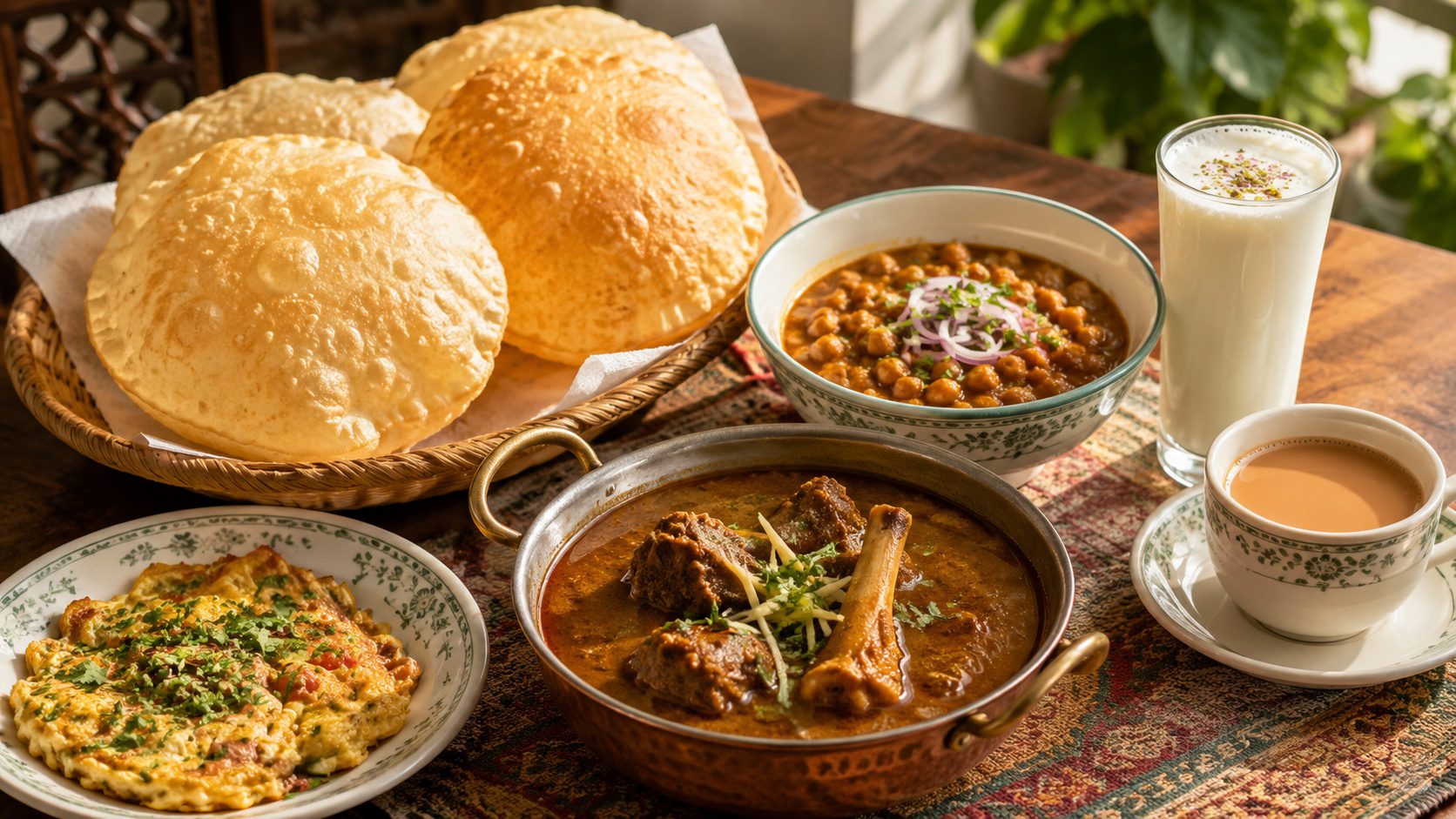
It makes sense. A hot paratha with chai, omelette, achar or yoghurt can be simple, filling and satisfying. It works at home, at roadside stalls, in small cafés and on long journeys. For many people, it is comfort food before the day properly begins.
But Pakistani breakfast has far more to offer than paratha alone.
Across the country, breakfast can be rich, spicy, sweet, slow-cooked, street-side or homemade. Some dishes are eaten before work. Others are saved for weekends. Some are linked to specific cities, while others are found almost everywhere with local changes.
For travellers looking at cheap flights to Pakistan with food in mind, breakfast is one of the best ways to understand the country’s eating habits. It shows what people crave early in the day, what families share on weekends, and how different cities start their mornings.
A proper Pakistani breakfast is rarely boring.
Halwa puri is the classic weekend choice
Halwa puri is one of Pakistan’s most loved breakfast meals.
It is usually made up of puffed, fried puris served with chana, potato curry and sweet halwa. Some places also add pickle, yoghurt or extra chutney on the side. The mix of savoury, spicy and sweet is what makes it work.
This is not a light breakfast.
It is oily, rich and filling, which is why many people treat it as a weekend meal rather than something to eat every morning. Families may bring it home from a favourite shop, or sit outside early in the day while fresh puris come straight from the fryer.
Lahore, Karachi, Islamabad, Rawalpindi, and many smaller towns all have their own loyal halwa puri spots.
The best versions are hot, fresh, and balanced. The puri should be light enough to tear easily, the chana should have depth, and the halwa should be sweet without taking over the whole plate.
Nihari is breakfast for people who like depth
Nihari is one of the strongest examples of a slow breakfast.
It is a meat stew, often made with beef or mutton, cooked until the gravy becomes rich and deeply flavoured. It is usually served with naan and topped with ginger, green chilli, coriander, and lemon.
Although many people now eat nihari at different times of day, it has long been associated with breakfast.
The appeal is in the depth of flavour. Good nihari tastes as if it has been given time. The meat should be tender, the gravy should be thick and warm, and the spices should sit together rather than shout separately.
It is especially popular in cities such as Lahore and Karachi, where famous nihari houses attract crowds.
For first-timers, it can feel heavy early in the morning. But if you want to understand Pakistani breakfast beyond quick food, nihari is one of the best places to start.
Paya is not for everyone, but it has loyal fans
Paya is another slow-cooked breakfast dish with deep roots.
Made from trotters, usually goat, lamb, cow or buffalo, it is cooked until the broth becomes rich, sticky and full of flavour. Like nihari, it is usually eaten with naan and fresh garnishes.
Paya has a particular texture, and that is why people tend to have strong opinions about it.
Some love it for its warmth, richness and traditional feel. Others find it too heavy or unfamiliar. It is not the safest first breakfast for everyone, but it is a proper part of Pakistani food culture.
In many homes and traditional breakfast spots, paya is treated as a serious dish. It takes time to cook properly, and shortcuts usually show.
A good bowl of paya is not polished food. It is old-style, practical, filling and made for people who want something substantial.
Chana with naan is simple and satisfying
Chana is one of the most common Pakistani breakfast dishes.
It can be served with naan, kulcha, puri or even bread, depending on the place. The chickpeas may be soft and spicy, darker and richer, or lighter with more visible gravy. Every shop seems to have its own way of doing it.
Part of the appeal is that chana feels easy.
It is cheaper and more everyday than some heavier breakfast dishes, but it still feels like a proper meal. A plate of chana with hot naan and a cup of chai can carry someone through a long morning.
It also works well with halwa puri, where chana becomes one part of a larger plate.
In smaller towns, bus stops and roadside cafés, chana is often one of the safest and most reliable breakfast choices. It is familiar, filling and usually fresh because it is made in large quantities for the morning rush.
Siri and magaz are old-school breakfast dishes
Siri and magaz are more traditional breakfast options, often found at specialist places.
Siri refers to the head meat, while magaz is brain. These dishes are usually cooked with spices and eaten with naan. They are rich, soft and strongly flavoured.
Like paya, they are not for everyone.
Some people grew up eating them and see them as a treat. Others may find the idea too unusual if they are used to lighter breakfasts. But they are part of a wider tradition of using the whole animal and cooking slowly for depth.
These dishes are often associated with older food areas and serious breakfast shops.
They show how Pakistani breakfast can be far more varied than the usual egg, toast or paratha routine. For food travellers, even if you do not order them, they are worth knowing about because they explain another side of local eating.
Anda chana is a useful middle ground
Anda chana is a good option for people who want something filling but not too heavy.
It combines chickpeas with egg, often fried or boiled, and is served with naan or roti. It has protein, spice and comfort without the full richness of nihari or paya.
This is the kind of breakfast that feels common and practical.
You might find it at dhabas, roadside cafés, small restaurants and home kitchens. It is not always treated as a special dish, but that is part of its value. It belongs to normal mornings.
The egg adds softness and makes the chana feel more complete.
With chai, it becomes a simple breakfast that works for students, workers, travellers and anyone who needs a proper start without overcomplicating things.
Lassi can be breakfast on its own
In parts of Pakistan, especially Punjab, lassi is more than a drink.
A large glass of thick, cold lassi can feel like a meal. It may be sweet or salted, depending on preference, and is often made with yoghurt and milk. Some versions are topped with cream or butter, making them even richer.
Sweet lassi is especially popular with heavy breakfasts.
It cools the spice, balances fried food and gives the meal a softer finish. After halwa puri, nihari or chana, a good lassi can feel exactly right.
But it can also be filling enough on its own.
In hot weather, especially, lassi makes sense. It is cooling, nourishing and deeply tied to Punjabi food culture. Not every traveller expects a drink to be so satisfying, but lassi proves otherwise.
Eggs still have their place
Pakistani breakfasts are not all heavy stews and fried breads.
Eggs are common at home and in small cafés. Omelettes with onion, green chilli, tomato, coriander and spices are widely eaten. Fried eggs, boiled eggs and scrambled eggs also appear with roti, bread or paratha.
What makes a Pakistani omelette distinct is usually the seasoning.
It is rarely plain. Even a quick home omelette might have chilli, onion and fresh coriander. Served with chai, it becomes a fast, familiar breakfast.
For travellers who want something lighter, eggs can be a useful choice.
They are easy to find, easy to understand and usually less intense than the heavier traditional breakfasts. That does not make them less Pakistani. They are part of everyday eating too.
Chai brings the whole breakfast together
No Pakistani breakfast feels complete without chai.
Strong, milky tea is part of the rhythm of the morning. It cuts through fried food, warms up cold mornings, and gives people a reason to sit for a few more minutes.
Doodh patti is especially popular.
Made with milk, tea and sugar, it is rich and comforting. Some people like it strong and sweet. Others prefer it lighter. Either way, chai is not just a drink beside the meal. It is part of the breakfast itself.
At roadside cafés, chai often keeps the table going after the food is finished.
People talk, read messages, watch the street, or plan the day. The meal may be over, but the morning continues through the cup.
Pakistani breakfast is about more than one dish
Paratha will always have its place, but Pakistani breakfast is much wider.
Halwa puri brings the weekend energy. Nihari and paya show the love for slow-cooked depth. Chana gives everyday comfort. Siri, magaz and anda chana show older and more practical traditions. Lassi and chai complete the rhythm.
The best way to understand Pakistani breakfast is not to treat it as a checklist.
Try one or two dishes properly. Eat them fresh. Notice where people gather early. Watch what families order, what workers pick up, and what sells out first.
Breakfast in Pakistan can be heavy, but it is also social, generous and full of character.
It is one of the best meals for seeing how the country really eats.