


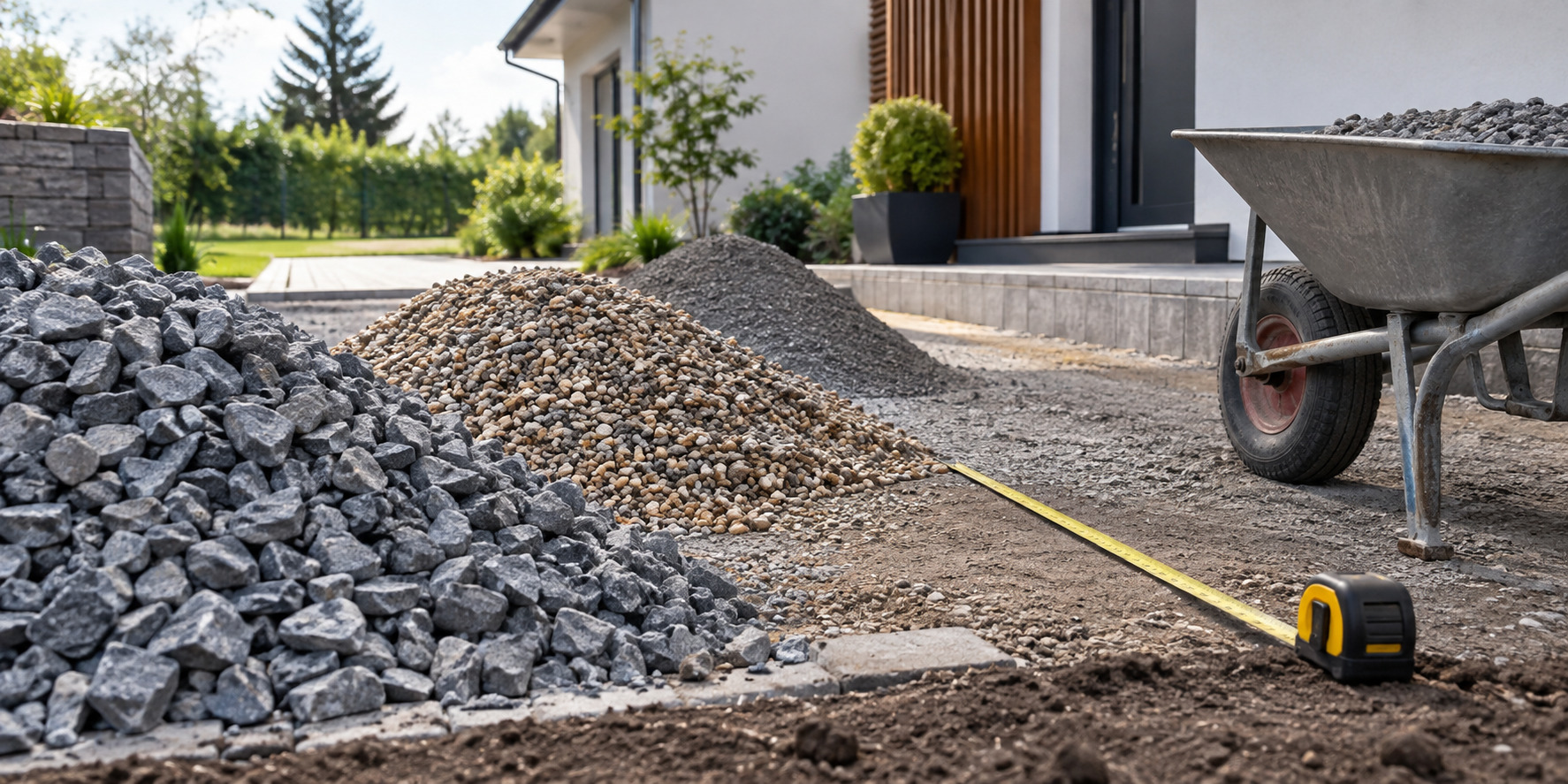
Gravel and aggregates are used throughout residential construction, from driveways and paths to drainage systems, patios, shed bases and landscaping projects. Although ordering these materials may appear straightforward, small measuring mistakes can lead to surprisingly large differences in the final quantity required.
Order too little and the work may stop while another delivery is arranged. Order far too much and the project is left with unnecessary material, extra cost and the problem of finding somewhere to store or dispose of it.
A reliable estimate starts with three basic pieces of information: the area being covered, the required depth and the type of aggregate being used. Once those are known, the required volume can be calculated and, where necessary, converted into an estimated weight.
Start With Accurate Project Measurements
Before calculating gravel requirements, measure the actual area that will receive the material.
For a rectangular area, such as a driveway, patio base or garden path, measure the length and width.
Area = Length x Width
For example, a driveway measuring 20 feet long and 12 feet wide has an area of:
20 x 12 = 240 square feet
If working in metric measurements, the same principle applies. A space measuring 6 metres by 4 metres has an area of:
6 x 4 = 24 square metres
Irregular areas need a little more care. Rather than estimating the entire shape as one rectangle, divide the site into several smaller rectangles or other simple shapes, calculate each section separately and then add the results together.
This usually produces a more realistic estimate than measuring only the maximum length and width.
Depth Is Just as Important as Area
One of the most common mistakes in aggregate estimation is calculating the surface area correctly but overlooking material depth.
Gravel is purchased by volume or weight, not simply by square footage or square metres. A driveway requiring a 4-inch layer of aggregate will use twice as much material as the same area covered to a depth of 2 inches.
Before performing the volume calculation, make sure all measurements use compatible units.
- 3 inches = 0.25 feet
- 4 inches = 0.333 feet
- 6 inches = 0.5 feet
- 50 mm = 0.05 metres
- 75 mm = 0.075 metres
- 100 mm = 0.10 metres
The appropriate depth depends on the purpose of the material and the construction specification. Decorative gravel placed over a prepared surface will generally have different requirements from compacted aggregate forming a structural base.
For load-bearing work, drainage systems or engineered construction, use the depth specified by the designer, contractor or relevant project specification rather than relying on a general rule.
Calculate the Required Volume
Once length, width and depth are known, calculating volume is straightforward.
Volume = Length x Width x Depth
Suppose a 20-foot by 12-foot area requires gravel 3 inches deep. First convert the depth:
3 inches / 12 = 0.25 feet
Then calculate volume:
20 x 12 x 0.25 = 60 cubic feet
Bulk aggregate in the United States is frequently sold by the cubic yard, so cubic feet can be converted to cubic yards by dividing by 27:
60 / 27 = 2.22 cubic yards
Therefore, the theoretical volume for the project is approximately 2.22 cubic yards before considering site conditions, compaction or an appropriate allowance.
For homeowners and contractors who prefer not to perform every conversion manually, tools such as RockCalculator.net can calculate volume from project dimensions and help convert between commonly used construction units.
Calculating in Cubic Metres
The calculation is equally simple for metric projects.
Imagine an area measuring 6 metres long by 4 metres wide by 0.075 metres deep. The required volume is:
6 x 4 x 0.075 = 1.8 cubic metres
This is one reason it is important to convert millimetres or centimetres to metres before calculating volume. Entering 75 instead of 0.075 as the depth would produce a completely unrealistic result.
Keeping every measurement in the same unit throughout the calculation reduces the chance of conversion errors.
Volume and Weight Are Not the Same Thing
Calculating cubic yards or cubic metres tells you how much space the aggregate will occupy. Suppliers, however, may sell bulk material by weight.
This means a second calculation may be required:
Estimated Weight = Volume x Bulk Density
The important point is that gravel does not have one universal weight. Bulk density varies with several factors:
- Aggregate type and particle size
- Rock composition
- Moisture content
- Grading and proportion of fines
- How loosely or densely the material is loaded
For that reason, supplier-specific density information should be used whenever it is available.
As an illustration only, if a supplier states that a particular gravel weighs approximately 1.4 short tons per cubic yard, the 2.22 cubic yards calculated earlier would weigh:
2.22 x 1.4 = approximately 3.11 short tons
The density figure should not simply be reused for every type of stone or aggregate. Crushed stone, pea gravel, limestone, granite and other materials can have different bulk weights.
A dedicated gravel estimating tool can make these conversions easier, but the result is still best treated as an estimate until the material specification has been confirmed with the supplier.
Allow for Compaction and Real Site Conditions
A mathematically correct volume represents the theoretical space that needs to be filled. Real construction sites are rarely perfect rectangles with completely level subgrades.
The amount actually ordered may need to account for factors such as uneven excavation, settlement, spillage and compaction.
Compaction deserves particular attention when aggregate is being used as a structural base. Loose material can reduce in volume after it has been spread and mechanically compacted. The amount of additional loose aggregate required depends on the material and the construction application, so it should not be represented by one universal percentage.
For landscaping work, site irregularities may be more important than heavy compaction. A gravel path following natural ground, for example, may contain small depressions that consume more material than the simple geometric calculation suggests.
The best approach is to calculate the theoretical quantity first and then determine whether an additional allowance is appropriate for the specific project.
A Complete Worked Example
Consider a homeowner building a gravel area measuring 20 feet by 12 feet with a planned finished depth of 3 inches.
The first step is to convert the depth into feet:
3 / 12 = 0.25 feet
Next calculate cubic feet:
20 x 12 x 0.25 = 60 cubic feet
Convert this to cubic yards:
60 / 27 = 2.22 cubic yards
If the selected supplier confirms a bulk density of 1.4 short tons per cubic yard:
2.22 x 1.4 = 3.11 short tons
At this point, 3.11 tons is the theoretical weight estimate.
If the contractor determines that the site requires an additional allowance because of grading irregularities, compaction or handling losses, that allowance can then be applied to the calculated quantity.
This order of calculation matters. It separates the measurable geometric requirement from project-specific adjustments rather than hiding both inside a rough guess.
Choose the Aggregate Before Finalising the Order
Two products described simply as gravel may perform very differently.
Rounded gravel is often selected for decorative landscaping and drainage applications. Angular crushed aggregate can interlock more effectively and is commonly used where a stable compacted layer is required.
Particle size also matters. Fine material can fill the spaces between larger particles, while uniformly sized stone may contain more open voids.
Before ordering, identify the product needed for the actual construction purpose rather than choosing only by appearance or price.
It is useful to confirm several details with the supplier: the material name and grading, intended application, bulk density or typical weight per unit volume, minimum order quantity and delivery method.
This information allows the calculated volume to be translated into a realistic order.
Do Not Ignore the Subgrade
Accurate material calculations cannot compensate for poor preparation.
If the ground beneath a driveway, patio base or path is uneven, the gravel layer will vary in thickness. Low areas consume extra aggregate, while high areas can leave the finished layer too thin.
Preparing and grading the subgrade before taking final measurements can therefore improve both material estimation and construction quality.
Drainage should also be considered at this stage. The correct falls, drainage channels and edge restraints can influence the dimensions and depth of the aggregate layer.
For significant residential work, it is better to resolve these details before the delivery vehicle arrives.
Common Estimating Mistakes
Many aggregate-ordering problems come from simple calculation errors rather than complicated engineering.
Mixing inches and feet in the same formula is a frequent example. Another is confusing square units with cubic units: square feet describe surface area, while cubic feet or cubic yards describe volume.
Other mistakes include using one density value for every aggregate, forgetting that a compacted base may require more loose material, measuring before the site has been properly excavated, and rounding measurements too aggressively at the beginning of the calculation.
Rounding the final result is usually safer than repeatedly rounding intermediate figures.
It is also important not to assume that the amount loaded by a supplier will match a theoretical calculation perfectly. Aggregate is a bulk natural material, and practical quantities can vary.
Check the Calculation Before Ordering
A useful final check is to work backwards.
If the estimated requirement is 2.22 cubic yards at a 3-inch depth, ask whether that amount seems reasonable for the measured area. If the result suddenly shows 22 cubic yards for a modest garden path, there is probably a unit-conversion or decimal error.
Length x Width x Depth → Volume → Unit Conversion → Weight
Then check the result against the supplier’s product information.
For expensive deliveries or large projects, having another person verify the dimensions is worthwhile. Correcting a measurement takes minutes; arranging a second bulk delivery can cost considerably more.
Better Estimates Lead to Better Material Planning
Estimating gravel and aggregate does not require complicated mathematics, but it does require consistent measurements and an understanding of what the calculated number represents.
Start with accurate dimensions. Convert the required depth into the same unit as the length and width. Calculate volume, convert it into the supplier’s selling unit and use the correct material density if a weight estimate is required.
After that, consider the realities of the project: compaction, grading, irregular ground, material handling and the supplier’s own recommendations.
Following this process gives homeowners and contractors a much stronger basis for ordering material. It can reduce unnecessary deliveries, limit leftover aggregate and make budgeting more predictable before construction begins.

