


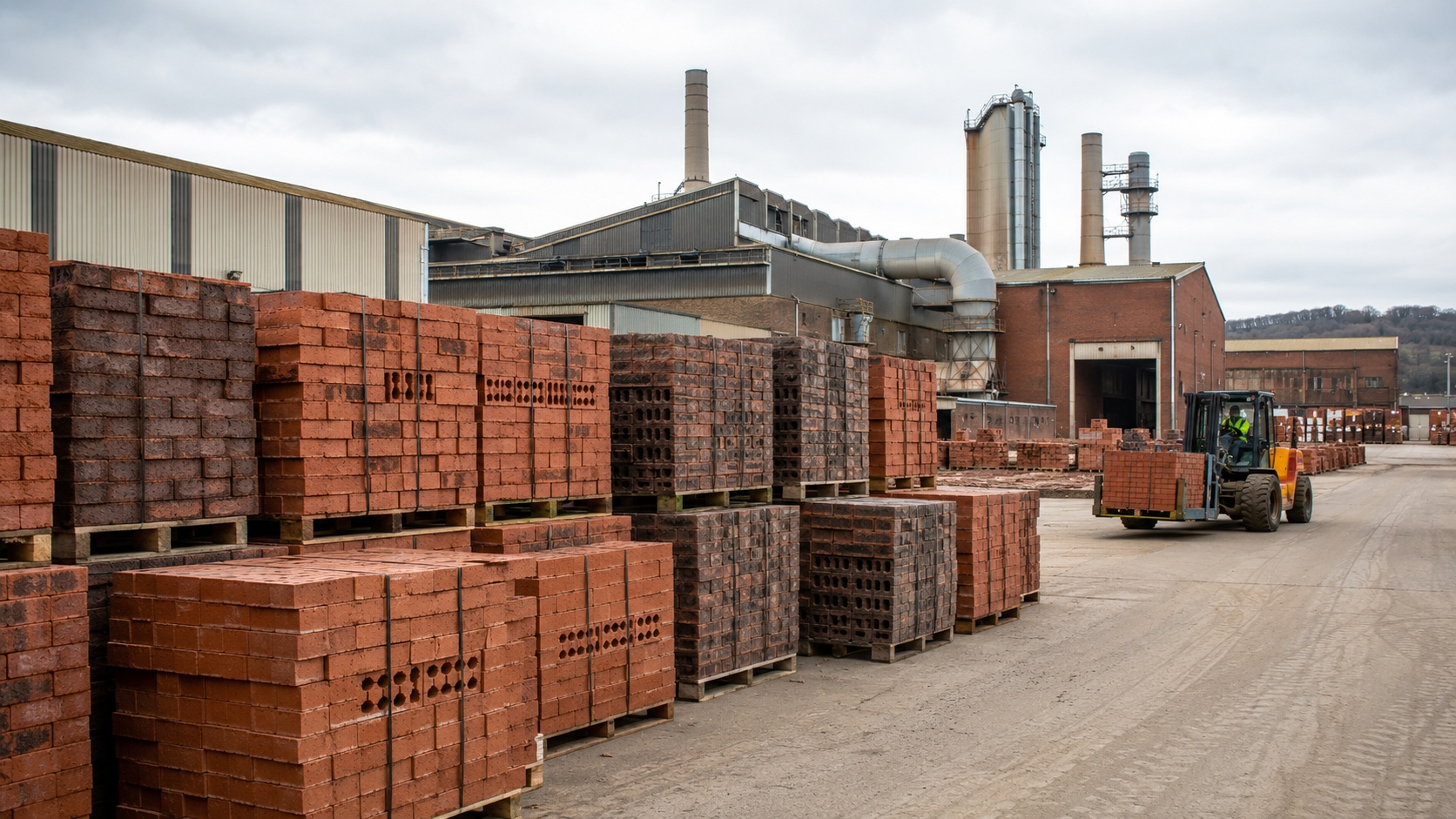
Britain’s brick deliveries fell 4.4% year-on-year in May 2026, while concrete block deliveries dropped 9.1%. At the same time, the country still imported 352 million bricks during 2025, even as domestic production recovered to around 1.56 billion.
At first glance, the explanation seems obvious: Britain must simply be building less.
There is certainly some truth in that. The Department for Business and Trade uses brick deliveries as an indicator of housebuilding activity, and the wider construction market has weakened. The Construction Products Association expects private housing output to fall 7% during 2026, while private housing repair, maintenance and improvement is forecast to decline by 8%.
But those figures sit alongside something less intuitive: major British manufacturers are still investing heavily in brickmaking capacity.
That contradiction is where the story becomes more interesting.
Brick has shaped Britain’s built environment for centuries, from Victorian terraces and inter-war suburbs to modern housing estates. Yet understanding today’s brick market requires more than counting how many bricks leave factory gates.
Falling deliveries can reflect weaker demand, changes in stock levels and lower factory utilisation. Imports may add resilience rather than simply signal dependence. And although overall production remains well below its 2022 peak, manufacturers are simultaneously closing older facilities and investing in newer, more efficient plants.
So the question is not simply whether Britain is using fewer bricks. It is what that tells us about how much we are building, where those bricks are coming from and how easy it will be to source the right ones when a project needs them.
Britain’s brick market is considerably smaller than it was in 2022
The longer-term figures put the latest monthly fall into perspective.
Government data covering domestic brick production and international trade show a substantial reduction from the unusually strong market of 2022.
| Year | UK brick imports | Brick exports | GB domestic production |
| 2022 | 570 million | 35 million | 1,959 million |
| 2023 | 329 million | 15 million | 1,626 million |
| 2024 | 316 million | 15 million | 1,331 million |
| 2025 | 352 million | 17 million | 1,557 million |
Source: Department for Business and Trade, Building Materials and Components statistics, June 2026.
Domestic production dropped from almost 1.96 billion bricks in 2022 to 1.33 billion in 2024 before recovering to 1.56 billion last year.
Imports followed a similar, if less dramatic, trajectory. The UK imported 570 million bricks in 2022, compared with 352 million in 2025.
Ibstock, one of Britain’s largest brick manufacturers, estimates that the total UK brick market reached around 1.85 billion bricks in 2025. That was an improvement on approximately 1.72 billion in 2024, but the company still described it as “materially below the 2.5bn recorded in 2022”.
That makes the current position look less like a straightforward loss of supply and more like an industry adjusting to a considerably weaker market.
The Construction Products Association’s latest forecast reinforces that interpretation. It expects overall construction output to contract by 2.5% in 2026, alongside the sharper falls forecast in private housing and private housing repair and maintenance.
When fewer houses are being started and households are commissioning less improvement work, it follows that fewer bricks and blocks will pass through the supply chain.
Are imported bricks replacing British ones?
Imports nevertheless deserve attention.
Government analysis says imported bricks have helped compensate for reductions in domestic production seen since 2008 and have accounted for just under 20% of the UK brick market in recent years.
That is substantial. Overseas manufacturing is clearly an established part of British brick supply rather than simply an emergency source used when domestic factories cannot keep up.
But the figures do not support a simple narrative in which foreign bricks are steadily replacing British production.
Imports were considerably higher in 2022 than they are today. Based on the Government’s production and import figures, imports were equivalent to roughly 22.5% of combined domestic production and imports in 2022, compared with approximately 18.4% in 2025, before allowing for exports and changes in stock.
Britain therefore remains reliant on international supply for a meaningful proportion of its bricks, but the recent numbers do not show an inexorable increase in that dependence.
Imports can also strengthen a supply chain.
They give merchants and contractors access to additional manufacturers, capacity and product ranges when domestic production does not perfectly match demand. In that sense, international sourcing can provide flexibility rather than simply create vulnerability.
The risks become more significant where particular specifications depend on a small number of producers, or where longer supply routes become exposed to freight disruption, energy prices, currency movements or geopolitical events.
That is a more useful distinction than simply asking whether Britain imports too many bricks.
British brick manufacturing is changing rather than disappearing
There is another reason to be cautious about drawing conclusions from production figures alone.
At the same time that national brick production remains below its 2022 level, manufacturers have been investing significant sums in modern British factories.
Much of that activity is particularly visible across the Midlands.
Ibstock has invested around £64 million in its Atlas factory in Walsall. The company says the facility adds more than 100 million bricks of annual manufacturing capacity to its network.
Importantly, that investment has happened alongside factory closures and reductions elsewhere. In its 2023 results, Ibstock said the combined effect of its investment programme and targeted closures would still result in a “permanent net capacity increase of up to 5%” compared with its 2022 clay brick manufacturing network.
Forterra has pursued a similar modernisation strategy.
Its Desford development in Leicestershire has annual production capacity of around 180 million bricks, while approximately £30 million has been invested in modernising its Wilnecote factory in Staffordshire. That investment is intended not just to increase efficiency, but to broaden the range of high-specification products the factory can manufacture and increase production of Staffordshire blue bricks.
That distinction matters.
A country can manufacture fewer bricks while retaining, or even increasing, its theoretical production capacity.
Factories do not run at maximum output regardless of market conditions. Manufacturers can reduce shifts, manage inventories, mothball production or close older plants when demand weakens while simultaneously investing in more automated and efficient facilities elsewhere.
Production statistics therefore tell us how many bricks are being made. They do not necessarily tell us how many Britain is capable of making.
Availability is not just about the number of bricks
That becomes much more obvious once the discussion moves from national statistics to an actual construction project.
For a completely new development, the brick specification can often be designed around products known to be commercially available. Where necessary, substitutions may be possible during the design and procurement process, subject to planning, technical and aesthetic requirements.
Refurbishment and extension work can be far less forgiving.
A contractor extending an existing building is not simply looking for “a brick”. The requirement may involve matching dimensions, colour, texture, finish, manufacturing characteristics and the appearance of brickwork that may have weathered for several decades.
Even bricks carrying broadly the same specification can vary between manufacturers and production runs. The characteristics of the clay, manufacturing process and firing conditions can all affect the finished appearance.
And sometimes the original product simply no longer exists.
That can make sourcing bricks for a modest extension surprisingly difficult compared with procuring thousands of units for an entirely new building.
Regional merchants encounter that problem regularly. Gilmore Building Supplies, for example, supplies a range of bricks across the Midlands and offers a brick-matching service where photographs, samples and, where appropriate, site visits can help identify suitable products.
At that point, the headline number of bricks available nationally becomes almost irrelevant. What matters is whether the particular brick required can actually be obtained.
Continuity can matter as much as capacity
There is also an important difference between being able to obtain a product today and being able to obtain the same product several months later.
A phased housing development may need additional bricks long after its first delivery. An extension may require more material once existing structures are opened up. Repair work can expose a larger affected area than anyone anticipated at tender stage.
Discovering halfway through a project that a particular brick is unavailable, has moved onto a long lead time or is now being supplied from a visibly different production batch can create delays far greater than the value of the material itself.
The response does not need to be particularly sophisticated.
Where appearance or specification matters, contractors can establish availability early, consider the total likely requirement rather than only the first phase, allow sensible quantities for wastage and changes, and discuss unusual matching requirements before programming masonry work around an assumed delivery date.
For prominent elevations, consistency between batches may also matter more than reducing the initial order by a relatively small number of bricks.
So, are we actually building less?
At present, largely yes.
Brick deliveries are falling against a background of weaker private housebuilding and refurbishment activity, while the overall UK brick market remains considerably smaller than it was at the 2022 peak.
But that does not mean Britain is running out of bricks.
Nor do the figures show British manufacturing simply being replaced by imports.
The more interesting change is happening underneath the headline numbers. Domestic manufacturers are rationalising older plants while investing in newer capacity. Imports continue to provide a significant part of supply without showing a clear recent trend towards ever-greater dependence. Meanwhile, weaker demand means factories have little reason to manufacture at their theoretical maximum.
For contractors and merchants, the practical issue is consequently more specific than national brick capacity.
It is whether the right brick, from a suitable source and in a consistent enough supply, can be obtained at the point a project actually needs it.
Britain may be building with fewer bricks.
For the moment, that tells us at least as much about the state of construction as it does about the bricks themselves.

