


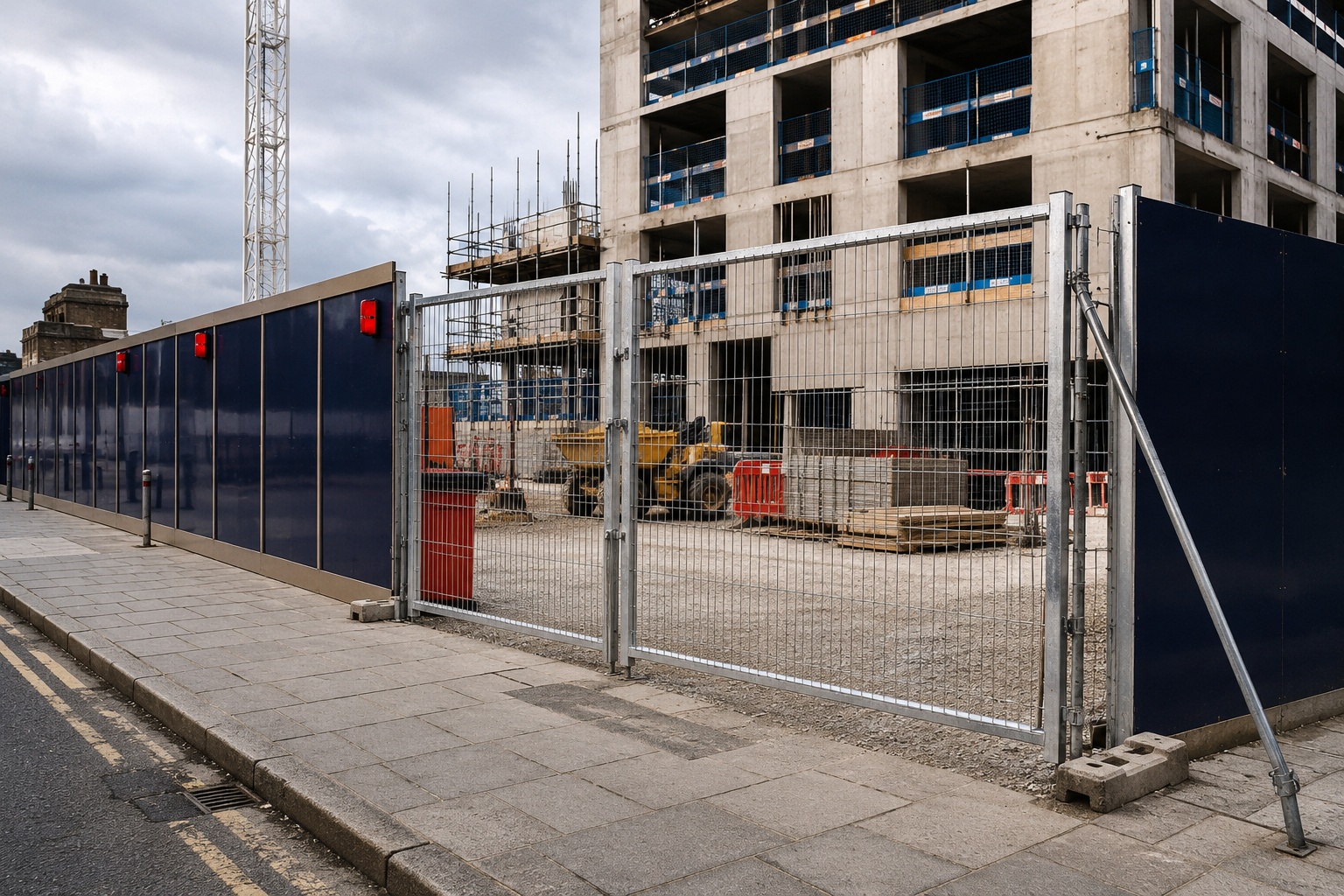
Construction-site boundaries tend to attract attention when they fail visibly: a damaged panel, an open gate, a section of hoarding brought down by wind. The harder question is whether a perimeter that looks intact is actually suitable for the risks around it.
That question came back into focus in June 2026, when the Health and Safety Executive urged construction companies to strengthen site security ahead of the school holidays. Its warning centred particularly on children gaining access to sites, but the underlying point was broader: perimeter security has to reflect the nature of the site and its surroundings, be kept in good order, and be reviewed rather than forgotten once installed.
Anyone who has spent time trying to turn HSE guidance into a practical site decision will know that this can be less straightforward than it sounds. The guidance is deliberately risk-based, which is sensible, but it also means there is rarely a neat answer along the lines of “use this fence, at this height, with this amount of ballast, and inspect it every Tuesday”.
Instead, contractors are expected to make a competent judgement about what is appropriate. That puts more emphasis on understanding the actual perimeter risk rather than simply proving that a fence exists.
The same fence can be appropriate on one site and inadequate on another
HSE’s current guidance on protecting the public is reasonably clear on one important principle: the form of the boundary should reflect both the site and its surroundings. It specifically points to factors such as population density, who needs access, whether the site is likely to attract children, existing boundaries and proximity to other buildings.
That creates some obvious differences between sites.
A development in the middle of an established housing estate has a very different public interface from a project buried inside a controlled industrial compound. A site beside a school or public footpath may have people passing within metres of the boundary throughout the day. Another may have little pedestrian exposure but regular HGV movements through its main entrance.
The scale or value of the project is not necessarily the best indicator of perimeter risk.
There is also a tendency to think about site security almost entirely in terms of people getting in. In reality, the boundary has to be considered in the other direction as well.
Vehicles entering and leaving, materials stored too close to the perimeter, excavations near accessible areas and work taking place alongside public routes can all create risk without anybody deliberately trespassing.
The perimeter is therefore not simply an anti-intrusion measure. It is part of the interface between an active construction site and everyone who is not supposed to be on it.
Mesh fencing or hoarding? There is no universal answer
This is one of those areas where people understandably look to official guidance for a simple specification and instead find phrases such as “suitable”, “where necessary” and “reflect the nature of the site”.
That is not especially helpful when somebody actually has to order the fencing, but there is a reason for it.
Temporary mesh fencing has clear advantages. It is relatively quick to deploy, it can be repositioned as the project changes and it maintains visibility through the boundary. Those are useful characteristics on many construction sites.
Solid hoarding provides considerably more screening and physical separation. That may make it preferable on some highly public-facing sites, sensitive developments or locations where privacy and visual screening are important.
Neither, however, is automatically the safer option in every situation.
A properly installed mesh perimeter may be entirely appropriate for one project. Poorly supported hoarding on an exposed boundary may create another problem altogether.
It also makes little sense to consider the panel independently of everything holding it up and allowing people through it. Suppliers such as Wade Building Supplies stock temporary fencing systems covering mesh panels, gates, hoarding, ballast and stabilising equipment. The product range itself illustrates a fairly obvious point that can sometimes disappear during procurement: the panel is only one component of the perimeter.
Gates deserve more attention than they usually get
A continuous fence line is relatively easy to understand. Gates are where things become operational.
A vehicle entrance may be perfectly secure overnight and effectively disappear as a boundary for several minutes every time a delivery arrives. A pedestrian gate may be opened dozens of times during a shift. What began as an occasional access point can become the main entrance after the site layout changes.
This is where a perimeter that looks perfectly respectable on a drawing can start to behave rather differently in practice.
There are the obvious issues: locking arrangements, access control and whether pedestrians and vehicles are being mixed unnecessarily.
Then there are the less dramatic weaknesses. A gap underneath a gate caused by uneven ground. A panel that no longer meets the gate properly after being moved. Materials or equipment placed nearby that make climbing considerably easier. A delivery procedure that relies on somebody remembering to close the gate afterwards.
None of these requires an elaborate security failure. They are ordinary construction-site problems created by ordinary construction-site activity.
That is precisely why gates and access points should be treated as active parts of the site-management process, rather than holes in the fence that were dealt with at the planning stage.
A secure fence also has to stay standing
Stability can sometimes be treated as an installation problem separate from security. In practice, the two are inseparable.
Ground conditions, exposure and the configuration of the fence all affect how a perimeter behaves. A run installed on level hardstanding presents different considerations from fencing on soft or uneven ground. An exposed boundary can behave very differently from the same system positioned between buildings.
Modifications matter as well.
A particularly easy mistake is to add screening, banners or other material to mesh fencing without considering what that does to wind loading. Something that was largely open to the wind can suddenly behave much more like a sail.
The appropriate response might involve bracing, ballast, different fixing arrangements or a different system altogether. There is no sensible universal quantity that can be quoted without knowing the system, location and conditions.
This is another area where the risk-based wording in official guidance can feel frustratingly non-prescriptive, but pretending there is a simple formula would be worse. Where stability is not obvious, the answer should be based on the manufacturer’s requirements and the site’s temporary-works arrangements rather than rule-of-thumb improvisation.
Sites change. Perimeters often do not keep up.
The fence installed during mobilisation may be completely suitable.
Three months later, the site around it may be almost unrecognisable.
A section has been moved for deliveries. A brace has disappeared because somebody needed it elsewhere. Materials are now stacked against a previously clear boundary. The excavation has advanced towards the fence. A new subcontractor is using a different gate. One panel has been clipped by plant and is being held approximately in position until someone gets around to replacing it.
Individually, these can look like minor defects.
Collectively, they can create a perimeter very different from the one that was originally assessed.
The risk behind it can change as well. A section of fencing that originally separated the public from open ground might later sit immediately beside a deep excavation or stored materials. Even if the fencing itself has not deteriorated, the consequences of someone getting through it have increased considerably.
That is why perimeter security is better understood as something that is managed through the project rather than something installed at the beginning of it.
Inspection frequency is not really the important question
It would be convenient if there were a universally applicable answer to “how often should temporary fencing be inspected?”
There isn’t.
HSE’s June warning says security should be checked and reviewed regularly and fencing or hoarding kept in good order. That leaves contractors to determine what “regularly” needs to mean for their site.
A routine inspection regime is clearly sensible, but the more important trigger is often change.
A perimeter deserves another look after significant weather, after vehicle impact, following evidence of trespass or tampering, after the fence line has been altered, when access arrangements change, or when new hazards appear close to the boundary.
There is also a difference between daytime and out-of-hours risk.
During working hours, an open vehicle gate might be actively controlled by site staff. At 6pm the same opening is simply an unsecured entrance. Plant that is supervised all day may need immobilising when everybody leaves. Excavations, ladders and stored materials still exist when the site team goes home.
This is where the idea of security in layers becomes useful.
The perimeter should discourage and prevent access, but site management should not assume that nobody will ever get through it. Hazards behind the boundary still need to be controlled on that basis.
The useful question is not “have we fenced it?”
For all the complexity of the guidance, the underlying principle is fairly practical.
A construction-site perimeter has to suit the site that actually exists, not the site shown on an early logistics plan.
That means considering the public around it, the hazards behind it, how people and vehicles pass through it, whether it remains stable and whether changes to the project have created weaknesses that were not there originally.
A row of fencing panels can establish a boundary. Keeping that boundary secure, stable and appropriate as the site changes is the part that requires active management.
For site managers, the practical test is simple: can members of the public still be kept safely away from the hazards the site presents, under the conditions that exist now?

