


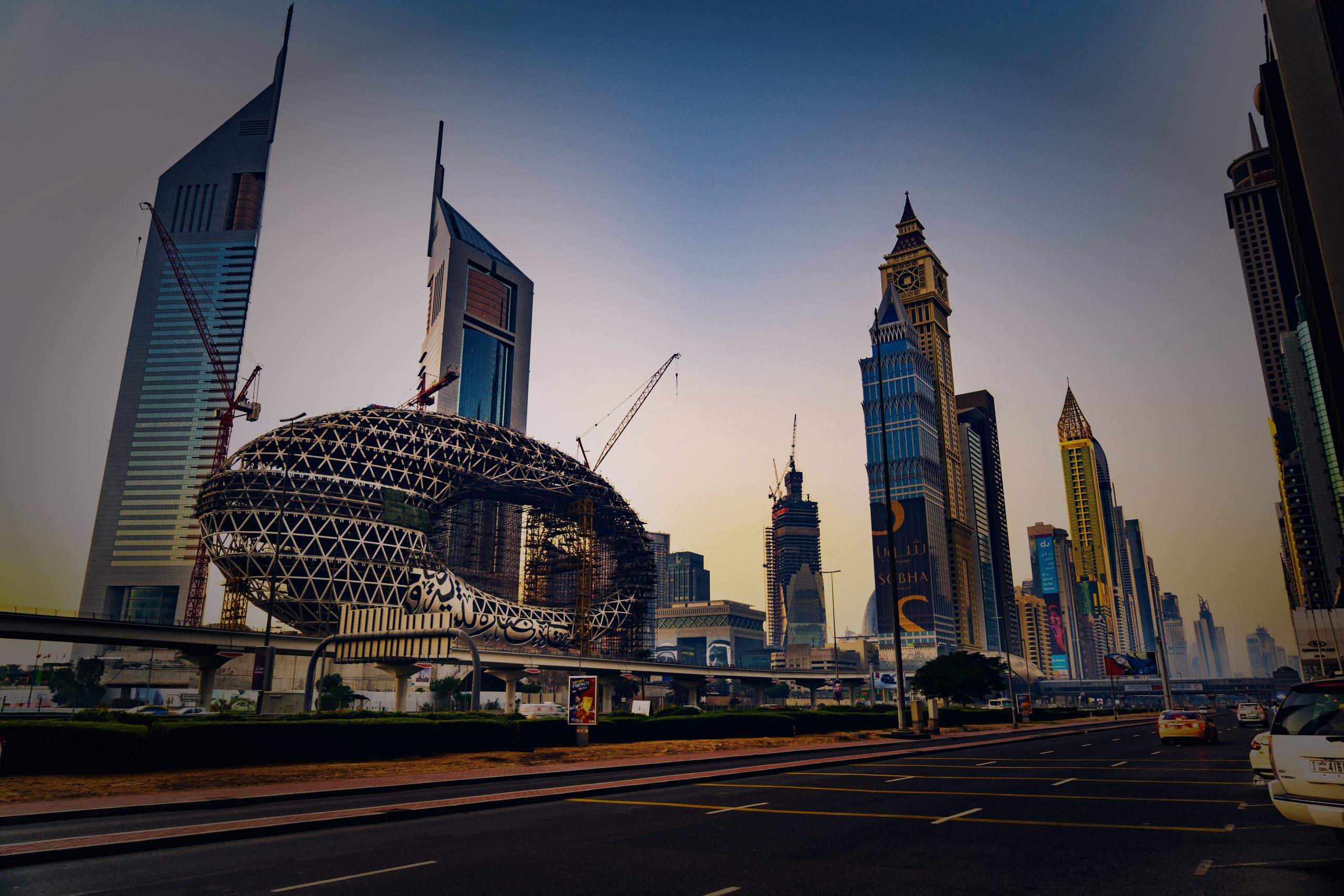
Energy shocks and food inflation don’t hit the headlines in spring. They land on doorsteps and dinner tables in autumn. The investors who understand this lag are already repositioning — and they’re moving toward Dubai.
Markets react to geopolitical conflict in real time. Economies react in seasons. This distinction — the gap between what a crisis does to a news ticker and what it does to an energy bill or a supermarket receipt — is the most consequential piece of macroeconomic intelligence facing any British property investor right now.
The ongoing Middle East conflict is not, as many UK investors are still categorising it, a regional event with regional consequences. Its economic transmission is structural, lagged, and aimed with uncomfortable precision at the vulnerabilities that the British and European economies have been managing since 2022. Autumn 2026 will arrive with a very different set of pressures than households and investors are currently pricing in.
The numbers that are already in the pipeline
In March 2026, the European Central Bank published its most authoritative assessment of the damage so far. The projections are sobering — not least because they represent conservative, institutional estimates rather than market speculation.
| 3.1% ECB projected eurozone inflation, Q2 2026 Driven by Middle East energy shock | 0.9% ECB revised eurozone GDP growth 2026 Down from pre-conflict 1.2% baseline | 5–10% Forecast EU food inflation in 2027 Rabo Research, March 2026 |
The energy exposure is structural. The Gulf region provides an estimated 60% of Europe’s jet fuel and 20% of its diesel. Natural gas prices surged 50–75% in the early weeks of conflict. The Conference Board estimates that oil sustained above $100 per barrel throughout 2026 could shave a further 0.1 to 0.3 percentage points from eurozone growth — on top of an already anaemic baseline. For the UK, with sterling facing its own pressures and import costs rising, the arithmetic is equally uncomfortable.
The fertiliser lag — autumn is when it arrives
One transmission mechanism that receives surprisingly little attention in the financial press is the fertiliser channel. The GCC and broader Middle East account for roughly 30% of global fertiliser supply — ammonia and urea — and as regional dynamics constrain export volumes, global fertiliser prices are projected to average 15–20% higher in the first half of 2026.
Key timing insight: As Rabobank’s senior agricultural analyst observed, “European fertiliser users will only feel the pain from the autumn, since they are already supplied for current needs.” From farm input cost to supermarket shelf, the transmission lag runs approximately four to six months. What British farmers are absorbing today in raw material costs becomes consumer food prices by October.
The FAO Food Price Index has already risen for two consecutive months, averaging 128.5 points in March 2026 — up 2.4% from February. Consumer food prices in Europe are already 33% above 2021 levels. The second inflationary cycle in three years is now beginning, and British households enter it with substantially depleted savings buffers and real wages only recently recovered from the last one.
A historical pattern, recently instructive
This dynamic has played out before, and recently enough to be directly relevant. Following Russia’s invasion of Ukraine in early 2022, Dubai recorded one of its strongest-ever inflows of high-net-worth residents and international capital. Russian, Ukrainian, and broader Central and Eastern European wealth rotated rapidly into Dubai property as a store of value, a tax-efficient alternative domicile, and a jurisdiction offering political stability. Transaction volumes surged. Prices across premium segments rose 30–40% over the following 18 months.
The 2026 dynamics carry a different origin but a structurally similar logic. Western European professionals, business owners, and property investors facing compressing real incomes, a higher taxation environment, and the psychological weight of proximity to regional instability are not yet moving in significant numbers. They are watching. But the economic pressures building now — energy costs landing on invoices, food inflation arriving at supermarkets, asset values under renewed pressure in several major European housing markets — will convert observers into movers. History suggests this transition typically occurs not during the shock itself, but three to six months after it is fully felt in everyday life.
That timeline points directly to autumn 2026.
Why Dubai absorbs this wave better than anywhere else
The structural appeal for a British investor or relocator in late 2026 is not the sunshine or the skyline — it is the arithmetic. No income tax. No capital gains tax. A dirham pegged to the US dollar, offering currency stability that sterling, under its current pressures, cannot match. A UAE economy projected by the IMF to grow at 5.0% while the UK and eurozone manage a fraction of that. A government that deployed a billion-dirham support package within two weeks of a tourism shock — demonstrating the fiscal agility of a state with the means and the will to act.
On the ground, Dubai’s property market is reflecting forward demand with unusual clarity. Q1 2026 delivered 29,312 new investors into the market — up 14% year-on-year, the largest incoming buyer cohort in the emirate’s recorded history. New off-plan launches are being repriced 10–20% higher for autumn and winter delivery. Supply is tightening precisely as demand is set to accelerate.
The asymmetry that matters: The autumn migration wave is probabilistic — based on well-documented historical precedent and compounding macroeconomic pressures. What is not probabilistic is that Dubai property available today will be cheaper in six months. That asymmetry — an uncertain upside catalyst alongside a near-certain upward price trajectory — is precisely the environment in which the best risk-adjusted allocations are made.
What this means for British property investors
The investor who acts now is acquiring at the floor of pricing. The investor who waits for the migration wave to make the mainstream financial press will be acquiring at its peak. This is not a novel dynamic — it is simply the mechanics of an emerging demand surge meeting a lean, credibly regulated supply pipeline.
For British investors with existing property portfolios, the question worth asking is not whether Dubai warrants attention. It is whether waiting until the headlines make it obvious is a strategy that has historically served well.