


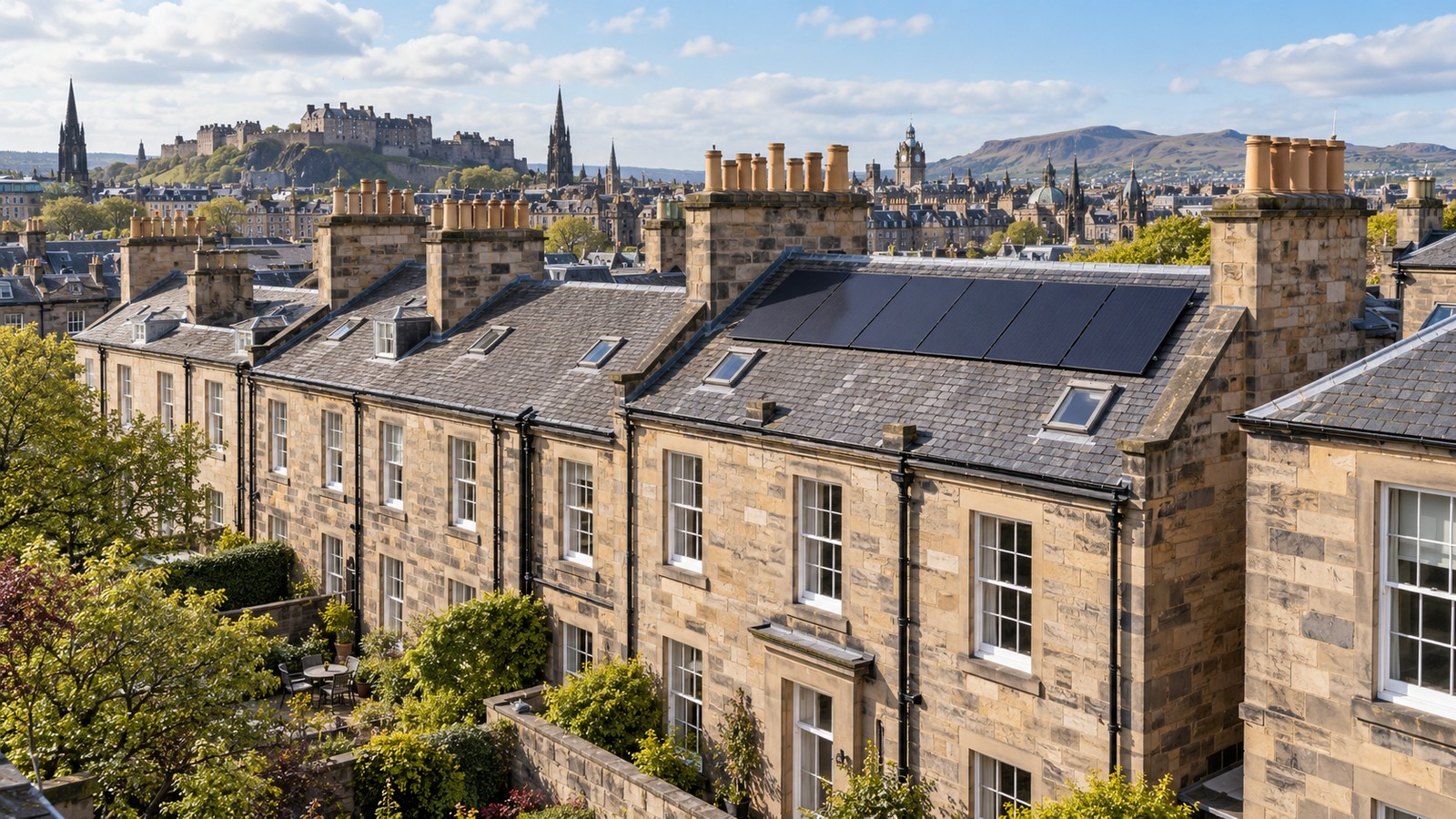
Edinburgh’s built environment is, by any measure, exceptional. But that same heritage creates genuine complications for homeowners who want to install solar panels. Thousands of properties across the city sit within conservation areas or carry listed status, and the rules that govern what you can and can’t do to them are meaningfully different from what applies elsewhere.
This isn’t a reason to give up on the idea. It is a reason to understand the picture before you commit to anything.
Why listed buildings complicate solar
In most parts of the UK, homeowners can install rooftop solar panels under permitted development rights without a planning application. Other approvals or restrictions may still apply depending on the property, but for many homes the process is relatively straightforward.
For listed buildings, it’s more complicated. Solar panels don’t benefit from permitted development rights on a listed building. That means you’ll need planning permission from the City of Edinburgh Council, and separately, listed building consent, which covers any works that could affect the character of the listed structure. These are two distinct requirements, and both need to be satisfied.
The city’s conservation area designations add another layer. A significant proportion of Edinburgh’s residential stock sits within a conservation area, and in those areas the planning rules are tighter than the standard national baseline. The Old Town and New Town together form part of a UNESCO World Heritage Site, which brings additional weight to how changes are assessed. Properties don’t need to be individually listed to face planning restrictions. The area they sit in can be enough.
For homeowners thinking about solar, a good first step is speaking to an installer familiar with heritage properties in the city, since the wrong advice at the outset can cost you time, money, or a refused application.
When battery storage changes the picture
For homeowners where rooftop installation isn’t viable, whether due to planning restrictions, roof condition, or building configuration, battery storage is worth understanding separately.
A home battery system can store electricity purchased from the grid during lower-tariff periods for use at higher-tariff times. Whether that translates into meaningful bill savings depends on your tariff structure, usage patterns, and system losses, so it isn’t a straightforward substitute for rooftop generation. It won’t replicate the economics of panels, and it still depends on the grid.
That said, for some homeowners it’s a useful option to model. A battery unit sited inside the home avoids most of the structural and roof-related questions that come with a rooftop installation, though alterations to the interior of a listed or protected building still need careful consideration before assuming it’s unconstrained.
The options around battery storage for Edinburgh homes are worth understanding properly, particularly for homeowners who have already looked at panels and hit planning or structural obstacles.
What permitted development actually covers
It’s worth being clear about what permitted development rights do allow, because the picture isn’t uniformly restrictive.
In Scotland, solar panels on a dwelling may be permitted development provided the installation is on a rear elevation or a side elevation that does not front a road, and panels do not protrude more than one metre beyond the roof plane. The system must also be removed when it’s no longer needed.
Where properties are unlisted and outside a conservation area, these conditions give homeowners in parts of East Edinburgh, West Edinburgh, and the city’s outer neighbourhoods a more straightforward route.
The key move is establishing exactly which category your property falls into before spending time or money on anything else. Your local authority can confirm conservation area boundaries, and the listed building register is publicly searchable via Historic Environment Scotland.
Roof and structural questions first
Whether or not a property faces planning restrictions, the roof itself is the starting point for any honest assessment.
Solar panels add weight and wind loading to a structure. On a modern house with a concrete or clay tile roof in reasonable condition, that’s rarely a problem. On a Victorian or Georgian tenement with ageing slate, shared roof structures, or complex chimney configurations, it needs proper evaluation.
Slate roofs can be worked with, but the installation method matters, and any fixings need to be appropriate for the material. A poorly fitted system can cause water ingress that is expensive and disruptive to fix. The property’s electrical installation needs assessing too. Older homes may need a consumer unit upgrade before a solar system can be commissioned safely.
None of this rules out older Edinburgh properties. Many support solar installations. It means the assessment phase matters, and it should involve someone who knows what they’re looking at.
Before you apply or commission anything
A few things are worth establishing before any installer visits or council communication happens.
First, check your property’s status. Is it listed, and if so, under which category: A, B, or C? Is it within a conservation area? These are publicly verifiable facts, and knowing them tells you which rules apply.
Second, if listed building consent is required, factor in the timeline. Applications take time. A decision isn’t guaranteed. And the design of your system may need to be adapted to meet what the council will approve.
Finally, if a rooftop installation turns out not to be viable, that isn’t the end of the conversation about energy costs. It’s the beginning of a different one.
Edinburgh’s housing stock is genuinely unusual. So are the rules that govern it. Homeowners who take the time to understand both are in a much better position, whatever they decide.
For a broader overview of costs and installation considerations, read PAD Magazine’s guide to home solar panel installation in the UK.

