


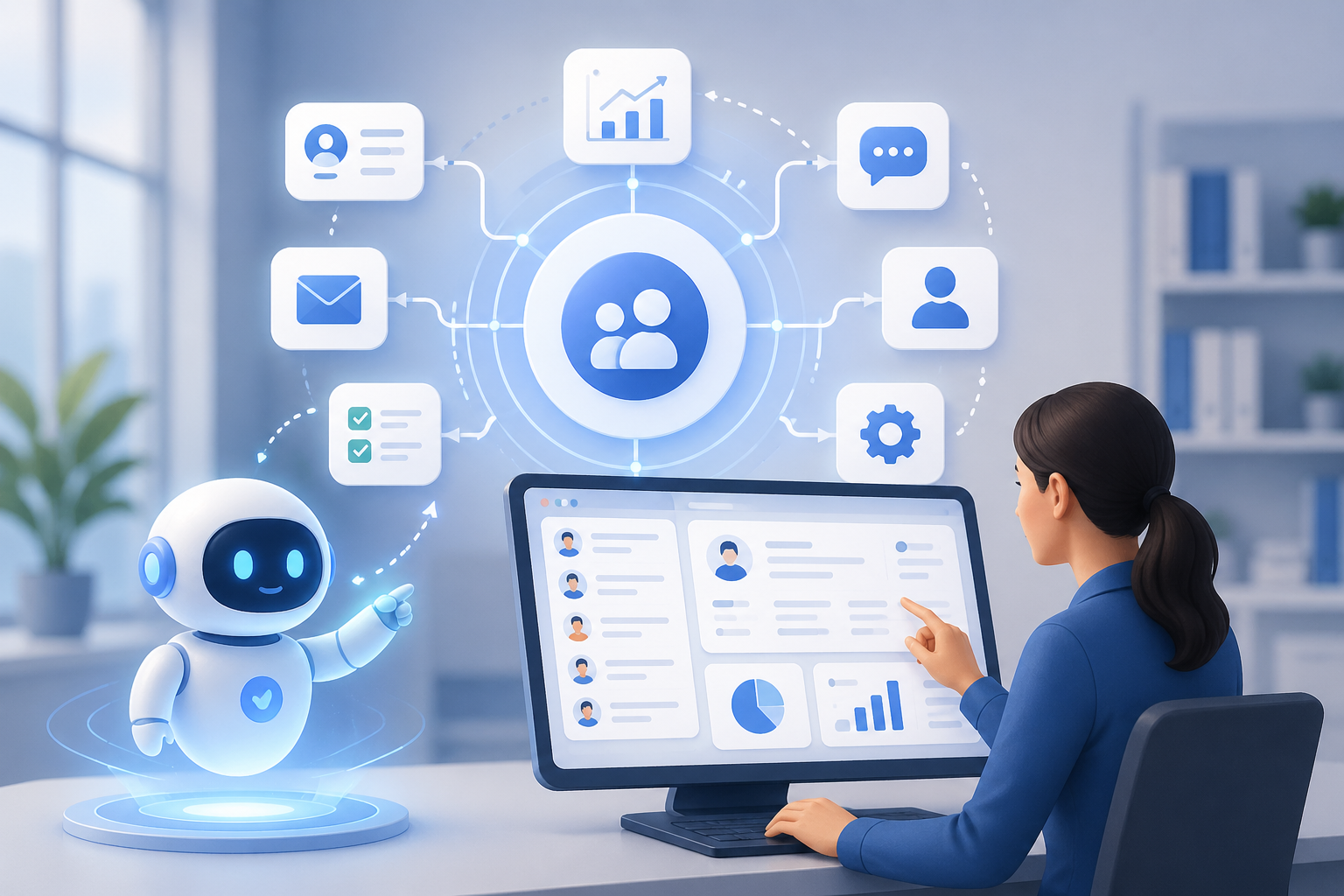
AI agents for business automation are redefining efficiency. Learn how its integration into CRM ecosystems can automate workflows without losing human control.
AI agents for business automation are unlike any other tool available to the sales team today. Where standard automation stops at executing a fixed script, these intelligent systems go further; they can make informed decisions, read context, and act independently before a problem surfaces.
The bottlenecks that once defined manual workflows, piling tasks, neglected leads, and missed follow-ups, no longer have to define yours.
Defining AI Agents for Business Automation
Many businesses use automation tools, but the features they offer remain basic; they have limited responses and pre-defined conversation rules. AI agents for business automation mark a turning point toward systems that can understand their environment and respond to customers’ preferences.
The distinction lies in the execution:
- Rule-based automation is designed for repetitive tasks and sending pre-determined messages based on specific triggers.
- AI agents are capable of logical reasoning and natural conversation, allowing them to adapt to the context of customer interactions.
These systems function as advanced assistants that can manage, plan, and apply workflows aligned with specific business objectives.
Core technologies behind autonomous agents
What makes AI agents for business automation more capable than standard automation comes down to three technical tools:
The first is reasoning. Agents use Chain-of-Thought (CoT) and Small Language Models (SLMs) processing to break down a goal into steps, evaluate options, and decide on an action independently. A sales agent, for example, can assess where a lead sits in the funnel and determine the right follow-ups without being explicitly programmed for that exact situation.
The second is contextual memory. Through retrieval-Augmented Generation (RAG) and vector databases, agents retain context across interaction. This matters because most sales conversations don’t happen in a single session. An agent that remembers a prospect asked about enterprise pricing, performs closer to a trained rep than a chatbot.
The third is governance. Agents operate within boundaries set by the companies: what they can say, what data they can access, and who they can contact. Deploying an agent that goes off-script on compliance can damage a relationship that no automation can save. Guardrail systems exist to prevent that.
Together, these three capabilities are what make the investment case credible.
Strategic Investment: Scalability and Cost Reduction
Investment in this technology is expected to increase by 2026 as businesses strive to overcome scalability issues. Shifting from manual to automation enables companies to simplify processes without additional human intervention.
One 2025 dataset put marketing cost savings at 37% for businesses using AI agents. For SMEs, this matters more than it might for larger companies: margins are tighter, and hiring additional staff to handle volume is rarely an option.
Moreover, the underlying shift is structural. Moving from manual to automated workflows doesn’t just reduce costs; it removes the ceiling on how many leads, customers, or campaigns a small team can manage simultaneously. For SMEs competing against larger players with bigger budgets, it’s more about staying in the game.
Integrating AI Agents into CRM Ecosystems
A CRM system is no longer merely a database but a management system for personalised actions. A tool like Kommo AI applies AI agents for business automation. It’s picking up key customer information and using it to trigger relevant engagement without manual input.
For small businesses, an AI-powered CRM makes each stage of the sales process visible and actionable. It can also integrate with tools, such as HubSpot, for content management or lead nurturing, creating a workflow that scales without requiring additional infrastructure.
Finding the right balance between human and machine in CRM
AI agents work best when the scope of their authority is clearly defined. A tiered approach helps businesses draw that line.
- Level 1 – Fully autonomous mode: AI performs simple, high-volume administrative tasks such as data entry, appointment booking, and status updates.
- Level 2 – Semi-autonomous mode: AI agent generates the response, reports, or proposes the next action. A staff member quickly reviews and gives final approval before anything goes out.
- Level 3 – Human-led: High-stakes negotiations, complex complaints, and long-term strategic decisions remain exclusively in staff members. AI may surface relevant data, but judgment and empathy are irreplaceable.
This approach ensures AI deals with volume efficiently while humans retain authority over outcomes that carry real consequences.
Addressing Implementation Challenges
Despite the advantages, businesses should be cautious about treating AI as a perfect solution. A study of 200 employees, cited by Harvard Business Review, found that an AI agent doesn’t necessarily replace manual work but rather alters it, sometimes increasing the workload. The tools are not the determining factor; It is the business strategy and change management around it.
Data integrity and system sync
The success of an AI system is dependent on the quality of the data source. If the system is not in sync, the data is divided. If the data is not good, the agent’s actions will not succeed. It is important to ensure that when looking for a program, it is accurate, consistent, and trustworthy, not just large storage capability.
Balancing automation and human intuition
Over-automation risks customer trust; if messages feel too templated, engagement could drop. A straight-to-the-point approach to automation involves a balance: AI handles repetitive, basic tasks, while human staff handles complex situations that require judgment and emotional intelligence.
The Future Outlook of AI Agents
The next development of AI agents for business automation is Multi-Agent Systems (MAS). In this case, multiple specialized agents work in coordination to perform an end-to-end process. This reduces bottlenecks, maintains context across the sales workflow, and operates as fast as a machine.
Additionally, Zero-UI interactions are the future for customer interactions. Conversations increasingly happen through voice assistants and messaging platforms like WhatsApp, where customers expect immediate, natural responses.
In this model, the AI agent becomes the invisible interface, handling inquiries, updating records, and routing requests internally. These shifts signal a future where the CRM is not a tool people log into, but a system that operates continuously in the background.
Final Thought
AI agents are not a shortcut; they are a structural upgrade. For companies looking to scale, the question is no longer whether to integrate AI into CRM workflows, but where to start and how to maintain control as the system grows.
The businesses that will benefit most are not those with the largest budgets, but those willing to map their processes clearly, identify where automation creates genuine value, and keep humans accountable for decisions that matter. That discipline, more than any tool or platform, is what separates effective AI adoption from expensive experiments.