


When specifying recessed downlights for commercial refurbishments, the lighting conversation often starts with wattage and colour temperature, and ends with a luminaire schedule. Occupants notice something else first: whether they can work at a screen, browse a display or sit in a lobby without becoming aware of the ceiling. Discomfort glare is often the reason.
The Society of Light and Lighting’s factfile on glare and Unified Glare Rating (UGR) describes glare as bright areas in the field of view that make a visual task harder, and notes that excessive glare can lead to errors, accidents and fatigue. A low UGR figure on a datasheet is a useful starting point, but it is not the same as a comfortable room. Geometry, finishes and viewing direction all change the result.
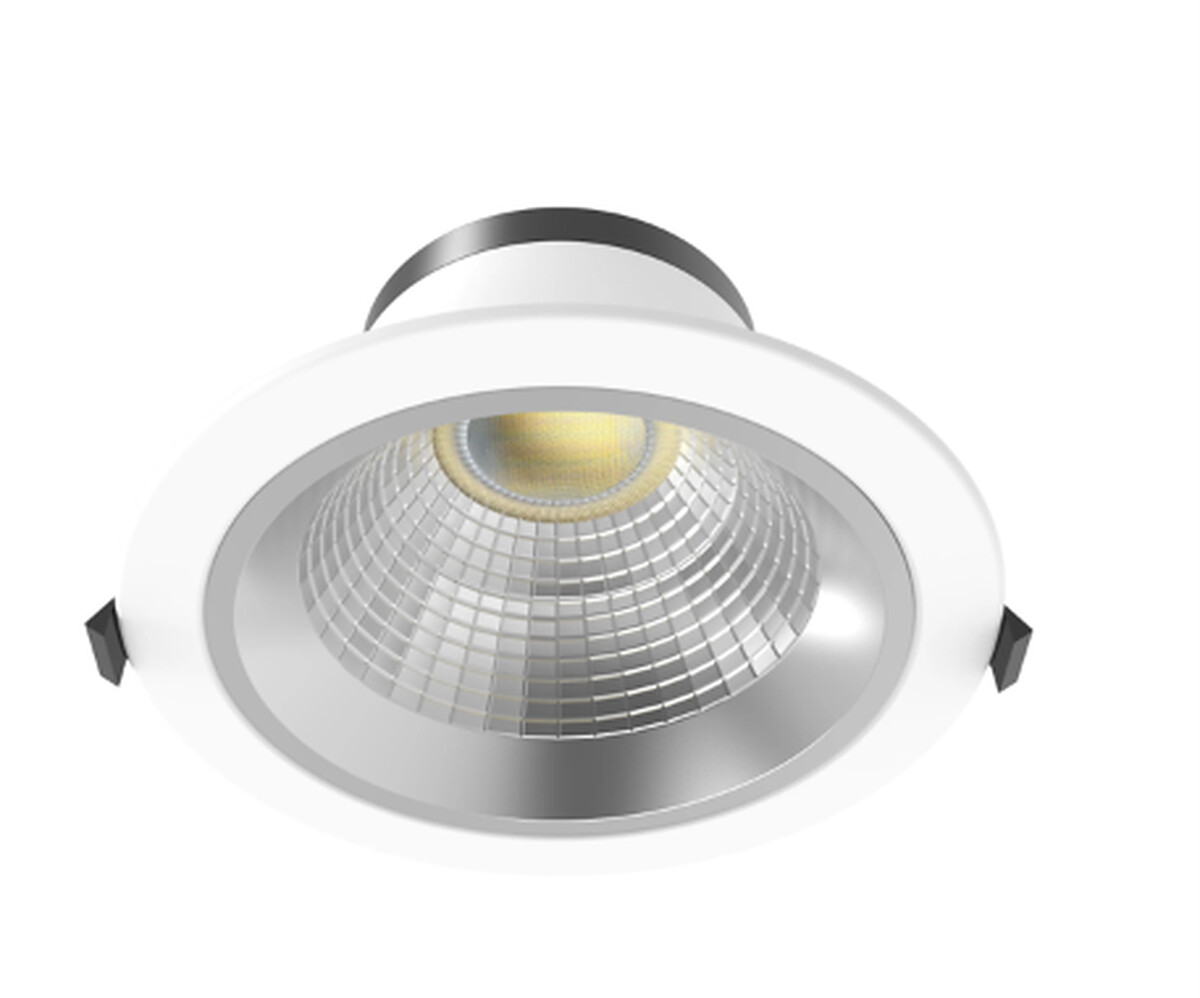
On a refurbishment, a single optical family that covers many existing ceiling openings is more useful than a one-size fitting. The DL46 range of anti-glare commercial downlights illustrates the idea: the same construction — a PC lens and an aluminium reflector, specified at UGR <19 — is offered in seven diameters, from a compact 85 mm body to a 279 mm fitting for larger architectural openings.
The DL46 series uses a PC lens and an aluminium reflector, with UGR <19 listed in the product data. Recessing the source inside the reflector keeps the bright surface out of everyday sightlines. AI recreation based on an A-ONE LED reference.
Choosing recessed downlights for commercial refurbishments
Most refurbishments inherit a pattern of holes. Before shortlisting recessed downlights for commercial refurbishments, measure the existing openings and check the available space above the ceiling. In this family the cut-outs run from 68–75 mm on the compact DL46-85, through 82–100 mm, 118–130 mm, 133–160 mm and 153–180 mm, up to 180–210 mm on the lobby-scale DL46-230 and 225–260 mm on the DL46-279. A 125 mm opening sits inside the 118–130 mm range of the office-oriented DL46-150. Each size also publishes a body height, a minimum complete installation space, and a ceiling-thickness limit of up to 40 mm.
Where insulation is present, confirm that the luminaire is rated as insulation-coverable and follow the installation instructions for coverage and driver placement. Coverability is not a fire-resistance rating, and the DL46 pages state that the fittings are not fire rated; any ceiling that forms part of the fire strategy needs a separate check. Ingress protection needs the same care. The series is specified as IP54 below the ceiling and IP20 above it. The exposed face offers splash protection; the upper side, and the external driver, do not.
Match beam, output and the visual task
Beam angle and wattage should follow the use of the room, not the next size in the catalogue. The compact DL46-85 is listed at 5W/7W with a 45° beam, for guest rooms and entrance areas. DL46-113 widens the beam to 50° and offers 6W/8W/10W/12W, a combination suggested for reception desks and café seating. For meeting rooms and smaller offices, DL46-150 keeps those four wattages but uses a 60° beam and a 118–130 mm cut-out.
For office refurbishments, PAD Magazine’s office renovation design guide covers how lighting controls fit alongside workspace layouts and other fit-out decisions.
Shared workspaces and training rooms are different, because people look across the room as well as down at a desk or a screen. The mid-size DL46-182 combines a 65° beam with selectable 12W/14W/16W/18W output and a 133–160 mm cut-out. The same beam and wattages appear on the larger DL46-205, aimed at retail and showroom schemes, with a 153–180 mm cut-out.
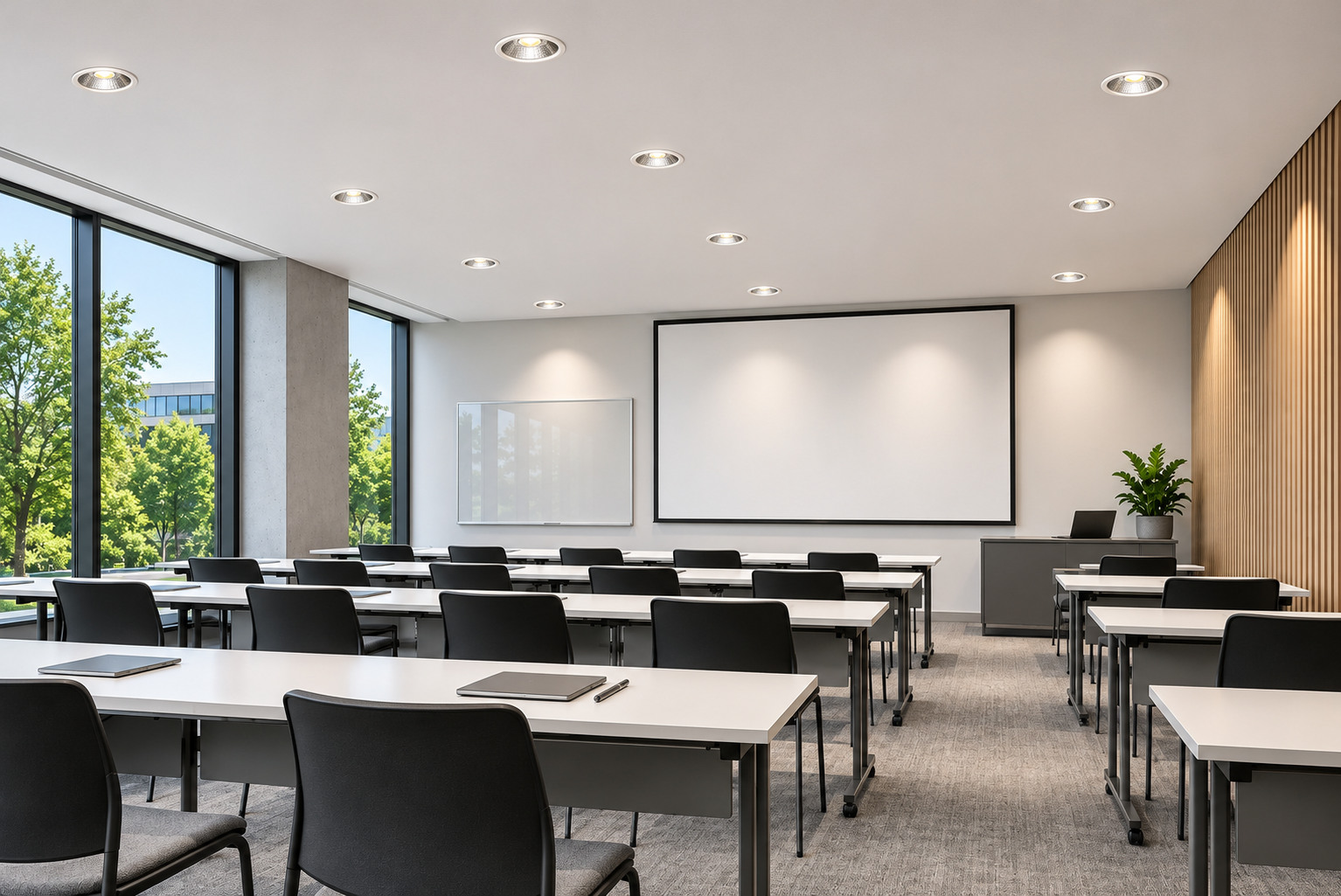
A training-room layout is one of the applications suggested for the mid-size DL46-182, whose 65° beam and 12W/14W/16W/18W settings are intended for spaces where people look across the room as well as down at a desk or a screen. AI recreation based on an A-ONE LED reference.
Lobbies and public foyers usually need a wider distribution and more output. DL46-230 is specified with a 70° beam and two alternative four-setting ranges, 15W/20W/25W/30W or 20W/25W/30W/35W; one of those two configurations must be selected when ordering. DL46-279 uses the same two power ranges with a 75° beam and a 225–260 mm cut-out. Spacing should come from the photometric file, the mounting height and the required illuminance, not from beam angle alone.
Settle colour quality and control before ordering
Colour temperature is offered as a 4CCT selection of 2700K, 3000K, 4000K and 5700K, with a single-CCT option and a custom range available on request. The four-setting switch is a commissioning convenience, not automatic tunable-white control. If a lobby or workspace is intended to change colour temperature through the day, that needs a separately agreed arrangement.
Colour rendering is a genuine project choice. The standard configuration is CRI 80 at 130 lm/W; the optional CRI 90 version is listed at 120 lm/W. The two figures should not be combined on the same line of a specification. Standard dimming is TRIAC, described as trailing- and leading-edge, or phase-cut, dimming. Confirm the driver, the wall dimmer and the connected load, especially at the low end, before approving a room-wide installation. The fittings use an external isolated TRIAC driver with six-position terminals; allow for that driver in the ceiling void, and for later access. Finishes are listed in white and black, and the input voltage is AC200–240V.
Write the checks into the package
Before finalising the schedule for recessed downlights for commercial refurbishments, ask for the drawing and photometric data for the exact wattage, colour temperature and CRI version being ordered. Assess the planned positions against screens, seating sightlines and display runs. A product specified at UGR <19 can still disappoint in a dark-finished room, or where fittings sit in the main direction of view.
A-ONE LED, established in 2008 and supplying Europe since 2010, manufactures from a 6,000 m² factory in Dongguan and offers OEM and ODM support. A five-year warranty applies to all products, including drivers. The more useful habit comes earlier: measure the ceiling you have, choose the optic for the task, and test the layout on paper before the tiles go back.
About the author
Luke Huang is General Manager of A-ONE LED Lighting Co., Ltd., a manufacturer of recessed downlights and spotlights established in 2008 and supplying Europe since 2010. He works with property, fit-out and OEM partners on the specification of commercial lighting, including anti-glare downlight families such as the DL46 series. Product data is published at www.aoneled.com.

