


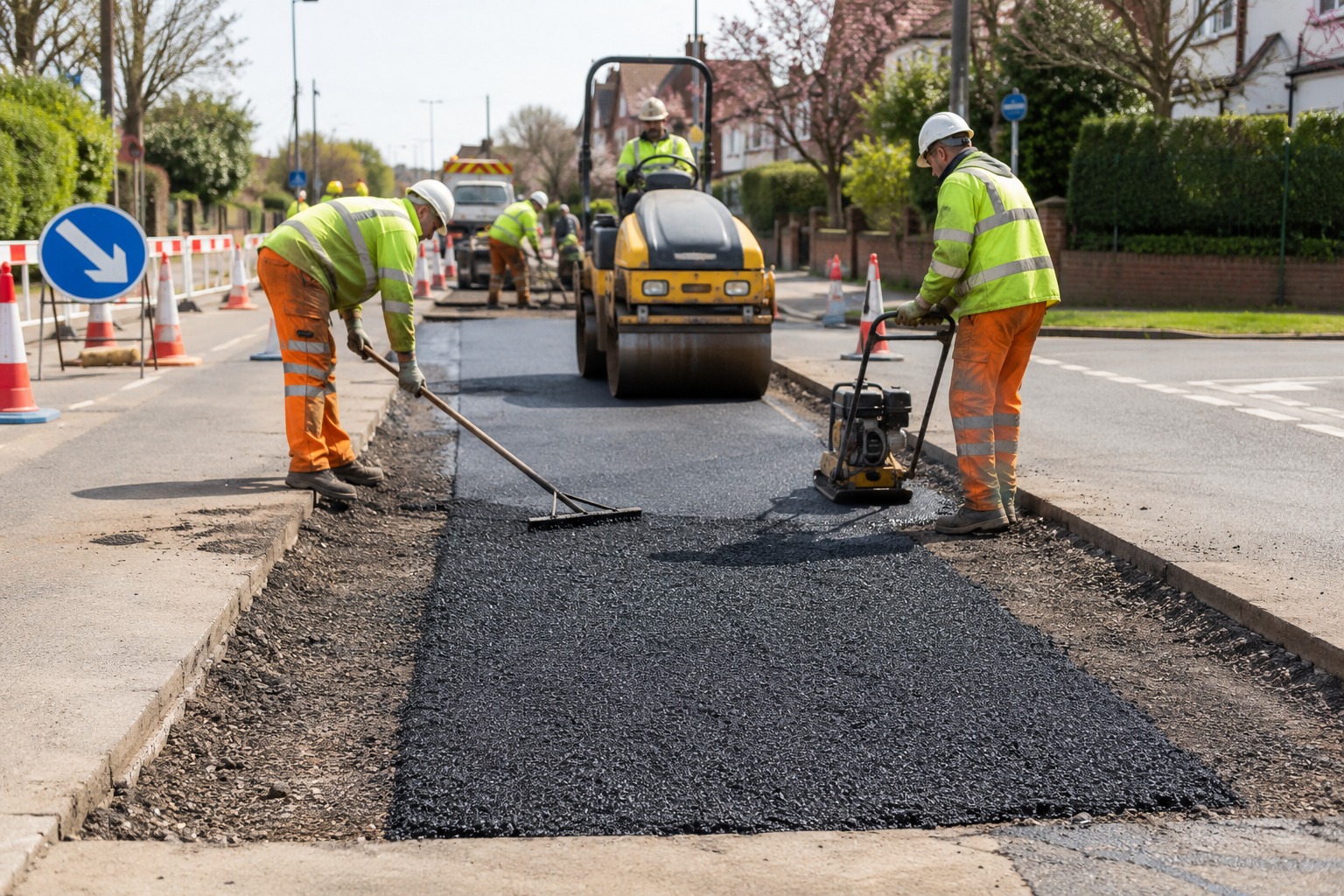
Reinstatement is the stage of a utility installation where the trench is backfilled, rebuilt in layers and resurfaced to the highway authority’s specification, and on most development sites it is the stage that decides whether the works get signed off once or three times. Developers tend to budget the dig and the connection carefully, then treat the surface as a tidy-up line at the bottom of the utility contractor’s quote. The programme risk sits the other way round. A water main can be laid, tested and chlorinated in a fortnight, and the same opening can generate defect notices for two years afterwards.
For anyone running a residential or mixed-use scheme where services come in off the public highway, reinstatement is worth understanding as a discipline in its own right, with its own specification, its own inspection regime and its own liability tail.
Reinstatement is a separate discipline from the excavation
The rules for reinstatement are set nationally, not by the site team. Works in the public highway are governed by the New Roads and Street Works Act 1991 and the technical detail lives in the Specification for the Reinstatement of Openings in Highways, published by the Department for Transport as the code of practice for reinstating a road after street works. The specification dictates layer thicknesses, permitted materials, compaction requirements by layer depth, surface tolerances, joint sealing and the treatment of the area surrounding the opening. None of that is negotiable on site, and none of it is judged by eye.
The practical consequence is that reinstatement calls for different plant, different materials and different qualifications from the pipelaying that precedes it. Rollers, plate compactors, planers, tarmac gangs and cold applied reinstatement materials for surface markings and anti-skid are a surfacing capability, not a groundworks one. Plenty of competent excavation crews are genuinely poor at compaction discipline, because compaction is invisible the day it is done and expensive 14 months later.
Geography matters too. A footway opening in a residential estate road, a carriageway opening in a high-amenity conservation area with block paving, and an opening in a road that has been resurfaced within the past 12 months are three different jobs with three different cost bases. The last of those can trigger a resurfacing requirement well beyond the trench line.
What the guarantee period actually commits a developer to
Every permanent reinstatement carries a statutory guarantee. Under the specification’s operational principles, the guarantee period runs for two years from completion of a compliant permanent reinstatement, extended to three years for deep openings where cover over the apparatus exceeds 1.5 metres. HAUC UK’s guidance on the SROH guarantee period makes an important point that catches people out: where the original reinstatement was not compliant, the guarantee clock does not start until compliant remedial work has been finished. A bad first attempt therefore buys a longer liability, not a shorter one.
Inspections are sampled across that whole period. Category A inspections happen while the works are live and look at signing, guarding, materials and compaction. Category B inspections happen within six months of the reinstatement being completed. Category C inspections happen in the three months before the guarantee expires, which means an opening completed in August 2026 can still be failed in the spring of 2029.
The cost of failure is rarely the tarmac. It is the return visit: mobilising a gang and plant again, re-applying for traffic management, closing a road a second time on a street where residents have already been inconvenienced, and paying inspection and defect fees while doing it. On a phased development, a defect notice landing on a completed spine road during handover to the local authority is a programme problem long before it is a money problem.
Developers should also be clear who holds the liability. Where a developer or their contractor works in the highway rather than a statutory undertaker, the works are usually licensed under section 50 of the New Roads and Street Works Act 1991, and the licence holder carries responsibility for the apparatus and the reinstatement. Where a self-lay provider installs a water main that will vest with the water company, the responsibilities are split differently again. Both arrangements are workable. Assuming the wrong one is how a developer discovers in year two that a defect is theirs.
Interim versus permanent, and the six-month window
Interim reinstatement is a legitimate and often sensible stage, not a shortcut. Where the permanent surfacing material cannot be laid immediately, or where a bay needs to settle or a road needs to stay open through a construction phase, a compliant interim reinstatement holds the opening safely. Interim work should normally be made permanent within six months, with a possible extension of up to a further six months by agreement with the highway authority.
The trap for a developer is losing track of interim bays across a long build programme. Openings from an early enabling phase sit under site traffic for a year, the interim surfacing deforms, and the permanent reinstatement then has to deal with a deteriorated base rather than a sound one. Keeping a live register of every opening, its date, its status and its guarantee start is dull and saves real money.
Appointing a contractor for the reinstatement scope
The single biggest lever a developer has over reinstatement risk is deciding, at procurement stage, who owns the surface. Splitting the excavation and connection between one contractor and the surfacing between another creates a seam that defect notices find with impressive reliability, because neither party owns the compaction that caused the failure. Buying the dig, the backfill, the base and the final surface from one accredited contractor removes the argument. Worth checking before appointment: NRSWA-qualified supervisors and operatives on the gang, WIRS accreditation where clean water mains are involved, ISO 9001 and 45001 certification, in-house surfacing plant rather than a subcontracted tarmac gang booked at short notice, and a written record of layer depths, materials and compaction passes for every opening. Contractors who work to water company frameworks tend to have that paperwork as standard, because their client audits it. Hertfordshire-based McFadden Utilities, which has held water company reinstatement and repair work since the 1980s and holds WIRS and WIAPS accreditation alongside its surfacing capability, sets out the scope covered by reinstatement after utility works including backfill, tarmac reinstatement, white works, cold applied reinstatement and anti-skid, which is a useful yardstick for what a single-contractor package should actually include.
Price comparison needs care here. A reinstatement rate that undercuts the market by a third is usually pricing a thinner base course, a shallower excavation of the surrounding surface, or fewer compaction passes. Any of those saves money on day one and spends it in year two.
Sequencing for a first-time sign-off
Good sequencing on a development site follows a consistent order. Agree the reinstatement specification with the highway authority before the first opening, so the base and surface build-ups are known rather than assumed. Confirm whether any affected road sits within a resurfacing embargo period. Book traffic management around the surfacing date, not just the dig date. Complete permanent reinstatement in the same mobilisation where site conditions allow it, because the second mobilisation is the expensive one. Record everything as built, then diary the Category B window and the guarantee expiry.
Reinstatement will never be the interesting part of a utilities package. It is, though, the part that stays on a developer’s file for two or three years after the water is on, and the part a highway authority will remember when the next phase needs a licence.

