


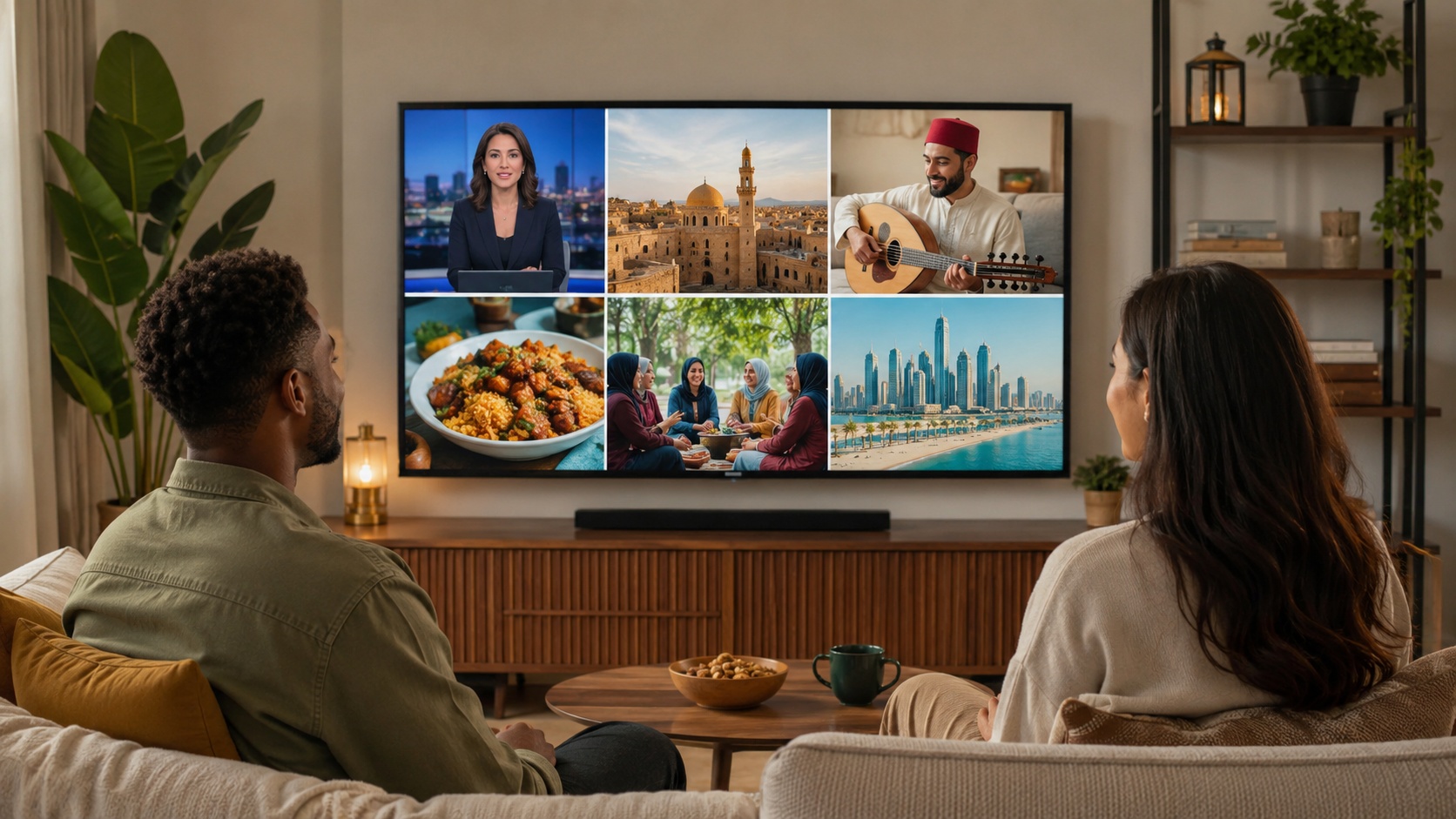
What a Western news viewer learned about Arab culture this week, most likely, came from a conflict zone, a political summit, or a terrorism story. What was actually on Arabic television that same week: a cooking competition where contestants argued about whether cardamom belongs in coffee, a satirical sketch mocking government bureaucracy, three simultaneous Ramadan dramas with competing plotlines, and enough coverage of a celebrity wedding to fill a newspaper supplement.
The gap between those two versions of Arab culture is not a media conspiracy but rather a cognitive bias that has real consequences for how people outside the Arab world form their mental picture of more than 400 million people across 22 countries.
Arabic channels don’t fix that gap on their own, but it makes the stereotype structurally harder to hold. Sustained exposure to TV in your native (or second native) language does something that news coverage and editorial explainers can’t:
What the Schedule Actually Contains
On any given evening, an Arabic-language broadcast schedule might include Egyptian sitcoms shot in Alexandria apartment blocks, Khaleeji reality formats with contestants from six different Gulf states, Lebanese talk shows where the host and two guests spend forty minutes disagreeing about a film, Moroccan sketch comedy, Syrian historical drama, Al Jazeera’s Arabic service covering stories the English channel won’t run, and children’s programming in Modern Standard Arabic designed to be understood from Cairo to Casablanca. That’s not a curated best-of. That’s Tuesday.
The variety alone challenges the premise that Arab culture is a single, describable thing. Egyptian comedies operate on entirely different social assumptions than Khaleeji game shows. Levantine drama handles family conflict differently from Maghrebi drama. This diversity is structural — built into the content, not labeled — and it registers before the viewer consciously processes it.
Why Comedy Gets There Fastest
A viewer who knows nothing about a culture will not start with drama, which requires patience and cultural context to track. Comedy cuts through because humour tends to expose the same universal tensions regardless of setting: the mother who interferes, the neighbour who knows too much, the government office where nothing works, the wedding that costs more than it should.
Tash Ma Tash, the Saudi satirical comedy that ran for 19 seasons, built its audience by skewering exactly these pressures — bureaucracy, marital dynamics, generational conflict — in ways that translate immediately. For viewers unfamiliar with Saudi society, it works as a natural entry point. Bassem Youssef’s Al Bernameg, a satirical news programme that drew comparisons to The Daily Show, worked differently but landed with a similar effect: political frustration expressed through comedy is a register that needs no translation. Viewers who might hesitate to commit to a full Ramadan drama often find comedy a more natural starting point. And once they’re in, something shifts. Laughing at the same thing as someone else is one of the more reliable routes to actually understanding them.
The Ordinary World That Doesn’t Make the News
Weather forecasts. School exam anxiety. Celebrity gossip that crosses three countries. A debate about the correct way to prepare a particular dish. Traffic complaints. Football match postmortems. A segment on rising apartment prices in Amman. These subjects fill hours of Arabic broadcasts daily, for an audience that lives a complete life not organized around the events Western outlets consider significant.
Extended exposure to this kind of programming changes the mental picture in a way that reading about a culture doesn’t. It becomes harder to hold a fixed, static image of a region in your head when you’ve watched its people argue about football results, plan Eid celebrations with relatives who aren’t speaking to each other, and stress about whether their children passed their university entrance exams, none of which required subtitles to recognize as familiar.
What Changes and What Doesn’t
Television doesn’t produce experts. Watching Arabic channels won’t give a non-Arab viewer fluency in Egyptian dialect, or a working knowledge of Levantine political history, or the ability to read the social codes of a Gulf majlis. That’s not what’s on offer. What is on offer is something different: complexity at the level of feeling rather than information. The sense that a region contains multitudes (comedians and bureaucrats and newlyweds and obsessive football fans and people with entirely ordinary problems) is harder to dislodge once it’s established. That’s a different kind of understanding, and often a more durable one.