


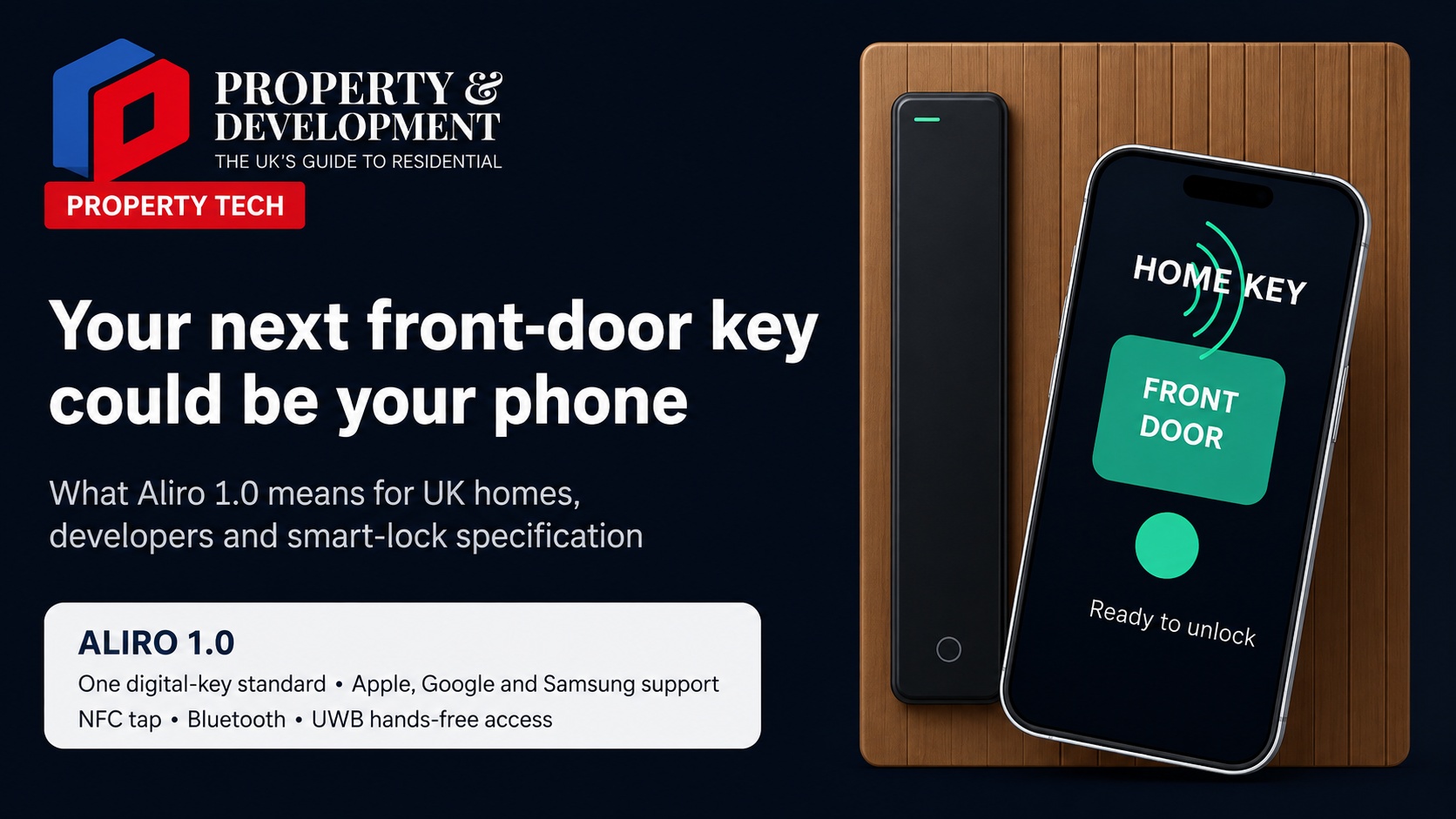
Smart locks have promised to replace the front-door key for years, but the experience has remained fragmented. One lock works best with Apple Home, another wants a particular app, a third supports a keypad but not the phone in your pocket. In February 2026, the Connectivity Standards Alliance launched Aliro 1.0 in an attempt to remove that friction.
For homeowners, the headline is simple: compatible doors can be unlocked using a phone or wearable through a digital credential stored in a major mobile wallet. For developers, landlords and access-control specifiers, the more interesting point is that Aliro is designed to work across Apple, Google and Samsung ecosystems rather than tying a building to one handset brand.
What exactly is Aliro?
The Connectivity Standards Alliance describes Aliro 1.0 as a common communication protocol and credential standard for access points ranging from single-family homes and apartment buildings to hotels, offices, universities, lifts and car parks.
The standard supports three familiar wireless technologies. NFC enables tap-to-unlock access; Bluetooth Low Energy supports longer-range communication; and Bluetooth plus Ultra-Wideband can enable hands-free entry by confirming that the authorised device is actually approaching the correct door.
That matters because it separates the access credential from a proprietary lock app. In principle, a resident can keep the credential in the wallet they already use on their phone or watch, while the building owner is free to select certified hardware from different access-control vendors.
Why property developers should pay attention
Digital access is already moving beyond luxury smart-home installations. Build-to-rent schemes, student accommodation, serviced apartments and mixed-use developments increasingly need to manage temporary residents, contractors, cleaners, delivery access and communal areas as well as permanent occupants.
A cross-platform standard changes the specification conversation. Instead of asking whether a lock supports one particular smart-home brand, developers can start asking whether the access system will work consistently when one resident uses an iPhone, the next uses a Galaxy and a third changes device midway through a tenancy.
The potential operational benefits are obvious: fewer proprietary apps, easier credential sharing, simpler changes of occupancy and less pressure to maintain parallel physical-key systems for every everyday interaction. It could also reduce one of the biggest barriers to smart-lock adoption — the fear that today’s hardware will become tomorrow’s incompatible ecosystem.
The smartphone is becoming part of the building specification
This shift has an unusual consequence: the phone in a resident’s pocket is no longer just a remote control for the home. It can become an access credential in its own right.
Samsung is already promoting Aliro-certified locks through Samsung Wallet and SmartThings, allowing compatible Galaxy devices to act as home keys. Samsung’s developer guidance describes tap-to-unlock access and automations triggered when the user enters the property. Apple already supports Home Key on compatible Apple Home and Matter locks through iPhone and Apple Watch. Apple’s UK guidance also supports shared household access and temporary guest codes on suitable locks.
For developers, this means handset compatibility deserves a line in the access-control risk assessment. A scheme should not assume every resident has the latest flagship, UWB support or a particular wallet. Physical keys, PINs, fobs or managed fallback credentials still matter, especially during device loss, battery failure or a phone upgrade.
What happens when the resident changes phone?
Aliro is designed to make cross-platform access easier, but people still replace phones far more often than they replace front doors. That creates a new lifecycle task for property managers: credentials must be revoked from lost or sold devices, re-issued to replacements and tested before the old handset leaves the resident’s control.
For households, the practical side is equally simple. If a smart-home upgrade or ecosystem switch gives you a reason to replace an older handset, it is worth establishing the residual value first rather than leaving the old device in a drawer. A service such as SellMyPhone.co.uk compares live offers from UK recyclers, which can help offset the cost of moving to a compatible replacement while putting the retired phone back into circulation.
Specification should focus on resilience, not novelty
The temptation with smart-home technology is to specify the newest feature and move on. Access control is different because failure has an immediate physical consequence: the resident cannot get through the door.
For that reason, the best Aliro deployments are likely to be the least flashy. Developers and landlords should consider:
- A non-phone fallback such as a physical key, secure PIN or managed fob.
- A clear process for lost, stolen, replaced or factory-reset devices.
- Compatibility testing across Apple, Google and Samsung wallet ecosystems.
- Whether hands-free UWB access is actually required or NFC tap is sufficient.
- Guest, contractor and short-term access workflows.
- How credentials are revoked when a tenancy or employment relationship ends.
- Whether the lock and access hardware can be maintained without replacing the entire smart-home platform.
A small standard with a big property implication
Matter made interoperability a mainstream smart-home objective. Aliro brings the same idea to the moment a person crosses the threshold.
It will take time for compatible locks, phones and wallet integrations to become universal, and developers should be wary of specifying a feature before the hardware ecosystem is mature. But the direction is clear: digital identity is becoming part of residential infrastructure.
The front-door key is one of the oldest pieces of technology in any home. In 2026, the property sector is finally getting a credible route to replacing it with something residents already carry — without demanding that the entire building choose the same phone.

