It usually starts with a pothole. Then another. Someone rings the council to report them and is told, politely, that the road is not the council’s to fix. That is often when residents first have to find out who is responsible for unadopted road resurfacing.
That is the moment many homeowners discover they live on an unadopted road. They are far from alone. The last government survey, back in 1972, counted roughly 40,000 unadopted roads in England and Wales, covering around 4,000 miles, and no later count has been made. Some are Victorian streets that were never taken over by the council. Others sit on modern estates where the developer never completed the handover.
If yours is one of them, here is how to find out where you stand, who pays for the upkeep, and how to get the road resurfaced properly the first time.
01First, check the road really is unadopted
Do not rely on how the road looks. Some smart, well-kept roads are private, and some tired-looking ones are public.
Every council that acts as highway authority must keep a list of the streets in its area that are maintainable at public expense, and under section 36 of the Highways Act 1980 anyone can inspect that list free of charge. Ask the council’s highways team whether your road is on it. If it is, repairs are the council’s job. If it is not, the road is private, at least as far as maintenance goes.
Next, check your title deeds and any management company paperwork. On newer estates, the deeds often set out who owns the road, who maintains it and how the costs are shared.
02Who pays for unadopted road resurfacing?
On an unadopted road, the council has no duty to pay for maintenance. As the House of Commons Library explains, responsibility rests with the frontagers: the owners of the properties that front onto the road.
How that works in practice depends on the road:
- On a modern estate, there is often a management company, funded through a service charge, that looks after the road along with the other shared areas.
- On an older private road, there may be no formal arrangement at all, and the frontagers have to agree among themselves who pays what. Residents often split the cost by the length of each property’s frontage, or equally, depending on what the deeds say and what everyone agrees.
Paying council tax does not change any of this. Council tax funds council services in general, not the upkeep of a particular private road.
03When the council can step in
The council is not completely absent. Under section 230 of the Highways Act 1980, if a private street needs repairs to remove a danger to traffic, the council can serve notice requiring the frontagers to carry them out. If they do not, it can do the work itself and recover the cost from the owners, shared by the length of their frontage.
The same section also offers a route to adoption. If a majority of the owners ask the council to bring the street up to standard under the private street works code, the council must do so and then declare it a highway maintainable at public expense. The catch is that the owners usually pay for the works first, and bringing an old road up to a modern adoptable standard, with proper drainage, kerbs and lighting, is rarely cheap.
04What a proper unadopted road resurfacing job involves
Most residents’ groups are not trying to get the road adopted. They simply want it fixed, and fixed so it lasts. That depends far more on what happens below the surface than on the surface itself.
It starts with a site visit. A good contractor looks at how the road is built, where the water goes when it rains, how the edges are holding up, and whether the problems are only in the top layer or run deeper.
The base decides how long the surface lasts. If the layers under the tarmac have failed, or water is sitting underneath, a new surface on top will crack and sink again within a few winters. Sometimes the answer is a patch or an overlay. Sometimes the worn surface needs to be planed off and relaid. Sometimes the base itself needs rebuilding.
Drainage and falls matter as much as the tarmac. Water standing on a road is the fastest way to destroy it, so the new surface needs the right falls towards gullies or soakaways.
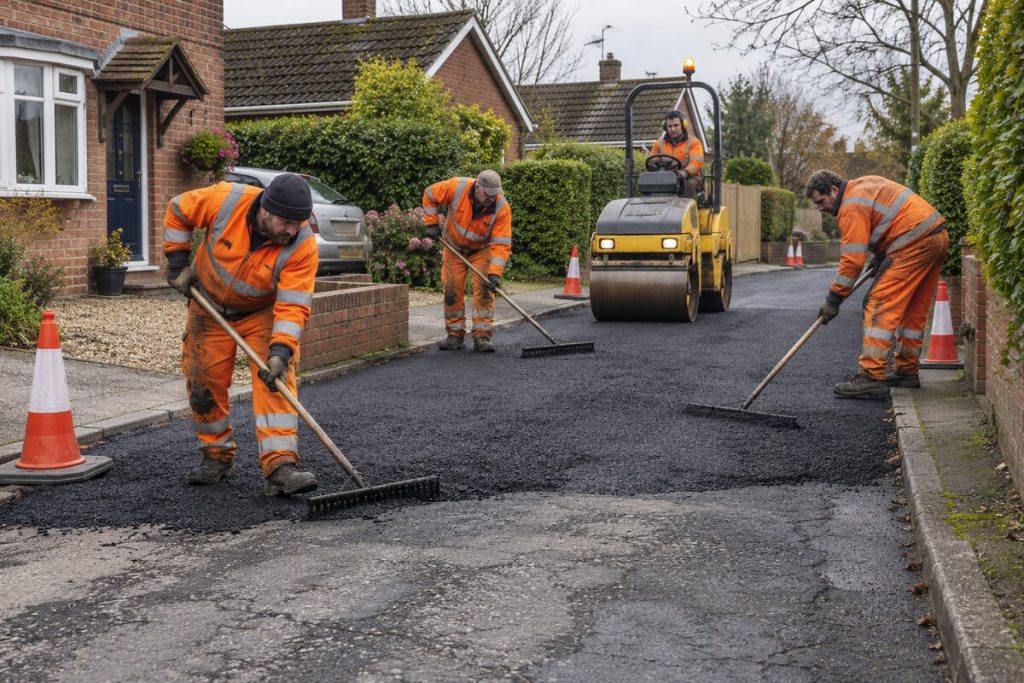
The method should suit the road. Narrow private roads and tight corners are often hand-laid. Longer runs suit machine-laying, which gives a more even finish at speed.
Residents should get a method statement and a programme. That means knowing in advance when the road will be closed, how long each section will take, and how people will get in and out of their driveways while the work is done.
Tarmac contractors such as McFadden Utilities, a family-run firm that resurfaces private roads for residents and management companies, start every job with a site visit, a method statement and a programme for exactly this reason. A surface is only as good as the layers it sits on.
05Comparing quotes for unadopted road resurfacing
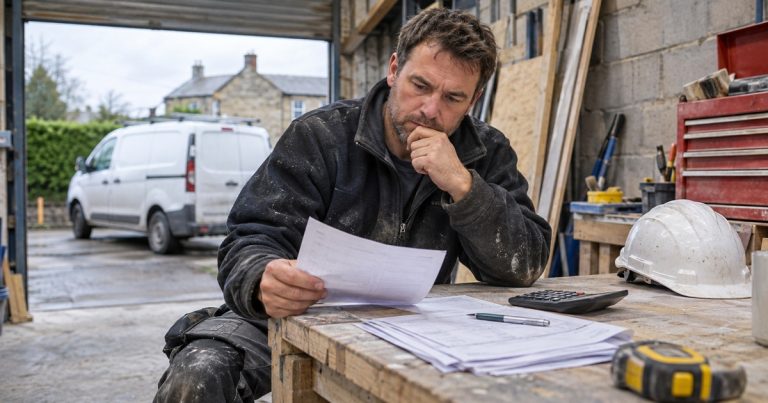
Collecting three quotes is sensible. Comparing them is harder, because two quotes for “resurfacing the road” can describe very different jobs. Before requesting quotes for unadopted road resurfacing, give each contractor the same written brief.
For related reading, see PAD Magazine’s coverage of pavers and plumbers among the UK’s most searched-for home professionals.
Ask every contractor to price the same things:
- The extent of the work, marked on a plan.
- What happens to the existing surface, whether it is overlaid, planed off or dug out.
- The layers being laid, with the material and thickness of each.
- Drainage work, including any new gullies, channels or falls.
- Edges and ironwork, such as kerbs, edging and raising or resetting manhole covers.
- Access arrangements and timing, including how long each property will be affected.
- What the guarantee covers, and for how long.
A cheaper quote that skips the base or the drainage is not cheaper in the end. It is the same job paid for twice.
06A road that lasts
Living on an unadopted road means the residents are, in effect, the highway authority. Done well, a resurfaced private road can serve everyone on it for many years. Done cheaply, it is back to potholes and phone calls before long. Check the road’s status, agree who pays, and specify the job properly before anyone picks up a rake.