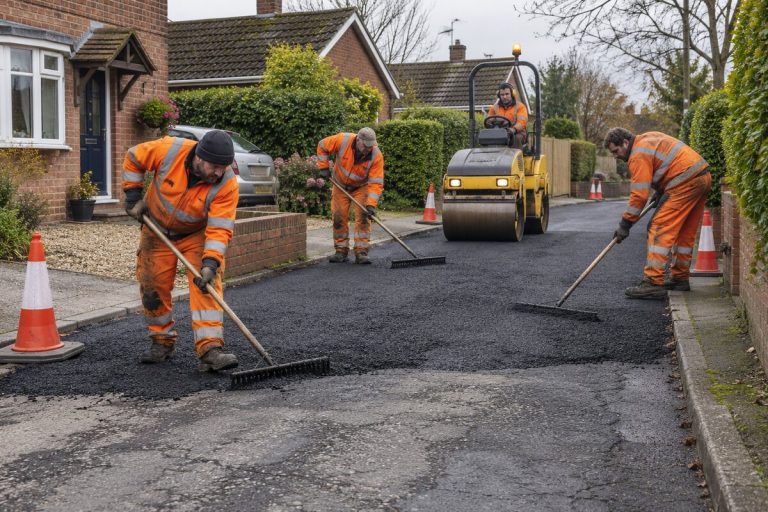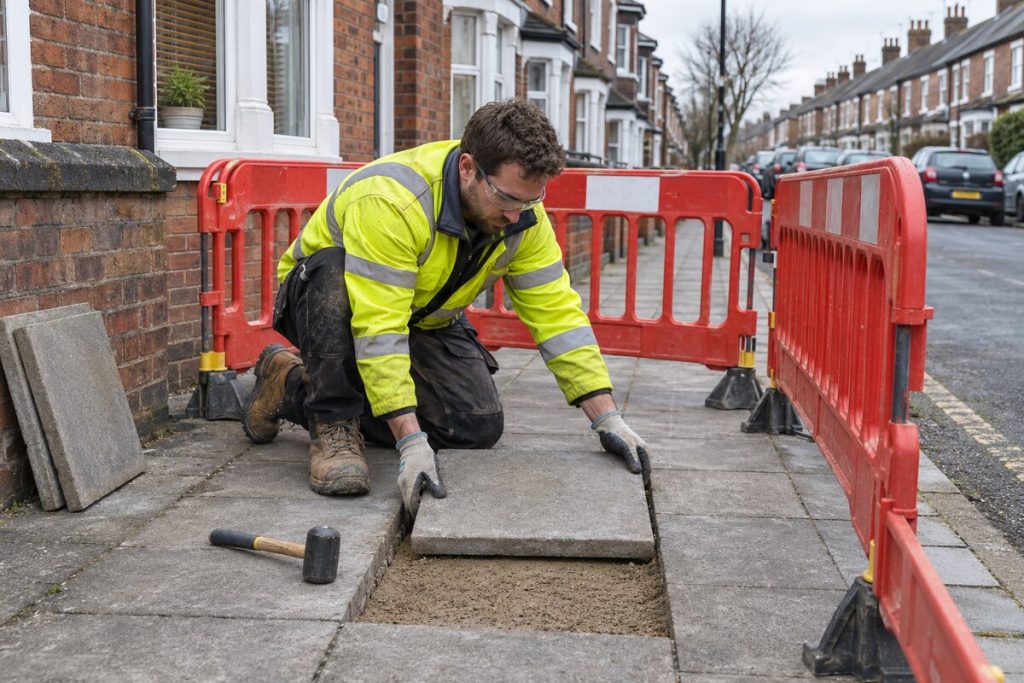
A new water connection, whether for a new build, an extension with its own supply or a house split into flats, almost always means digging. Usually it means two trenches: one in the street, from the water main to your boundary, and one on your own land, from the boundary to the building. Pavement reinstatement is the work of restoring the public footway after the street trench has been dug.
Once the pipes are in, both trenches have to be filled in and the surfaces put back. In the trade that is called reinstatement, and who does it depends entirely on which side of the boundary you are standing on.
01Who is responsible for pavement reinstatement on the public side?
Take Thames Water as an example. When it quotes for a new connection, the price covers its work between your property boundary and its water main. Before it can start, it needs agreement from whoever controls the road, usually the local council or, on the busiest London routes, Transport for London.
The digging in the street counts as street works, and the law is clear about who puts the street back. Under section 70 of the New Roads and Street Works Act 1991, the undertaker carrying out the works must reinstate the street, starting as soon as reasonably practicable after the work is complete. For a water connection, that means the water company or the contractor working on its behalf, not you.
02Why the pavement often looks temporary at first
Many homeowners are surprised when the pavement outside their house is patched with plain black tarmac, even though it used to be paving slabs or block paving. That is often an interim reinstatement: a safe, temporary surface that lets the footway reopen while the ground settles.
The same section of the Act sets a deadline. Where the reinstatement is interim, the permanent reinstatement must be completed within six months. The finished surface has to meet the national standard for reinstatement, the Specification for the Reinstatement of Openings in Highways, which sets out how trenches in roads and footways must be backfilled, compacted and resurfaced.
03If it sinks or cracks later
Permanent pavement reinstatement comes with a guarantee. Under the specification, the undertaker remains responsible for the reinstatement for two years after it is completed, or three years where the trench was deeper than 1.5 metres. If the patch in the pavement sinks, cracks or starts to break up within that time, it is the undertaker’s job to put it right.
If you spot a problem, report it to the council’s highways team or to the water company, with photographs and the date. Resist the temptation to fix it yourself: doing so can muddy who is responsible for the repair.
04The private side: your trench, your surface
Inside your boundary, the position is the opposite. Thames Water’s guidance is direct: you are responsible for installing the pipework within your property boundary, and any works outside the public land are yours to carry out. The same principle applies with other water companies.
That means the trench across your front garden or driveway, and the surface over it, is down to you and whoever you hire to lay the supply pipe. This is where most disappointments happen. A plumber or groundworker may be happy to lay the pipe and backfill the trench, but “backfill” is not the same as relaying your block paving, matching your resin driveway or restoring a lawn.
If the pipe installer’s quote only covers backfilling, ask a paving specialist to quote separately for restoring the driveway or path. See PAD Magazine’s coverage of pavers and plumbers among the UK’s most searched-for home professionals.
Before work starts, agree in writing:
- Who reinstates each surface the trench will cross, such as the driveway, the path and the garden.
- What each surface will be put back with, for example whether the original blocks are lifted and relaid or new materials used.
- How the trench will be filled, in compacted layers with suitable material rather than tipped back in one go.
- Who to call if it settles after the first winter.
Taking dated photographs of the driveway and pavement before any digging starts is a simple step that saves arguments later.
05What good pavement reinstatement looks like
Whether it is a public footway or your own driveway, a good reinstatement follows the same principles.
The trench is filled in layers and compacted as it goes. Spoil tipped back in one go settles, and the surface above sinks with it. Proper backfill is placed and compacted layer by layer.
The sub-base suits the surface above. A footway needs a different foundation from a driveway that carries cars, and both need more than the material dug out of the hole.
The surface matches what was there. Block paving relaid to the same pattern and level, slabs replaced like for like, and tarmac joints sealed so water cannot get underneath.
There is no settlement after the first winter. That is the real test. A good reinstatement should be hard to spot a year later.
Reinstatement contractors such as McFadden Utilities, which puts back roads, footways, kerbs and block paving after utility works, treat backfill and sub-base as the most important part of the job for exactly this reason. When the layers are right, the surface stays down. When they are wrong, the ground sinks, the surface fails and someone pays for the same trench twice.
06A trench filled properly once
A new water connection should be the start of a better supply, not the start of a sinking driveway. Know which side of the boundary each trench is on, expect the public side to be put right by the water company within the legal timescales, and agree the private side in writing before anyone starts digging. A trench filled properly once does not need digging up again.