An air source heat pump installed in England and Wales typically costs around £12,800 before any grant, and the Boiler Upgrade Scheme takes £7,500 off that, or £9,000 for eligible homes heated by oil or LPG with no mains gas. Whether one suits your home depends mainly on outdoor space, a radiator system and how well the house holds heat.
This guide sets out the official cost data, the grant rules, the planning limits and what to check before you ask for quotes. Every figure was checked against the linked source on 12 November 2026.
01How does an air source heat pump work?
An air source heat pump moves heat from the outside air into your home, and it can do this even when the outside air is cold. The RICS consumer guide to domestic air source heat pumps says 1kWh of electricity generates 3kWh to 4kWh of heat.
Almost all grant-funded installs are air-to-water heat pumps, which made up 98% of Boiler Upgrade Scheme applications to the end of September 2026. They heat the water in a wet central heating system with piped radiators. RICS says heat pumps are most efficient at a flow temperature of about 55°C, and that a lower flow temperature gives greater efficiency savings.
Air-to-air heat pumps heat the air in a room instead of water. They qualify for a smaller grant, covered below.
02How much does an air source heat pump cost to install?
The most reliable cost data comes from the government’s own Boiler Upgrade Scheme statistics, which record what MCS certified installers charged on grant-funded jobs. For air-to-water heat pumps installed between July and September 2026, the median cost was £12,826.
| Measure | July to September 2026 |
|---|---|
| Lower quartile cost | £10,717 |
| Median cost | £12,826 |
| Upper quartile cost | £15,461 |
| Median system size | 8kW |
These costs are reported by installers and include the equipment, labour and VAT. They should include the value of the grant, so they show the price before the grant is deducted. The highest and lowest 10% of reported costs are left out.
Bigger systems cost more. Median costs for the 2025/26 financial year by heat pump size were:
| Heat pump size | Median installed cost, 2025/26 |
|---|---|
| 4kW to 6kW | £11,494 |
| 6kW to 8kW | £12,164 |
| 8kW to 10kW | £12,688 |
| 10kW to 12kW | £13,948 |
| 12kW to 14kW | £15,366 |
| All sizes | £13,024 |
RICS puts the cost for a home with a typical gas boiler and existing radiators and pipework at £12,000 to £15,000, which is in line with the government data. Your own quote will depend on your home’s heat loss, whether radiators need upgrading and whether you need a hot water cylinder.
03How much is the Boiler Upgrade Scheme grant?
The Boiler Upgrade Scheme gives £7,500 towards an air source heat pump in England and Wales. Homes that use oil or LPG and have no mains gas connection can get an extra £1,500, and Ofgem says the resulting £9,000 grant is available until 31 March 2027.
| Technology | Grant |
|---|---|
| Air source (air-to-water) heat pump | £7,500 |
| Air or ground source heat pump in an eligible off-gas home using oil or LPG | £9,000 until 31 March 2027 |
| Ground source heat pump | £7,500 |
| Air-to-air heat pump | £2,500 |
| Biomass boiler (rural, off the gas grid only) | £5,000 |
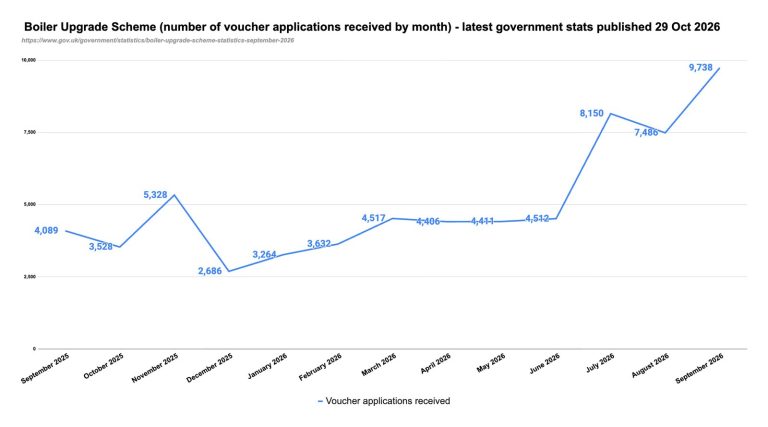
Demand has risen since the higher rate began. Government statistics show 8,107 applications for the £9,000 grant between July and the end of September 2026, and September 2026 had more voucher applications than any month since the scheme started.
04Who is eligible for the Boiler Upgrade Scheme?
Under the gov.uk eligibility rules, you must own the property, which can include a business, a second home or a rental property. You must be replacing a fossil fuel heating system, which gov.uk defines as oil, gas, electric or LPG.
- Hybrid heat pump systems do not qualify.
- You cannot get the grant to replace an existing low carbon heating system.
- Most new build properties and social housing are not eligible, and nor are properties that have already had government funding for a heat pump or biomass boiler.
- A single system can be up to 45kWth.
- Your installer must fit and commission the heat pump within 120 days of applying.
Having already had funding for insulation does not stop you applying. You do not apply yourself: an MCS certified installer applies to Ofgem on your behalf, and the grant is taken off the cost of the installation.
05Will a heat pump cost more to run than a gas boiler?
It depends on how efficiently the heat pump runs and on your tariff. RICS says the running costs of a heat pump and a traditional gas boiler are similar, and warns that claims of big savings may not be entirely correct.
Electricity costs far more per unit than gas. Under the Ofgem price cap for 1 October to 31 December 2026, the average direct debit rates are:
| Fuel | Unit rate | Daily standing charge |
|---|---|---|
| Electricity | 26.32p per kWh | 54.83p |
| Gas | 7.97p per kWh | 29.68p |
That makes electricity about 3.3 times the price of gas per unit. If a heat pump turns 1kWh of electricity into 3kWh of heat, each unit of heat costs about 8.8p; at 4kWh of heat it falls to about 6.6p. A gas boiler pays 7.97p for each unit of gas before any boiler losses.
That simple sum leaves out standing charges, heat pump tariffs and your boiler’s real efficiency. The government’s heat pump checker compares the cost and carbon savings for your type of home, and our report on the October 2026 energy price cap explains how the cap affects bills.
06Is my home suitable for an air source heat pump?
RICS highlights five things to check before you commit.
| Check | What RICS says |
|---|---|
| Heating system | A pure electric (dry) heating system is not compatible. You need a wet system with piped radiators. |
| Outdoor space | Homes with no outside space, or a very small yard or garden, are likely to be unsuitable. This typically affects flats. |
| Hot water | If you have a combination boiler, you will need space for a hot water storage cylinder. |
| Radiators | You may need double panel radiators because heat pumps run at lower water temperatures. Only professional calculations will confirm it. |
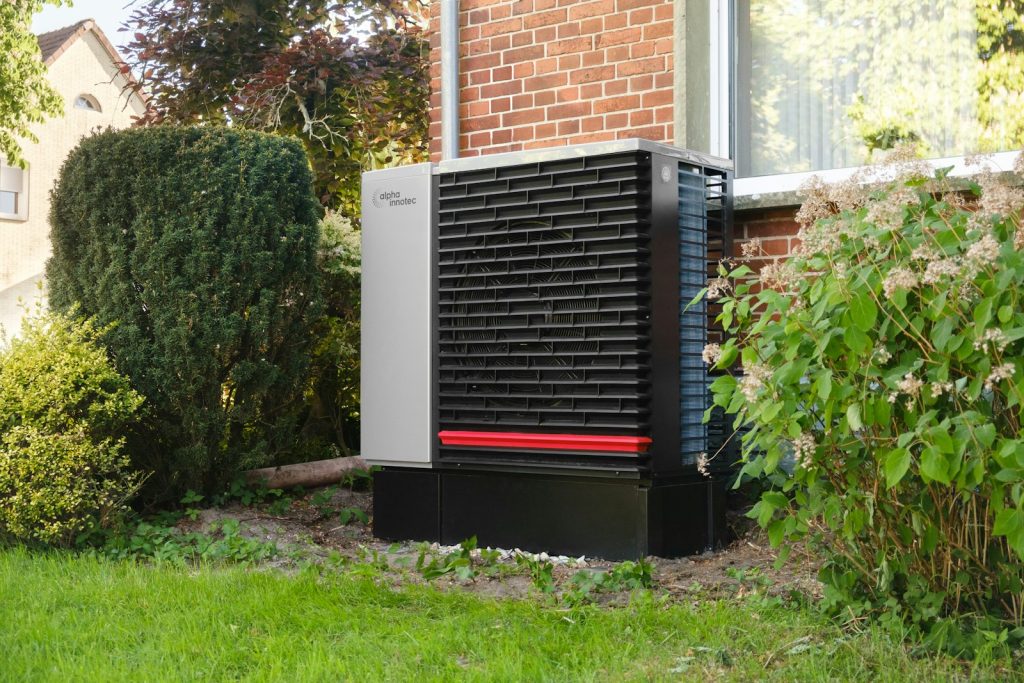
| Noise | The noise is similar to a fridge, so the unit should sit away from your windows and your neighbours’ windows. |
A heat pump works best in a home that holds its heat. RICS suggests draught stripping around doors and windows, adding insulation and upgrading windows to make a property “heat pump ready”.
Our guides cover how to draught-proof a front door, loft insulation mistakes to check and how external wall insulation works around windows. If rooms feel cold even with the heating on, this explainer on heat loss is a good place to start.
07Do you need planning permission for an air source heat pump?
In England, a heat pump on a house is permitted development, so it does not need a planning application, as long as it meets every limit and condition in the Planning Portal guidance.
| Rule | Limit in England |
|---|---|
| Standard | Must comply with the MCS Planning Standards (MCS 020a). From 28 May 2026 this is the only permitted scheme. |
| Size | The outdoor compressor unit must not exceed 1.5 cubic metres on a house, or 0.6 cubic metres on a block of flats. |
| Number | The first two on a detached house; the first one on any other house. |
| Wind turbines | Only if there is no wind turbine on the building or within its grounds. |
| Roofs | Not on a pitched roof. On a flat roof, at least 1 metre from the edge. |
| Listed buildings and scheduled monuments | Not permitted development. |
| Conservation areas and World Heritage Sites | Not on a wall or roof that fronts a highway, and no nearer a highway than the building. |
| Elsewhere | Not on a wall above ground floor level if that wall fronts a highway. |
The unit must not be used only for cooling, must be removed when no longer needed and should be sited to minimise its effect on the look of the building and the area. Rights can be removed by a planning condition or an Article 4 Direction, so check with your local planning authority if you are unsure.
Wales updated its rules on 1 June 2026. The Welsh Government guidance also requires MCS 020(a) and a unit of no more than 1.5 cubic metres, allows up to two units on a detached home and one on other homes, and rules out pitched roofs and listed buildings.
In Scotland, Planning Circular 1/2024 allows one air source heat pump per property. It must not project more than 1 metre from a wall or roof, is not allowed within the curtilage of a listed building or in a World Heritage Site, and in a conservation area must be on the rear elevation at ground floor level. In Northern Ireland, ask your council planning office before you install.
08How do you find an MCS certified installer?
Use the MCS find an installer tool to search near you and to check that a business is certified. MCS describes itself as the UK’s quality mark for small-scale renewables such as heat pumps.
You need an MCS certified installer to claim the Boiler Upgrade Scheme grant, and gov.uk advises contacting them for quotes and to check whether a heat pump suits your property. Ofgem may contact you to confirm the installer is acting for you and may visit to check the installation, and MCS may carry out its own checks.
Ask each installer how they sized the system and whether your radiators or hot water cylinder need changing. Comparing two or three written quotes with the government cost data above will show whether a price is in the usual range.
09What grants are available in Scotland and Northern Ireland?
The Boiler Upgrade Scheme only covers England and Wales. In Scotland, Home Energy Scotland offers grant funding of up to £7,500 for a heat pump, an optional interest-free loan of £7,500 on top, and an uplift of £1,500 for rural and island homes.
Home Energy Scotland only funds heat pumps that provide all of a home’s heating and hot water, and you must not start work until you have the funding offer in writing. In Northern Ireland, gov.uk says the Boiler Replacement Scheme is now closed.
10What should you do before you book an installer?
Run the government’s suitability checker, tackle draughts and insulation, then ask MCS certified installers for a heat loss calculation and written quotes. If a heat pump is part of a bigger project, our guide to the order of renovation work helps you plan, and our guide to home solar panel installation covers adding panels.
If you live in a listed building, a conservation area or a flat, speak to your local planning authority before you commit.
This is a general guide based on official and industry sources checked on 12 November 2026. Grant rules and prices change, so confirm the details with gov.uk, Ofgem and a qualified MCS certified installer before you go ahead.