


A renovation tends to focus on what you can see: the kitchen, the bathrooms, the floors and the garden. The pipe that brings water into the house is easy to forget, because it is buried and it still works. In an older home, though, it may be lead, or it may be too narrow for the extra bathroom you are planning. Either way, it is far easier to deal with while the floors are up and the garden is already dug.
Two Pipes, Two Owners
The supply into a house is made up of two sections, and they belong to different people. Ofwat explains that the communication pipe runs from the water main to the property boundary and is normally the water company’s responsibility, while the supply pipe runs from the boundary into the building and belongs to the owner.
Thames Water puts the dividing line at the outside stop valve. Its communication pipe runs from the main to the outside stop valve at your boundary, and your supply pipe runs from there to the inside stop valve in the house.
That split matters, because it decides who pays for what when the pipe needs replacing.
If the Pipe Is Lead
Lead supply pipes are mainly a concern in older homes. Thames Water’s lead pipe replacement scheme is open to properties built before 1970 that are suspected of having lead supply pipework, and your plumber can confirm what the pipe is made of at the inside stop valve.
Under the scheme, Thames replaces any lead pipework that belongs to it at no cost, provided you are planning to replace your own lead supply pipe within the next three months. It aims to complete its part within three months of you qualifying, and you can use either an independent plumber or a WaterSafe approved plumber for your side.
There is one detail worth knowing before you plan the rest of the job. Thames describes the scheme as a like for like replacement and says this “includes the size and location of the pipe”. Existing smaller pipes of 12 to 15 mm are replaced with the industry standard 25 mm. So the scheme modernises the pipe, but it is not a way to move the supply or make it larger than standard.
If your home is in another water company’s area, check whether it runs a similar scheme and what it covers.
If the House Needs More Water
A renovation can add demand. Thames Water’s guidance on when you might need a new water connection says that if you are building an extension, especially one with a new bathroom, you might need more water. It adds that if your plumbing is fine but you are still not getting enough water into the property, you might need to upgrade to a bigger pipe.
This is where the like-for-like rule matters. If the renovation needs a larger supply or a different route into the house, it is no longer a straight lead swap. It becomes an application to the water company for a new connection, and the water company decides the size. Thames’ charging arrangements give 25 mm or 32 mm as typical for one house, and Thames keeps responsibility for sizing the pipe itself.
The practical point is to ask the question early. If the plans add bathrooms or extra outlets, raise the supply size with your plumber before the trench is dug, not after the new pipe is in the ground.
Replacing the Supply from the Boundary
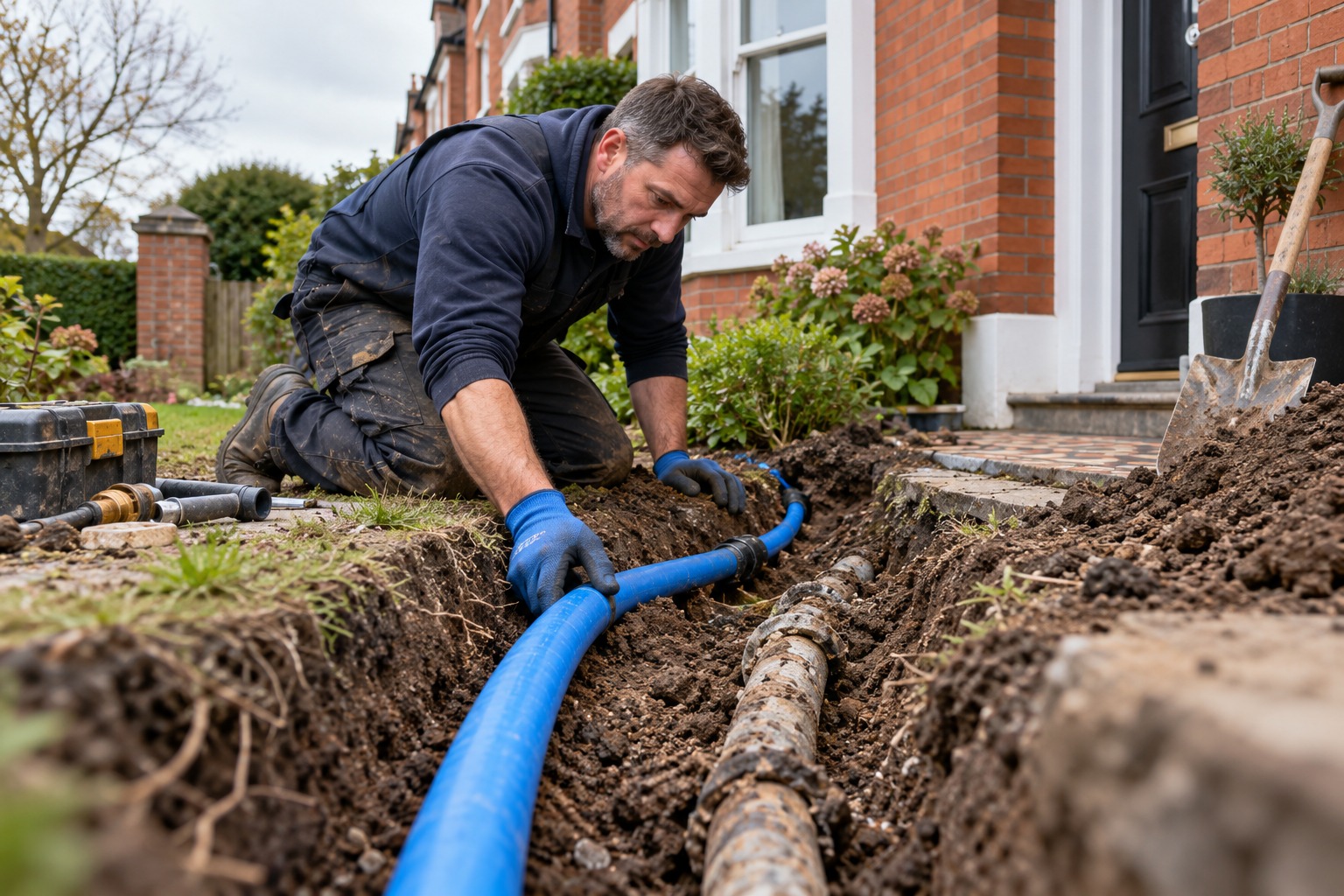
On your side of the boundary, the job is a trench from the boundary to the house, a new pipe laid in it, and a connection at each end. Depth matters. Water regulations guidance sets a minimum depth of 750 mm and a maximum of 1,350 mm for an underground supply pipe, and going outside that range needs the water company’s permission. Thames also asks for a new supply pipe to pass a water regulations inspection or be certified by a WaterSafe approved plumber.
The route does not have to follow the old one. While everything is open, it can make sense to bring the pipe in where the new kitchen or utility room will be, or to keep it clear of an extension’s foundations. Just remember that a new location sits outside a like-for-like lead scheme.
Some utility contractors take this on as a single job. McFadden Utilities, a family-run firm in Welwyn Garden City, for instance, deals with old lead supplies by tracing the existing pipe and replacing the supply from the boundary along the same route or a better one, then connecting at the main and at the house and reinstating the path, drive or garden. Where a new connection is needed at the main, that work does not have to be done by the water company either. Thames’ charging arrangements treat service connections up to 63 mm as contestable, so a contractor accredited under the Water Industry Registration Scheme can carry it out. You can check a firm’s accreditation on the LRQA WIRS register.
Getting the Timing Right
The supply is buried, so the order of work matters as much as the pipe itself. A sensible sequence looks like this:
- Check what the incoming pipe is made of early, before the kitchen or flooring goes in.
- If it is lead, register for your water company’s replacement scheme, if it runs one, before the trench is due. Thames, for example, asks that you plan to replace your side within three months.
- If you need a bigger supply or a new route, apply to the water company for the connection as soon as the design is settled.
- Dig the trench before the driveway, paths and landscaping go in.
- Size the internal plumbing to match the new supply, not the old one.
The Short Version
The incoming water supply is the one part of the plumbing you cannot easily get at once a renovation is finished. Find out what it is made of before the plaster goes on, use the water company’s lead scheme where it applies, and if the house needs more water, treat the bigger supply as its own application rather than an afterthought.
For wider renovation planning, PAD Magazine’s guide to hidden home upgrades that make a big difference covers other improvements to consider before the finishing work begins.

