


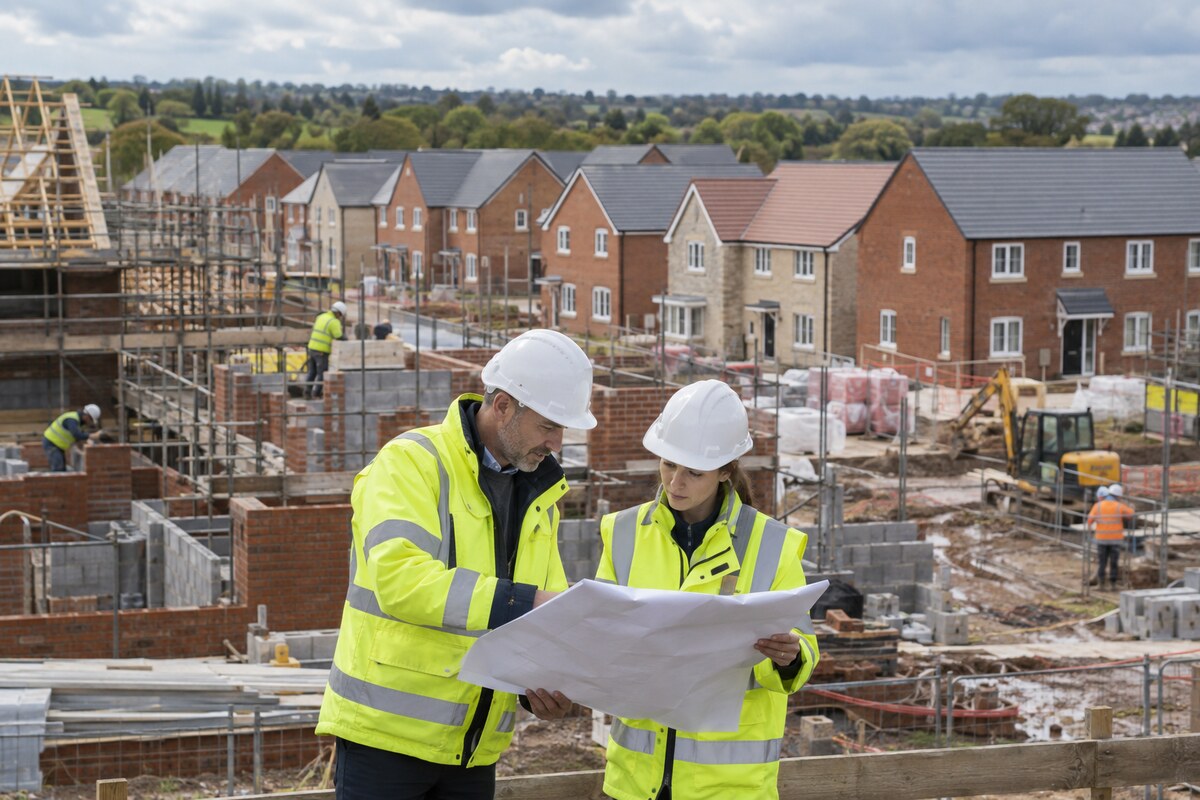
The government’s 1.5 million homes target has come under renewed scrutiny after Communities Secretary Angela Rayner acknowledged that there is only a slim chance of delivering the promised number of new homes in England before the next general election.
The target was introduced as a central part of the government’s housing programme. It was intended to increase supply, improve affordability and respond to the growing pressure facing renters and prospective homeowners.
However, difficult market conditions, construction costs and slower activity among private housebuilders have raised questions about whether the target can still be achieved within the original timeframe.
What does the 1.5 million homes target involve?
The government’s ambition is to deliver 1.5 million new homes in England over the parliamentary period. Reaching that figure would require an average of approximately 300,000 additional homes each year.
The target includes different forms of housing rather than a single type of development. Private homes, affordable properties, council housing and social rented accommodation can all contribute to the overall supply.
Delivery also depends on several stages working together. Land must be identified, planning permission secured, infrastructure provided and construction completed before a home can be counted as delivered.
A large planning pipeline does not therefore guarantee that the same number of homes will be built. Some consented projects are delayed, redesigned or paused because they are no longer financially viable.
Why is the 1.5 million homes target becoming harder to reach?
Inflation, borrowing costs and uncertainty across the construction market have affected the pace of development.
Higher financing costs can make it more expensive for developers to purchase land, begin construction and hold unsold properties. Building materials, labour, energy and regulatory requirements can also increase the final cost of delivering each home.
Private housebuilders normally respond to market demand. If mortgage affordability weakens or buyers become more cautious, developers may reduce the speed at which they complete and release properties.
This creates a challenge for a target based on total delivery. Planning reforms can increase the number of sites available, but they cannot force private developers to build homes faster when market conditions are weak.
Housing pressure has not disappeared
The difficulty of meeting the 1.5 million homes target does not mean demand for housing has fallen.
Official figures published by the Office for National Statistics showed that the average UK monthly private rent reached £1,393 in the year to July 2026, representing annual growth of 3.7%.
Average rents reached £1,451 in England, while regional results continued to vary significantly.
Rising rents can make it harder for households to save for a deposit. They can also increase demand for affordable and social housing, especially in locations where private rental costs have moved far ahead of local earnings.
Housing supply therefore remains an important issue even when the wider property market slows. A weaker sales market may discourage private construction while doing little to reduce the number of people who need suitable homes.
Social and affordable housing could become more important
The government has placed greater emphasis on council and social housing as pressure builds around the overall target.
Current plans include significant investment in social and affordable homes, with a stated focus on increasing the number of properties available at below-market rents.
This could help reduce the programme’s dependence on private housebuilders. Councils and housing associations do not operate under exactly the same sales model as commercial developers, allowing them to deliver homes based more directly on local need.
However, affordable housing programmes face their own challenges. Local authorities need suitable land, planning capacity, infrastructure funding and access to contractors. Housing associations must also balance new construction against the cost of improving and maintaining their existing properties.
Funding announcements are therefore only the beginning of the delivery process. The number of homes completed will depend on how quickly projects move from allocation and planning to construction.
Can planning reform support the homes target?
Planning is frequently identified as one of the main barriers to new housing. Delays, local opposition and limited capacity within council planning departments can all slow development.
Recent reforms are intended to make more land available and encourage construction near transport connections. These measures may improve the pipeline of sites with development potential.
Yet planning permission is only one part of the process. Developers must still establish that a project is commercially and technically viable. Sites may require new roads, schools, drainage, utilities and environmental mitigation before construction can proceed.
PAD Magazine’s guide to land promotion and planning gain explains how land moves through the planning system before it becomes suitable for development. The process can take years, especially when major infrastructure or policy changes are required.
Faster decision-making could help, but planning reform will have limited effect if projects remain financially unviable after permission is granted.
Could modular construction accelerate delivery?
Modern methods of construction are often presented as one possible way to support the 1.5 million homes target.
Building components in controlled factory environments can reduce weather delays, improve consistency and shorten the amount of work required on site. Standardised designs may also help public authorities deliver similar housing types across several locations.
PAD has previously examined how modular and refurbished buildings could address the UK’s construction bottleneck.
However, modular construction is not a complete solution on its own. Projects still need land, planning approval, utilities, foundations, transport and skilled installation teams. Manufacturers also require a reliable pipeline of orders to justify investment in factories and production capacity.
The strongest results may come when modern construction methods are combined with long-term public housing programmes rather than used only for isolated developments.
The difference between housing starts and completed homes
Housing announcements often refer to sites, planning permissions, funding allocations, housing starts and completed homes. These figures describe different stages and should not be treated as interchangeable.
A housing start indicates that construction activity has begun. A completion means the property is finished and ready for occupation.
An increase in starts can be an encouraging sign, but it may take months or years for those properties to reach completion. Large developments are also frequently delivered in phases over an extended period.
When assessing progress towards the 1.5 million homes target, completed homes provide the clearest measure. Planning approvals and starts are useful indicators of future supply, but they do not represent homes that households can already occupy.
What happens if the homes target is missed?
Missing the headline target would not necessarily mean that the entire housing programme had failed. The location, affordability, quality and tenure of the homes delivered also matter.
A smaller number of well-planned homes in areas with strong transport, employment and public services could provide greater long-term value than a larger number built without the necessary infrastructure.
However, a substantial shortfall would increase pressure on future governments and local authorities. Housing shortages could continue to affect rents, affordability, homelessness services and waiting lists for social housing.
The construction sector could also be affected. A stable pipeline of housing projects supports employment, training, manufacturing and investment throughout the wider supply chain.
Can England still deliver 1.5 million homes?
The target has not formally been abandoned, but the latest comments show that ministers recognise the scale of the challenge.
Reaching 1.5 million homes would require stronger delivery from private developers, councils and housing associations at the same time. It would also depend on planning capacity, infrastructure investment, market confidence and the availability of skilled workers.
The 1.5 million homes target may remain useful as a statement of ambition, even if the final total falls short. However, the government will increasingly be judged on completed homes rather than promises, planning reforms or funding announcements.
The real test will not simply be whether England reaches a particular number. It will be whether the homes delivered are affordable, well located and capable of meeting the needs of the communities in which they are built.

