


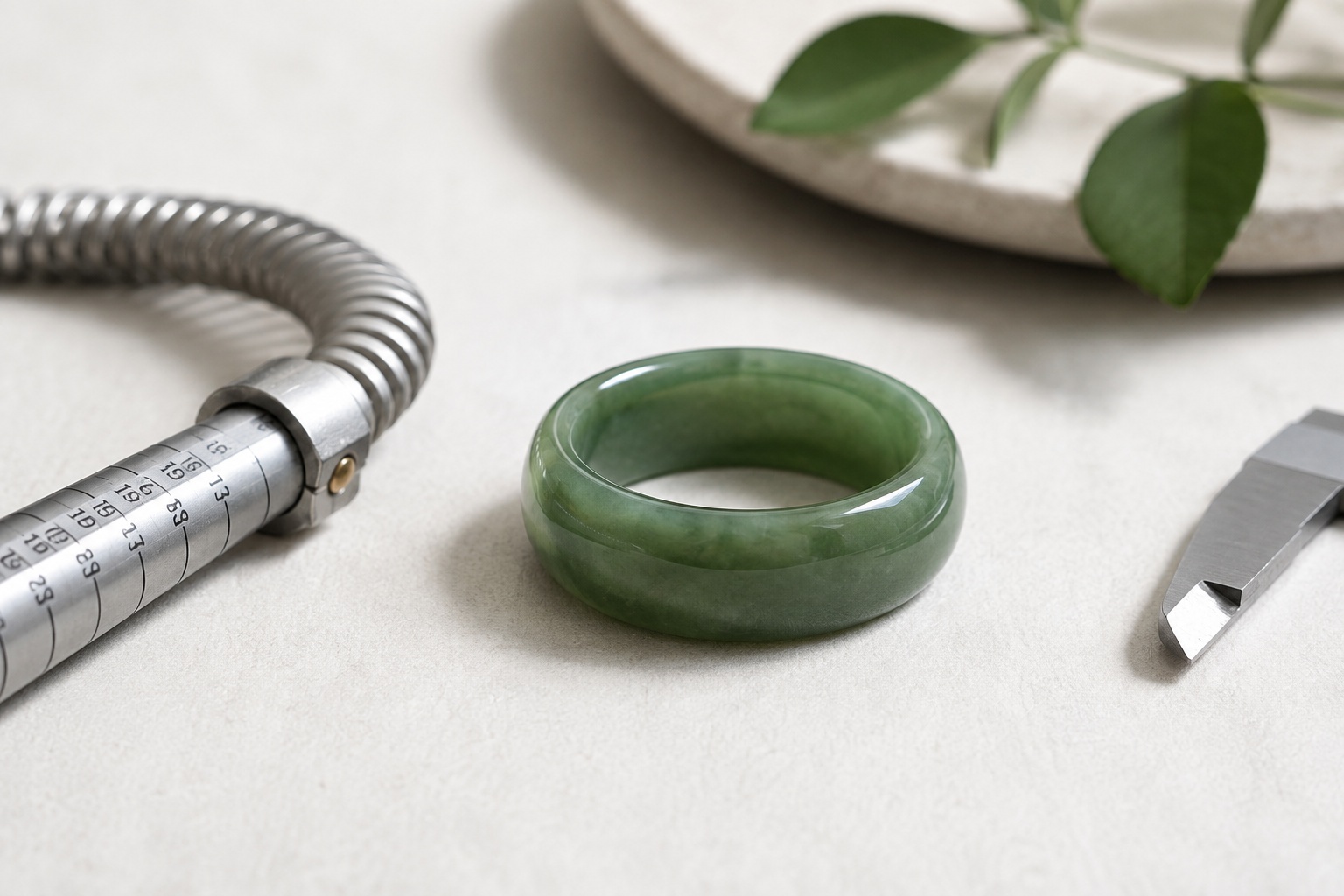
A gold ring that’s half a size out is a twenty-minute job at any jeweller. A jade ring that’s half a size out is a paperweight. The difference is worth understanding before you order, not after.
Jade rings have an unusually high rate of never being worn, and the reason is almost never that the buyer stopped liking the piece. It’s fit.
The material creates a problem that most jewellery doesn’t have: a substantial proportion of jade rings physically cannot be adjusted after they are made, by anyone, at any price. Combine that with international buying, inner diameters quoted in millimetres, and a sizing system most Western buyers have never encountered, and you get a lot of beautiful objects sitting in drawers.
All of it is avoidable with about ten minutes of measuring. Here is the whole process.
Two constructions, two completely different sizing problems
Before anything else, establish which kind of ring you’re looking at, because the answer determines everything that follows.
A one-piece jade ring is carved from a single block of stone. The band and the face are one continuous piece of material with no metal anywhere. In Chinese, these are the classic forms, and they include plain bands, wide “saddle” rings, and carved designs cut directly into the stone.
A set jade ring has a jade element — usually a cabochon, sometimes a carved plaque — mounted into a metal band of gold, silver, or platinum.
The distinction matters because only the second type can be resized, and even then only the metal part.
Why a one-piece jade ring can never be resized
Resizing a metal ring works because metal is ductile. A jeweller cuts the band, adds or removes a segment, solders the join, and reshapes and polishes it. The metal flows, bonds, and takes a finish that hides the work.
Stone does none of that. Jadeite and nephrite cannot be stretched, compressed, cut and rejoined, welded, or annealed. There is no process — not heat, not pressure, not adhesive — that adds material to a stone ring or closes a gap in one and leaves a sound object behind.
Making it larger would mean grinding away material from the inside, which thins the band. A stone ring is already a thin closed loop of brittle material with no metal to absorb impact; removing thickness from a structure that is load-bearing in bending pushes it toward failure. Even a modest increase in size takes a wearable ring and makes it a fragile one.
Making it smaller isn’t possible at all.
So for a one-piece jade ring the inner diameter it was carved to is permanent. You are not buying a ring in a size. You are buying a specific ring that fits a specific finger.
Set rings are different, but the flexibility is narrower than it sounds. A jeweller can resize the metal band, usually within a range of a size or two, and the work has to avoid stressing the stone or the setting. Full-eternity styles and tension settings often can’t be adjusted at all. Ask before assuming.
Converting millimetres to your local size
Most jade listings quote inner diameter in millimetres, because that’s how the trade measures. Western buyers usually know their size as a US number or a UK letter, and the two don’t map intuitively.
The relationship is straightforward: inner diameter multiplied by π gives circumference, and both US and UK systems are keyed to circumference. Useful reference points:
| Inner diameter | US size | UK size | Circumference |
|---|---|---|---|
| 15.7 mm | 5 | J½ | 49.3 mm |
| 16.5 mm | 6 | L½ | 51.9 mm |
| 17.3 mm | 7 | N½ | 54.4 mm |
| 18.1 mm | 8 | P½ | 57.0 mm |
| 19.0 mm | 9 | R½ | 59.5 mm |
| 19.8 mm | 10 | T½ | 62.1 mm |
Two things to note. US sizes run roughly 0.8 mm of diameter apart, so a difference of less than a millimetre is a full size — which is why a listing quoting “17–18 mm” has not told you enough to buy safely.
And jade listings often quote to one decimal place — 17.2 mm, 16.8 mm — because each ring is an individual object rather than a batch item. That precision is genuine information, not marketing. Use it.
Measure the knuckle, not the finger
The most common sizing error with any ring is measuring the base of the finger. The ring has to pass the knuckle, which on most people is wider.
The reliable method is to measure a ring you already own and wear comfortably on the intended finger. Measure the inside diameter across the widest point with a ruler or callipers. This gives you a number you know works, on a known finger, without any conversion guesswork.
If you have no ring to measure, wrap a strip of paper around the base of the finger, mark the overlap, and then check it will pass the knuckle by sliding the loop over. Take the larger of the two measurements. Divide the circumference in millimetres by 3.14 to get the diameter.
A caution about string. String stretches and paper strips can be pulled tight without noticing. Both routinely produce a reading half a size to a full size too small. If your two methods disagree, trust the measured ring.
For a one-piece jade ring specifically, err very slightly large. A ring that is fractionally loose is wearable and can be worn on a different finger. A ring that will not pass the knuckle has no remedy at all.
Time of day, temperature, and the things that change your size
Finger size is not a constant, and the variation is larger than most people expect — commonly around half a size across a day, and more across seasons.
Fingers are smallest in the morning and after cold exposure, and largest in the evening, in heat, after exercise, after salt, and after alcohol. Pregnancy, weight change, hormonal cycles and arthritis all shift baseline size, some temporarily and some not.
Measure late in the day, at normal room temperature, when you are neither hot nor cold. That’s the honest reading — the size that will be comfortable most of the time rather than the smallest your finger ever gets.
If you’re between sizes and the ring is one-piece, take the larger. If it’s set in metal, take the smaller, since it can be adjusted upward more easily than down.
Band width changes the fit
This one catches people out, and it applies to any ring, but especially to jade, where wide bands are a traditional style.
A wide band fits more tightly than a narrow band at the same nominal size. More of the band is in contact with the finger, there is less room for soft tissue to move, and the ring cannot flex.
The usual guidance is to go up about half a size for a band wider than roughly 6 mm, and up to a full size for a band over about 8 mm. A wide one-piece jade “saddle” ring at your normal size will frequently be too tight.
Some jade rings also have a comfort-fit interior — the inside surface domed rather than flat, so it rides on a narrower contact line. Comfort-fit generally runs slightly large, so a normal size is fine. If the listing doesn’t say, assume flat.
Buying as a gift
Rings are the highest-risk jewellery gift, and one-piece jade rings are the highest risk within that category, because the usual fallback — take it in for resizing — doesn’t exist.
Best case: borrow a ring the recipient already wears on the intended finger and measure the inside diameter. This is worth some effort to arrange.
If you can’t: consider not buying a ring. A pendant on an adjustable cord, or a beaded or sliding-knot bracelet, fits essentially anyone and carries the same material and meaning without the failure mode. This is genuinely better advice than guessing a size.
If you’re set on a ring: buy a set one rather than a one-piece carving, so the band can be adjusted, and check the returns policy across borders before ordering — a gift that can’t be exchanged is a gift the recipient has to pretend to like.
Before you order: the checklist
- Which construction? One-piece stone or stone set in metal.
- What is the exact inner diameter in millimetres, for the specific item — not a range across the collection.
- How wide is the band, and have you allowed for it?
- Flat or comfort-fit interior?
- Does the seller state whether the piece can be adjusted at all?
- What is the returns process if it doesn’t fit, and who pays shipping?
A seller who publishes exact per-item diameters is giving you the thing you actually need. A listing that offers only S/M/L on a one-piece stone ring is asking you to take a risk it could easily have removed.
Once it fits
Sizing is the mechanical half of choosing a jade ring. The other half is the part the tradition is actually about — what the carving depicts, and where the piece is worn.
Chinese convention treats both as carrying meaning: the motif encodes something specific, frequently through wordplay rather than symbolism, and placement on the hand is a second layer of information on top of it. A guide to jade ring meaning covers the motifs that recur most often and what each is doing.
It’s also worth reading before you finalise the size, not after — because the conventions around which finger to wear jade ring designs on may change which finger you intend to wear it on, and every measurement in this article is finger-specific. Index and ring fingers commonly differ by a full size or more on the same hand.
Decide on the finger first. Then measure it. Then buy the ring that fits that number, and expect it to be the number for good.

